
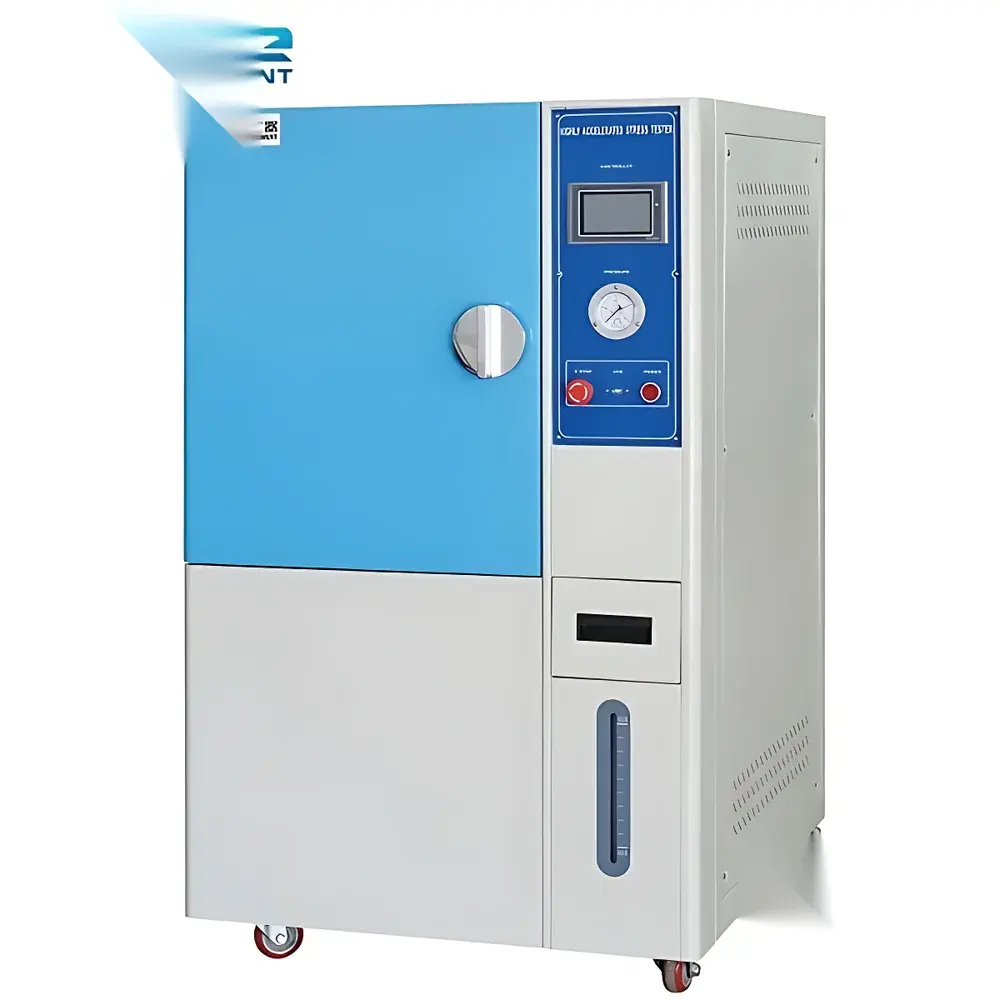
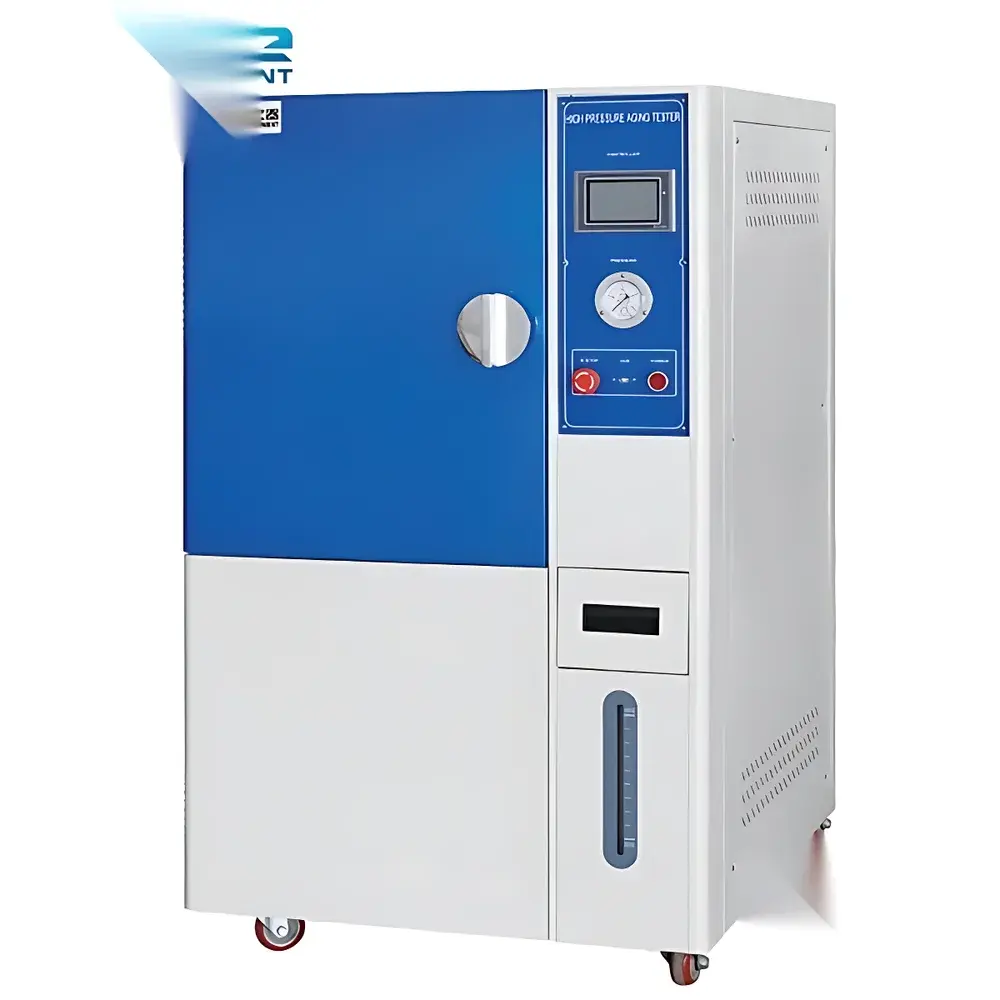
Non-Saturated High-Pressure Life Aging Test Chamber
| Brand | Other Brands |
|---|---|
| Origin | Imported |
| Manufacturer Type | Authorized Distributor |
| Pressure Range | 0–6 kgf/cm² (0–0.6 MPa) |
| Operating Pressure | 2.0 kgf/cm² (≈200 kPa gauge) |
| Temperature Range | +100°C to +132°C (saturated steam), Extended Range: RT+10°C to 200°C |
| Humidity Range | 75–100% RH (saturated steam environment) |
| Pressure Ramp Time | ≤45 min (0 → 2.0 kgf/cm²) |
| Test Duration | 0.00–999.99 hr |
| Safety Locking | Pressure-actuated mechanical door interlock |
| Vacuum Preconditioning | Integrated vacuum pump with HEPA-filtered air purge |
| Compliance | ASTM D3574, DIN 53504, ISO 188, IEC 60068-2-13, UL 746B, MIL-STD-810H, JIS K 6257, NACE TM0177 |
Overview
The Non-Saturated High-Pressure Life Aging Test Chamber is an engineered environmental stress test system designed to accelerate aging mechanisms in sealed or semi-sealed components under controlled elevated temperature, high humidity, and sub-critical hydrostatic pressure conditions—without full saturation. Unlike conventional saturated steam autoclave testers, this chamber maintains a precisely regulated non-saturated vapor phase above boiling point, enabling accelerated evaluation of moisture ingress, polymer hydrolysis, seal integrity degradation, and electrochemical corrosion pathways in materials exposed to humid thermal stress. It operates on the principle of controlled partial-pressure steam exposure combined with mechanical compression, facilitating realistic simulation of long-term field service conditions for electronics encapsulation, automotive gaskets, medical device housings, and multilayer PCB laminates.
Key Features
- Integrated PID-controlled pressure regulation system (0–6 kgf/cm² range) with real-time digital monitoring and programmable ramp profiles; calibrated for repeatable 2.0 kgf/cm² operational pressure (≈200 kPa gauge) with structural safety margin exceeding 6 atm absolute pressure.
- Dual-mode thermal control via VT-4810 microprocessor-based controller: simultaneous PV/SV display, K-type thermocouple input, SSR-driven 12 V output, and extended operating range from ambient +10°C up to 200°C—optimized for both steam-phase aging (+100°C to +132°C) and dry-heat preconditioning.
- Circular horizontal test chamber design minimizes condensate accumulation and eliminates direct steam jet exposure to operators; engineered with self-tightening door sealing—mechanical interlock engages only when internal pressure drops below atmospheric, ensuring fail-safe operation per ISO 13857 and EN 61000-6-4 requirements.
- Automated sequence management: programmable start/stop, automatic pressure release, vacuum break, and timed water replenishment; standard configuration supports continuous operation up to 1000 hours without manual intervention; optional fully automated make-up water system available with level-sensing reservoir and solenoid-controlled feed.
- Vacuum-assisted air exchange cycle: integrated vacuum pump evacuates chamber prior to test initiation, followed by HEPA-filtered ambient air reintroduction—ensuring oxygen-controlled, particulate-free atmosphere critical for corrosion-sensitive samples and polymer stability assessment.
Sample Compatibility & Compliance
This chamber accommodates a broad spectrum of sample geometries—including printed circuit boards (single/multi-layer, HDI, flex-rigid), semiconductor packages (QFN, BGA, CSP), automotive connectors and elastomeric seals, pharmaceutical blister packaging, and medical-grade polymer housings. Its operational envelope aligns with internationally recognized aging and reliability standards: ISO 188 (rubber—accelerated aging), ASTM D3574 (flexible cellular materials), IEC 60068-2-13 (damp heat, cyclic), UL 746B (polymeric materials for electrical equipment), MIL-STD-810H Method 507.6 (humidity), JIS K 6257 (vulcanized rubber), and NACE TM0177 (sulfide stress cracking). All control logic and data logging functions support GLP/GMP traceability frameworks, including configurable audit trails and user-access-level permissions.
Software & Data Management
The chamber interfaces with optional PC-based control software supporting multi-channel real-time logging of temperature, pressure, humidity, and elapsed time at user-defined intervals (1 s to 60 min resolution). Data exports comply with CSV and Excel-compatible formats for statistical process analysis (SPC), Weibull life modeling, and failure mode correlation. The system architecture supports 21 CFR Part 11-compliant electronic signatures, role-based authentication, and immutable event logs—including door open/close events, pressure deviations, thermal excursions, and vacuum cycle completion status. Optional Ethernet or RS-485 connectivity enables integration into centralized lab monitoring networks (e.g., LabVantage, Thermo Fisher SampleManager).
Applications
- Accelerated life testing of hermetic and quasi-hermetic electronic assemblies to identify latent defects in conformal coatings, underfill materials, and die-attach adhesives.
- Evaluation of moisture barrier performance in flexible OLED displays, thin-film solar cells, and MEMS sensor packages.
- Validation of adhesive bond durability in automotive lighting modules subjected to thermal-hygric cycling and pressure differentials.
- Qualification of sterilization-resistant polymer formulations used in Class II/III medical devices per ISO 11607-1.
- Corrosion susceptibility screening of plated contacts and solder joints under chloride-enhanced humid pressurized environments.
FAQ
What distinguishes “non-saturated” high-pressure aging from standard autoclave testing?
Non-saturated operation maintains vapor phase below 100% relative humidity at elevated temperature and pressure—avoiding full condensation while still inducing significant moisture diffusion gradients. This better replicates real-world under-hood or enclosed enclosure conditions where condensation is intermittent rather than continuous.
Can the chamber perform vacuum-only or dry-heat-only cycles?
Yes—vacuum preconditioning is standard; dry-heat operation up to 200°C is supported via independent thermal control, with optional inert gas purging capability for oxidation-sensitive samples.
Is pressure calibration traceable to national standards?
All pressure transducers are supplied with factory calibration certificates traceable to NIST or PTB equivalents; on-site recalibration services are available with documented uncertainty budgets per ISO/IEC 17025.
How is door safety verified during routine maintenance?
Mechanical interlock functionality is validated using a certified pressure decay test protocol prior to each qualification run, with documented pass/fail records retained per ISO 9001 clause 8.5.1.
Does the system support custom test profile programming?
Yes—up to 99 programmable steps per profile, including ramp/soak sequences for pressure, temperature, and dwell time, with conditional branching based on real-time sensor feedback.



