
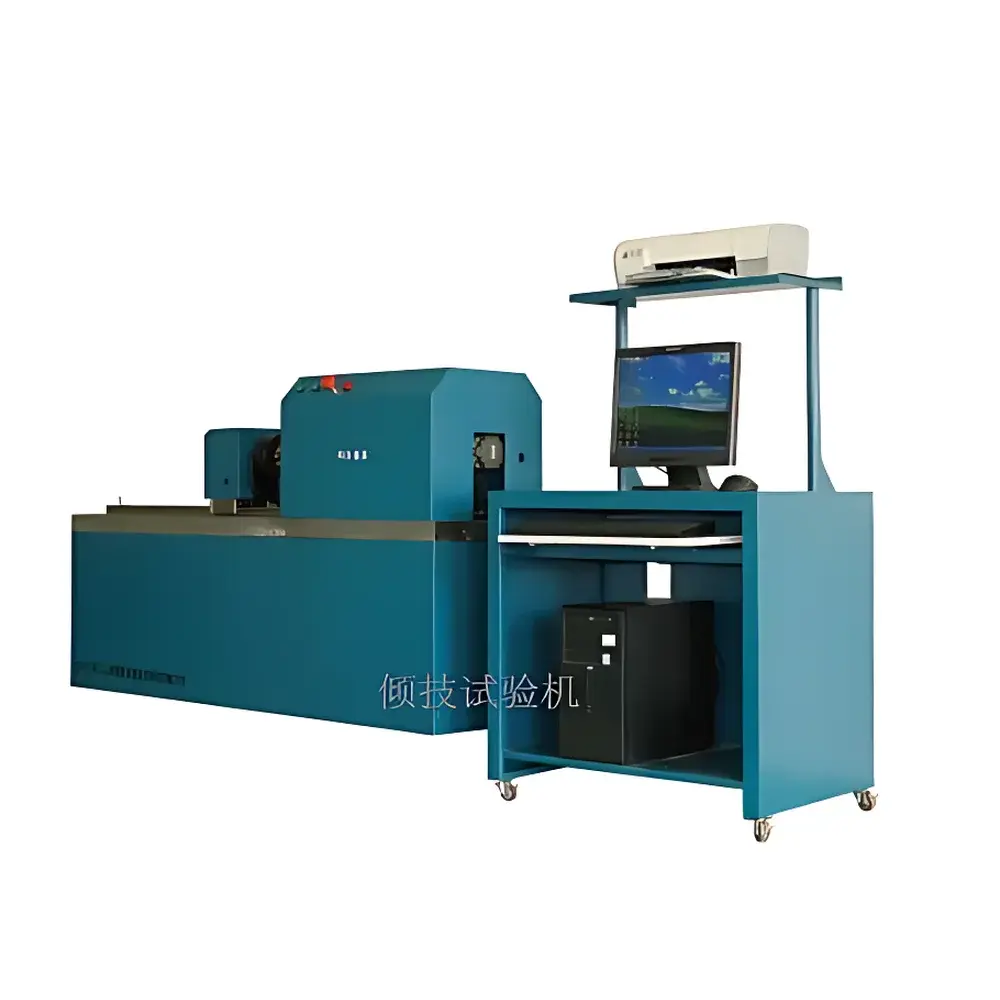
Qinji Torsion Testing Machine for Optical Fiber Splice Enclosures
| Brand | Qinji |
|---|---|
| Model | Torsion |
| Origin | Shanghai, China |
| Type | Torsion Testing Machine |
| Standards Compliance | GB/T 9370–1999, JJG 269–1981, GB/T 239–1999 |
| Max Torque Capacity | 0–10,000 N·m |
| Torque Measurement Accuracy | ±0.5% of reading |
| Torque Range | 50–5,000 N·m |
| Angular Displacement Range | 0 to ±100,000° (4-digit display) |
| Angular Measurement Accuracy | ±0.5% |
| Angular Resolution | ±0.001° |
| Angular Precision | 0.009° |
| Rotational Speed Range | 0.01–1,000 °/min (infinitely variable) |
| Speed Accuracy | ±0.2% of set value |
| Torque Resolution | 1/350,000 (full-scale, no range switching) |
| Maximum Distance Between Grips | 1,500 mm |
| Specimen Clamping Diameter | Φ8–Φ40 mm (expandable) |
| Dimensions (L×W×H) | 2800 × 4700 × 1250 mm |
| Weight | 1,500 kg |
Overview
The Qinji Torsion Testing Machine for Optical Fiber Splice Enclosures is a high-capacity, precision-engineered mechanical testing system designed specifically for evaluating torsional mechanical behavior of fiber optic infrastructure components—particularly splice enclosures—and broader structural elements including metallic and non-metallic rods, shafts, fasteners, and composite assemblies. Operating on the principle of controlled angular displacement under applied torque, the system adheres to fundamental torsion mechanics defined by Saint-Venant’s theory and enables quantitative determination of shear modulus (G), proportional limit, non-proportional stress, and ultimate torsional strength. Its robust architecture supports both static and quasi-dynamic torsional loading protocols, making it suitable for R&D validation, quality assurance in manufacturing, and regulatory conformance testing across telecom, aerospace, and civil infrastructure sectors.
Key Features
- High-torque capacity up to 10,000 N·m with full-scale resolution of 1/350,000—ensuring consistent sensitivity across the entire measurement range without manual range switching.
- Dual-axis digital angular encoder system delivering ±0.001° resolution and verified angular precision of 0.009°, enabling accurate characterization of elastic and plastic deformation regimes.
- Infinitely variable rotational speed control from 0.01 to 1,000 °/min, with speed stability maintained within ±0.2% of setpoint—critical for strain-rate-sensitive material evaluation.
- Modular grip configuration accommodating specimens from Φ8 mm to Φ40 mm (extendable), with adjustable axial spacing up to 1,500 mm to accommodate large-format splice enclosures and cable assemblies.
- Integrated micro-angle measurement module compatible with optional extensometry for direct determination of shear modulus G and torsional elastic constants per ASTM E143 and ISO 7438.
- Industrial-grade frame construction (2800 × 4700 × 1250 mm; 1,500 kg) ensures minimal deflection under load and long-term dimensional stability during repeated testing cycles.
Sample Compatibility & Compliance
The system is validated for testing optical fiber splice enclosures per IEC 61300-2-4 (mechanical torsion endurance) and ITU-T L.1200 (fiber management system reliability). It also supports standardized evaluation of metallic and polymeric structural components in accordance with GB/T 239–1999 (metal wire torsion test), GB/T 9370–1999 (torsion testing machines—verification requirements), and JJG 269–1981 (metrological verification procedures). All torque and angular measurements are traceable to national standards via calibrated reference transducers. The machine meets general requirements for GLP-compliant laboratories, supporting audit-ready documentation when paired with validated software configurations.
Software & Data Management
The embedded virtual instrumentation platform provides closed-loop test control, real-time data acquisition at ≥1 kHz sampling rate, and automated calculation of key torsional parameters—including torque–angle hysteresis loops, yield torque, maximum torque, and angular displacement at failure. Data export conforms to ASTM E1437 and ISO/IEC 17025 reporting templates. Raw datasets are stored in vendor-neutral CSV and XML formats. Optional software modules support 21 CFR Part 11 compliance with electronic signatures, audit trails, and user-access-level permissions—enabling deployment in regulated environments such as telecom equipment certification labs and third-party accreditation bodies.
Applications
- Validation of torsional integrity and sealing performance of outdoor and underground optical fiber splice enclosures under simulated installation and environmental stress conditions.
- Determination of torsional fatigue life for armored fiber cables and reinforced splice housings subjected to wind-induced twisting or ground movement.
- Shear modulus (G) and torsional stiffness evaluation of polymer-based enclosure materials (e.g., PBT, PC, and UV-stabilized HDPE) per ISO 527-2 and ASTM D790.
- Verification of bolted joint integrity and clamp torque retention in multi-port splice trays and distribution frames.
- Comparative analysis of torsional resistance between standard and enhanced designs—supporting design iteration and failure mode analysis (FMEA).
- Support for ISO/IEC 17025 accredited testing services, including calibration certificate generation and uncertainty budgeting per GUM (JCGM 100:2008).
FAQ
Does this machine comply with international telecom standards for splice enclosure testing?
Yes—it satisfies torsional test requirements specified in IEC 61300-2-4 and ITU-T L.1200, and its metrological verification aligns with JJG 269–1981 and GB/T 9370–1999.
Can the system be integrated into an existing LIMS or QA database?
Yes—via configurable API and standardized CSV/XML export, enabling seamless integration with laboratory information management systems and enterprise QA platforms.
Is technical support available after installation?
Qinji provides on-site commissioning, operator training, one-year comprehensive warranty, and lifetime maintenance support—including spare parts logistics and firmware updates.
What calibration documentation is supplied with the instrument?
Each unit ships with a factory calibration certificate traceable to CNAS-accredited reference standards, along with a full uncertainty budget per ISO/IEC 17025 Annex A.3.
Can the machine perform low-speed creep torsion tests?
Yes—the 0.01 °/min minimum speed setting, combined with high-resolution torque feedback, enables controlled creep and stress-relaxation studies over extended durations.



