
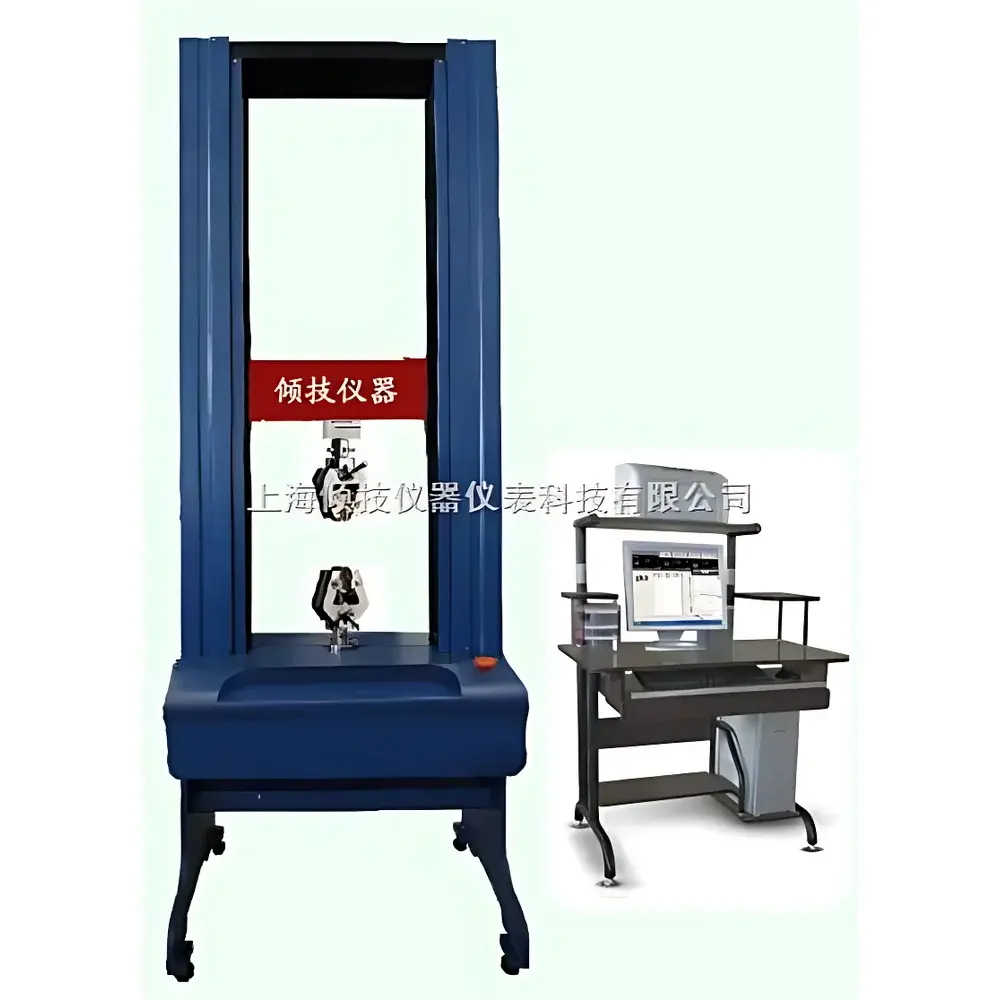
QJ211 Universal Testing Machine for Wire and Cable Mechanical Characterization
| Key | Max Load: 30 kN |
|---|---|
| Load Cell Accuracy | ±0.5% |
| Measuring Accuracy | < ±0.5% |
| Control System | Fully Digital Display Interface |
| Valid Test Width | ~420 mm |
| Effective Stroke | ~800 mm |
| Test Speed Range | 0.01–500 mm/min |
| Speed Accuracy | ±0.5% |
| Stroke Accuracy | ±0.5% |
| Displacement Accuracy | ±0.5% |
| Safety Features | Electronic Limit Switches, Emergency Stop Button |
| Unit Weight | ~2650 kg |
Overview
The QJ211 Universal Testing Machine is an electromechanical static testing system engineered for precise mechanical property evaluation of wire and cable assemblies, as well as a broad spectrum of metallic and non-metallic materials. Based on the fundamental principles of uniaxial tensile and compressive force application under controlled displacement or load control, this machine complies with standard test methodologies defined in ISO 6892-1 (metallic materials – tensile testing), ASTM D412 (rubber and elastomers), ASTM D882 (thin plastic sheeting), IEC 60811-501 (electric cables – mechanical tests), and EN 50396 (cable sheath and insulation mechanical testing). Its rigid dual-column frame, high-stiffness crosshead guidance, and calibrated load cell ensure repeatable force transmission and minimal deflection during high-load testing up to 30 kN — critical for evaluating conductor elongation, jacket tensile strength, insulation adhesion, and overall structural integrity of low- and medium-voltage power and data transmission cables.
Key Features
- High-capacity dual-column architecture rated for continuous operation at loads up to 30 kN, with optional load cell configurations for optimized resolution across sub-kN and multi-kN ranges.
- Digital closed-loop servo control system enabling precise speed regulation from 0.01 mm/min (for creep and relaxation studies) to 500 mm/min (for high-speed tear or burst testing), maintaining ±0.5% speed accuracy throughout the full range.
- Integrated real-time dynamic display interface showing synchronized load, displacement, strain (when extensometer-equipped), and time-based curves; supports automatic peak detection and yield point identification per ISO 6892-1 Annex B.
- Robust mechanical safety subsystem including programmable electronic stroke limits, hardware-based emergency stop circuitry compliant with ISO 13850, and overload protection that halts motion before exceeding 105% of selected load range.
- Modular fixture mounting platform compatible with standardized wedge-action grips (for wires, strips, and rods), pneumatic clamps (for soft polymers), peel fixtures (90° and 180°), shear adapters, and custom-designed cable anchor assemblies per IEC 60754-2 requirements.
Sample Compatibility & Compliance
The QJ211 accommodates specimens ranging from fine-diameter copper conductors (≥0.1 mm) and fiber-optic buffer tubes to armored cable bundles and extruded polymer jackets. It supports standardized specimen geometries per ASTM D3043 (structural composites), ISO 527-2 (plastics), and GB/T 2951.11 (cable insulating compounds). All test procedures are traceable to national metrological standards via NIST-traceable load cell calibration certificates. The system meets essential requirements for GLP-compliant laboratories under ISO/IEC 17025:2017 for mechanical testing, and its operational logs—including user ID, timestamp, test parameters, and raw data—can be configured to satisfy audit trails required by FDA 21 CFR Part 11 when paired with validated software extensions.
Software & Data Management
While the base unit operates via embedded digital controller with front-panel navigation, optional PC-based software provides advanced data acquisition, curve fitting (e.g., Young’s modulus calculation via initial linear slope), statistical reporting (mean, SD, CV%), and export to CSV, PDF, or XML formats. Data files include metadata headers specifying operator, environmental conditions (if external sensors integrated), calibration status, and test standard reference. Audit-ready features include electronic signatures, version-controlled test method templates, and immutable log archives — supporting regulatory submissions for cable qualification under UL 44, CSA C22.2 No. 38, or EN 50575 (Construction Products Regulation).
Applications
- Tensile strength and elongation-at-break assessment of stranded copper/aluminum conductors and tinned variants.
- Peel strength measurement of bonded insulation-to-sheath interfaces in multi-layer LV cables.
- Compression resistance of cable fillers and bedding compounds under simulated conduit loading.
- Shear behavior of armor wire wraps under torsional pre-stress conditions.
- Creep deformation analysis of cross-linked polyethylene (XLPE) insulation over extended durations at elevated temperatures.
- Mechanical validation of halogen-free flame-retardant (HFFR) compounds per IEC 60332-1-2 vertical tray flame test support requirements.
FAQ
Does the QJ211 meet international accreditation requirements for third-party cable testing labs?
Yes — when operated with documented calibration records, validated test methods, and proper environmental monitoring, the system satisfies technical competence criteria outlined in ISO/IEC 17025:2017 Clause 6.4 (Equipment) and Clause 7.2 (Method Validation).
Can the machine perform cyclic loading or fatigue tests?
No — the QJ211 is designed for static and quasi-static mechanical testing only. For dynamic or high-cycle fatigue evaluation (e.g., bending endurance of flexible cables), a dedicated servo-hydraulic or electrodynamic fatigue testing system is required.
Is extensometer integration supported for strain measurement?
Yes — the system includes analog and digital input channels compatible with clip-on, video, or laser extensometers meeting ISO 9513 Class 1 accuracy for Poisson’s ratio and modulus determination.
What maintenance intervals are recommended for long-term reliability?
Biannual verification of load cell linearity and crosshead alignment is advised; annual recalibration against traceable deadweight standards is required for ISO 17025 compliance. Lubrication of lead screws and inspection of grip jaw inserts should occur every 200 operational hours.



