
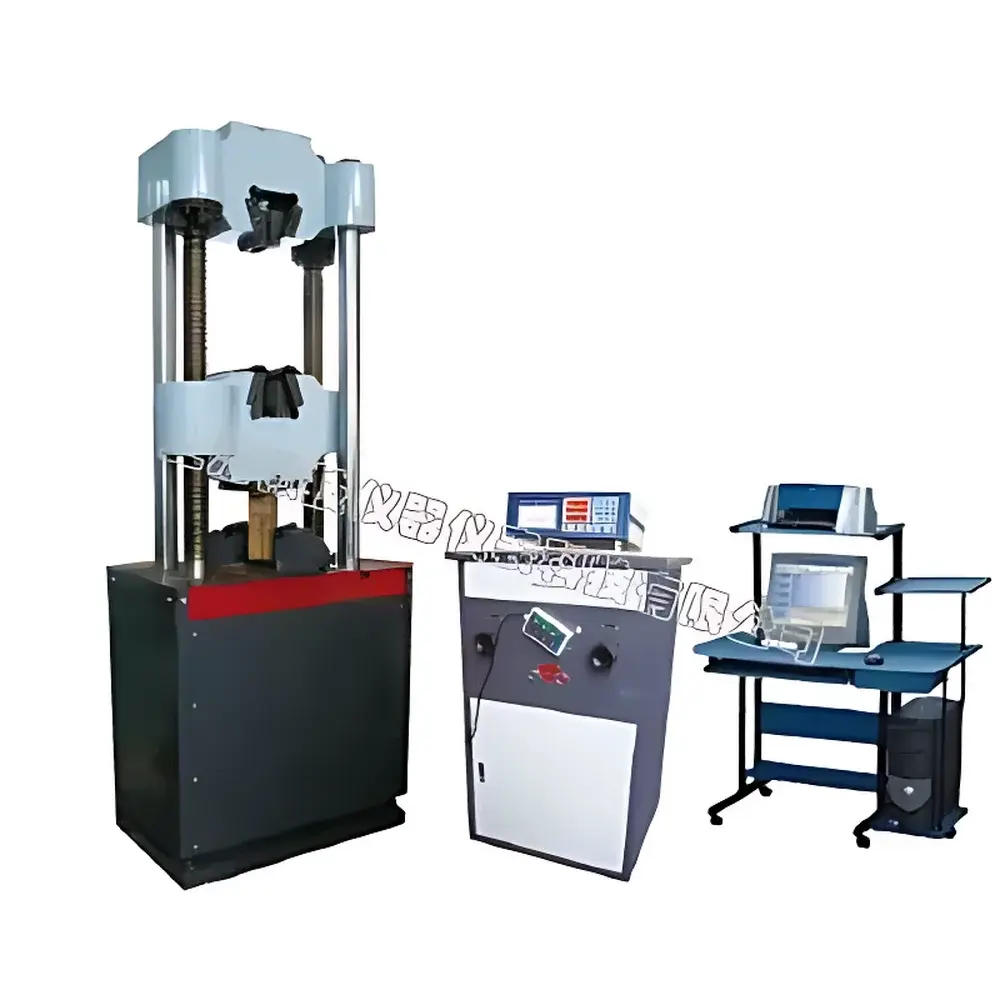
Qinji QJWE Series Electro-Hydraulic Servo Universal Testing Machine
| Brand | Qinji |
|---|---|
| Origin | Shanghai, China |
| Model | QJWE |
| Type | Electro-Hydraulic Servo Testing Machine |
| Test Accuracy | ±1% |
| Relative Resolution | ≤0.5% |
| Compression Space | 550–900 mm |
| Tensile Space | 550–700 mm |
| Round Specimen Grip Range | Φ6–70 mm |
| Flat Specimen Grip Thickness | 0–40 mm |
| Piston Stroke | 200–250 mm |
| Maximum Bend Span | 400–900 mm |
| Shear Specimen Diameter | Φ10–Φ30 mm |
| Dimensions (L×W×H) | 640×550×1800 mm to 1255×866×4700 mm |
| Motor Power | 1.5 kW or 3.25 kW, 3-Phase |
| Machine Weight | 1200 kg or 6600 kg |
Overview
The Qinji QJWE Series Electro-Hydraulic Servo Universal Testing Machine is a high-capacity, force-controlled mechanical testing system engineered for static tensile, compression, bending, and shear evaluation of structural materials under standardized loading conditions. Based on the principle of closed-loop electro-hydraulic servo control, the system employs proportional valve actuation with real-time feedback from precision load cells, extensometers, and displacement transducers to maintain target stress or strain rates with high reproducibility. Designed for compliance with international mechanical testing standards—including ASTM E4, ASTM E8/E8M, ASTM E9, ISO 6892-1, ISO 7500-1, and GB/T 228.1—the QJWE series supports full traceability in quality assurance environments requiring GLP/GMP-aligned documentation workflows.
Key Features
- Lower-mounted hydraulic cylinder with adjustable test space—enabling flexible specimen handling for long or bulky samples without reconfiguration.
- Digital electro-hydraulic servo control architecture with fully programmable loading profiles: constant rate of load, constant rate of stress, constant rate of strain, or load hold sequences.
- High-accuracy imported load cells (±1% accuracy per ISO 7500-1 Class 1) and linear variable differential transformers (LVDTs) for synchronized measurement of force, displacement, and axial deformation.
- Modular gripping systems: interchangeable wedge-action hydraulic clamps for round specimens (Φ6–Φ70 mm) and flat specimens (up to 40 mm thick), supporting ASTM E8 and ISO 6892-1 specimen geometry requirements.
- Integrated bending fixture support with adjustable span (400–900 mm) and standardized roller configurations compliant with ASTM E290 and ISO 7438.
- Rugged welded steel frame with reinforced base plate and column assembly—optimized for stability during high-force tests up to 2000 kN.
Sample Compatibility & Compliance
The QJWE platform accommodates metallic alloys (steels, aluminum, titanium), concrete cylinders and prisms, cementitious composites, polymer sheets and rods, and fiber-reinforced laminates. Specimen geometries conform to standard test methods including ASTM A370, ASTM C39, ASTM D695, ISO 604, and EN 12390-3. All hardware and firmware are designed to meet electromagnetic compatibility (EMC) requirements per IEC 61326-1 and safety standards per ISO 12100. Optional calibration certificates traceable to NIM (National Institute of Metrology, China) or internationally recognized NMIs are available upon request.
Software & Data Management
The system operates with proprietary Windows-based control and analysis software supporting dual-mode operation: manual jog control and automated test sequencing via pre-defined method templates. Real-time data acquisition at ≥1 kHz enables precise capture of yield onset, plastic flow, fracture initiation, and post-yield behavior. All test data—including raw sensor streams, processed curves (stress–strain, load–displacement), and metadata (operator ID, timestamp, environmental conditions)—are stored in encrypted binary files with XML-based annotation. Audit trail functionality complies with FDA 21 CFR Part 11 requirements when configured with user authentication, electronic signatures, and immutable log archiving. Export formats include CSV, PDF reports (customizable per lab template), and universal .udf (Universal Data Format) for third-party analysis tools.
Applications
- Mechanical property certification of structural steel grades per EN 10025 and ASTM A615 in metallurgical QA labs.
- Compressive strength validation of precast concrete elements in civil engineering R&D facilities.
- Shear strength characterization of adhesive joints and composite interlaminar interfaces per ASTM D1002 and ISO 14687.
- Bending modulus and flexural strength determination for thermoplastic pipes (ISO 13968) and wood-based panels (EN 310).
- Calibration verification and periodic performance checks of secondary force standards in metrology institutes.
FAQ
What standards does the QJWE series comply with for force measurement accuracy?
The system meets ISO 7500-1 Class 1 requirements (±1% error limit) when equipped with certified load cells and calibrated per ISO 376 procedures.
Can the machine perform cyclic or low-cycle fatigue testing?
No—the QJWE is designed exclusively for quasi-static monotonic loading; for dynamic or fatigue applications, refer to Qinji’s dedicated electrodynamic testing systems.
Is remote monitoring or network integration supported?
Yes—Ethernet-enabled controllers allow secure LAN/WAN access for real-time status viewing, job queuing, and centralized data aggregation via OPC UA or Modbus TCP protocols.
What maintenance intervals are recommended for hydraulic components?
Hydraulic oil replacement and filter inspection are advised every 2,000 operating hours or annually, whichever occurs first; detailed service logs are auto-generated within the software.
Are custom grips or fixtures available beyond standard configurations?
Yes—Qinji offers OEM-design support for application-specific tooling, including notched-tension, torsion-compression, and elevated-temperature test assemblies, subject to mechanical feasibility review.



