
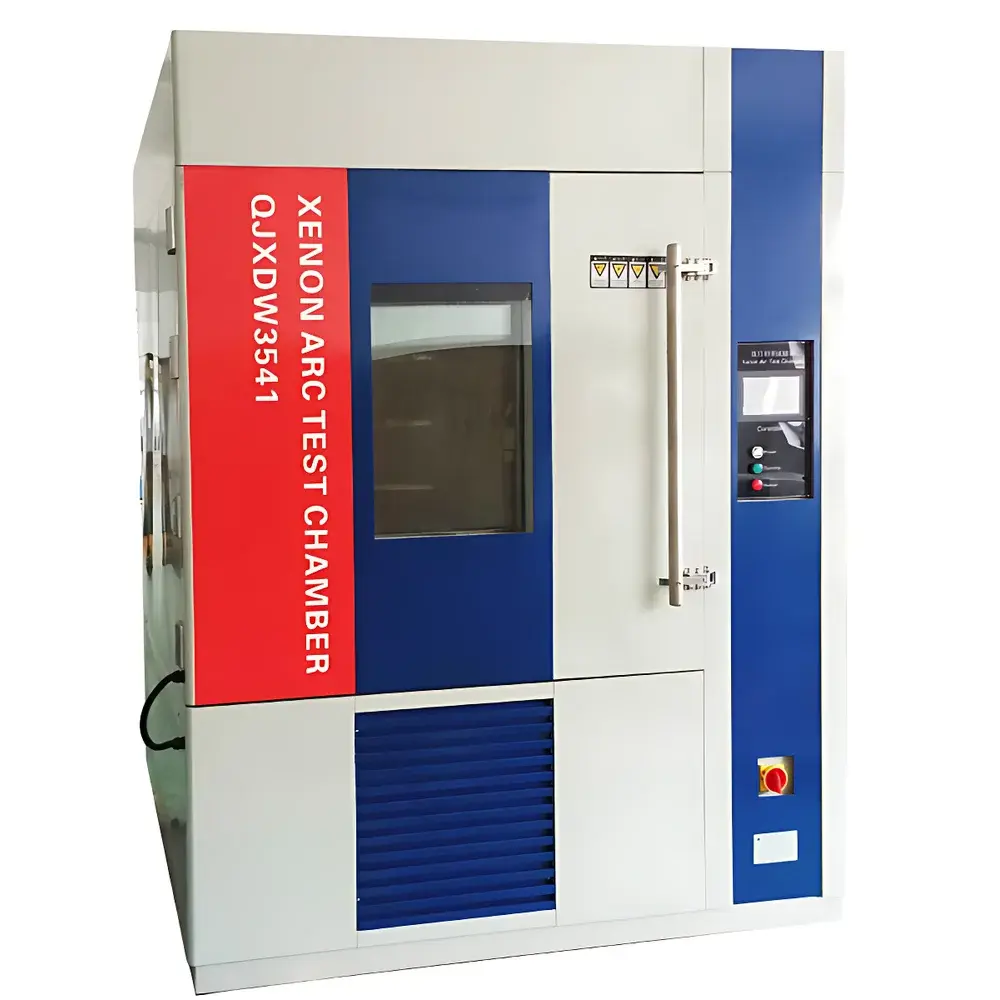
Qingji QJXDW3541 Xenon Arc Weathering Test Chamber
| Brand | Qingji |
|---|---|
| Origin | Shanghai, China |
| Model | QJXDW3541 |
| Lamp Power | 6 kW |
| Temperature Range | RT+10°C to 80°C ±1°C (adjustable) |
| Humidity Range | RT+10°C to 80°C ±1°C (adjustable) |
| Spectral Range | 290–800 nm |
| Irradiance | 550 W/m² (300–800 nm) |
| Sample Rack Rotation Speed | 5 rpm |
| Interior Chamber Dimensions | 500 × 500 × 600 mm |
| Rainfall Duration | 0–9999 min (adjustable) |
| Rainfall Cycle Interval | 0–240 min (adjustable) |
| Lamp Life | ~2000 h |
| Cooling Method | Air-cooled (3 kW) / Water-cooled (4.5 kW) |
| Lamp Voltage/Current | 220 V ±5%, 20 A |
Overview
The Qingji QJXDW3541 Xenon Arc Weathering Test Chamber is an engineered environmental simulation system designed for accelerated weathering evaluation of polymeric and composite materials—particularly synthetic athletic track surfaces, coatings, plastics, automotive glazing, and architectural cladding. It replicates the principal degradation drivers found in natural outdoor exposure: broadband solar radiation (UV, visible, and near-IR), thermal cycling, and moisture-induced stress (condensation, rain, and humidity). Unlike UV fluorescent lamp-based testers, this chamber employs a high-intensity 6 kW xenon arc lamp to deliver a spectral output closely aligned with terrestrial sunlight (CIE No. 85, ISO 4892-2, ASTM G155), enabling physiologically relevant photochemical aging mechanisms—including polymer chain scission, pigment fading, chalking, and surface embrittlement. The chamber operates on a programmable cycle basis, allowing users to define precise sequences of irradiation, dark condensation, and simulated rainfall—mimicking diurnal and seasonal climatic patterns in compressed timeframes. Results generated under controlled, repeatable conditions support comparative material screening, formulation optimization, and conformance verification against international durability standards.
Key Features
- High-fidelity xenon arc light source (6 kW) with spectral output calibrated to ISO 4892-2 and ASTM G155 reference spectra (290–800 nm); irradiance monitored and displayed in real time (300–800 nm: 550 W/m²)
- Precise temperature control across RT+10°C to 80°C ±1°C, with uniformity ≤2°C throughout the test volume
- Integrated humidity management system supporting condensation cycles and programmable rainfall simulation (duration: 0–9999 min; interval: 0–240 min)
- Motor-driven rotating sample rack (5 rpm) with dual-radius configuration (inner/outer radii: 100/220 mm; center distance: 165 mm; height: 420 mm) ensuring uniform irradiance distribution
- Modular flat sample tray design compatible with standardized specimen holders (e.g., ISO 11341, ASTM D7869 frames) and optional multi-angle mounting fixtures
- Dual cooling architecture: air-cooled (3 kW) and water-cooled (4.5 kW) modes selectable based on ambient heat load and operational continuity requirements
- Digital controller with intuitive interface for setting and logging irradiance accumulation, temperature/humidity profiles, and cycle timing parameters
Sample Compatibility & Compliance
The QJXDW3541 accommodates rigid and semi-rigid specimens up to 500 × 500 × 600 mm (W × D × H), including full-scale rubber granule samples, cured polyurethane layers, EPDM tiles, and coated aluminum composites. Its operational envelope satisfies core requirements of ISO 4892-2 (Plastics — Methods of exposure to laboratory light sources — Part 2: Xenon-arc lamps), ASTM G155 (Standard Practice for Operating Xenon Arc Light Apparatus for Exposure of Non-Metallic Materials), and GB/T 16422.2 (Chinese national standard equivalent). While not inherently compliant with FDA 21 CFR Part 11 or GLP audit trails out-of-the-box, the system supports integration with external data acquisition platforms capable of electronic signature, audit logging, and secure user access control—enabling alignment with GMP-aligned quality systems where required.
Software & Data Management
The embedded microprocessor controller provides real-time display of irradiance (W/m²), accumulated radiant exposure (MJ/m²), chamber temperature, relative humidity, and rainfall status. All setpoints and measured values are logged at user-defined intervals (1 s to 60 min resolution) and exportable via USB to CSV format for traceability and post-processing. Optional PC-based software (Qingji WeatherLog Pro v3.x) enables remote monitoring, multi-chamber synchronization, automated report generation (PDF/Excel), and compliance-ready data archiving—including timestamped operator entries and parameter change logs. Raw datasets conform to ISO/IEC 17025 documentation expectations when paired with validated calibration certificates for irradiance sensors and thermohygrometers.
Applications
- Accelerated aging validation of polyurethane- and SBR-based running track systems per IAAF Technical Specifications and EN 14877
- Comparative UV resistance testing of pigment systems in traffic markings, playground surfacing, and modular flooring
- Formulation development for elastomeric sealants, roof membranes, and facade coatings exposed to subtropical or arid climates
- Pre-certification screening for automotive interior trim components subject to ISO 16322-1 and SAE J2412
- Quality assurance of recycled rubber crumb used in sustainable sports infrastructure projects
- Correlation studies between accelerated xenon exposure and real-world field performance (e.g., color shift ΔE*ab, gloss retention %, tensile strength loss)
FAQ
What standards does the QJXDW3541 comply with?
It meets the fundamental hardware and operational requirements of ISO 4892-2 and ASTM G155 for xenon arc exposure testing. Calibration and validation procedures must be performed per ISO/IEC 17025-accredited methods to claim full conformance.
Is the xenon lamp replaceable in the field?
Yes—the lamp assembly is modular and serviceable using standard tools; typical replacement time is under 45 minutes with no optical realignment required.
Can the chamber operate continuously for extended durations?
With proper maintenance (lamp cooling, filter cleaning, humidity reservoir refills), uninterrupted operation up to 1000 hours per cycle is achievable; recommended lamp replacement occurs at ~2000 hours.
Does the system support third-party calibration services?
Yes—Qingji provides NIST-traceable irradiance sensor calibration certificates and partners with ISO/IEC 17025 laboratories for on-site thermohygrometric verification.
What maintenance is required for long-term reliability?
Monthly inspection of air filters, quarterly cleaning of quartz lamp housings and humidity nozzles, biannual verification of irradiance sensor response, and annual recalibration of temperature/humidity sensors are advised per the manufacturer’s technical manual.



