
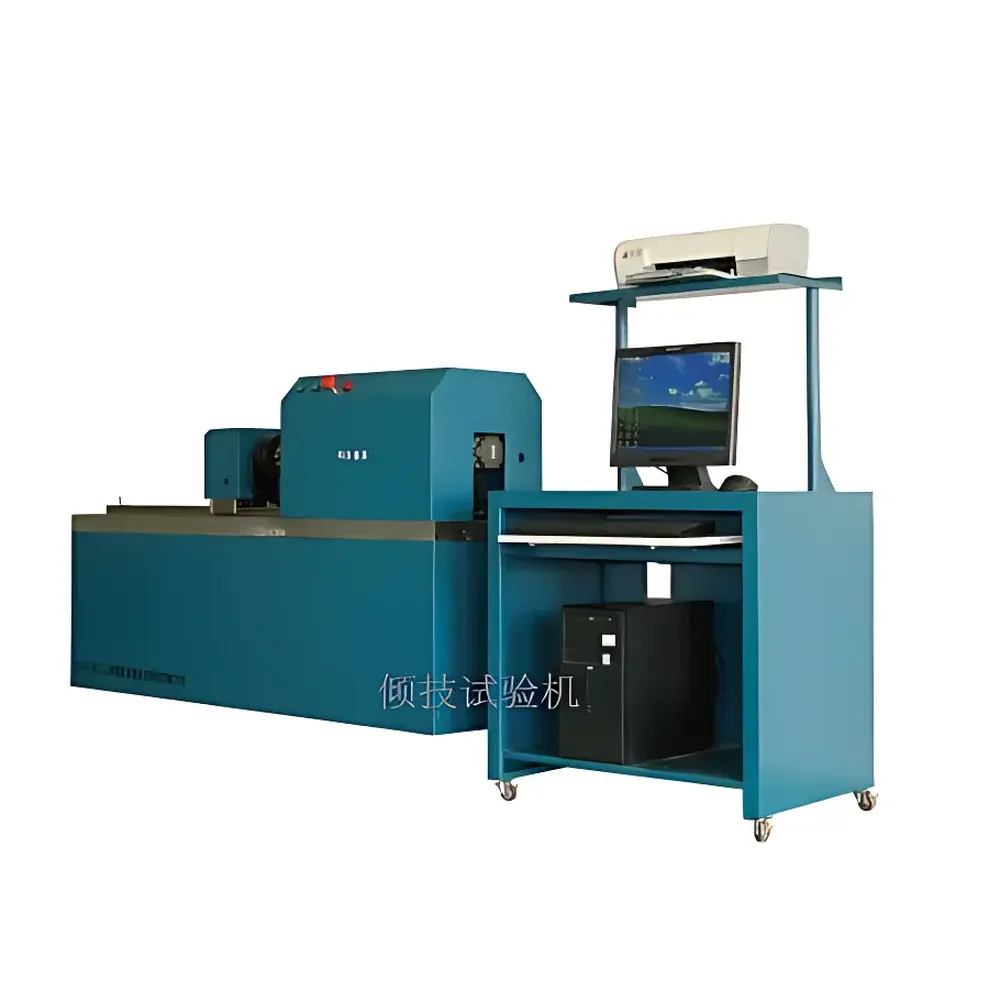
Qinji QJNZ High-Temperature Tensile-Shear-Torsion Testing Machine for Thermal-Insulated Aluminum Profiles
| Brand | Qinji |
|---|---|
| Origin | Shanghai, China |
| Model | QJNZ |
| Maximum Load Capacity | 0–30 kN |
| Temperature Range | −7 °C to 350 °C (stable at 350 °C) |
| Heating/Cooling Rate | ≥5 °C/min |
| Temperature Control Resolution | 0.1 °C |
| Load Cell Accuracy | 0.01% FS |
| Force Measurement Accuracy | <±1% or <±0.5% |
| Displacement Measurement Accuracy | ±0.5% |
| Strain/Deformation Measurement Accuracy | ±0.5% |
| Speed Range | 0.01–500 mm/min (extendable to 1000 mm/min) |
| Speed Accuracy | ±0.5% |
| Effective Test Width | 420 mm |
| Effective Stroke | ~800 mm (height-adjustable) |
| Safety Features | Electronic travel limit protection, emergency stop button |
| Net Weight | 265 kg |
| Control Mode | Full PC-based control with dual digital/analog interface |
| Compliance | GB, ISO, JIS, ASTM, DIN |
Overview
The Qinji QJNZ High-Temperature Tensile-Shear-Torsion Testing Machine is an integrated electromechanical testing system engineered for the mechanical characterization of thermal-insulated aluminum profiles and related structural composites under controlled thermal environments. It combines uniaxial tensile, transverse shear, torsional, compressive, flexural, peel, tear, puncture, and low-cycle fatigue testing capabilities within a single platform—enabling multi-modal mechanical evaluation across a wide temperature spectrum from sub-zero (−7 °C) up to 350 °C. The system employs a precision servo-controlled actuator coupled with high-stiffness load frame architecture and a thermally isolated environmental chamber, allowing stable isothermal conditions during dynamic loading. Its design adheres to fundamental principles of materials mechanics—applying calibrated force, displacement, and torque inputs while simultaneously capturing real-time response data—including stress–strain curves, shear modulus evolution, torsional stiffness degradation, and interfacial delamination thresholds—under thermally accelerated conditions relevant to architectural fenestration, automotive extrusions, and rail transport applications.
Key Features
- Multi-function mechanical testing capability: simultaneous or sequential execution of tensile, shear, torsion, compression, bending, peel, tear, and low-cycle fatigue tests
- Integrated high-temperature environmental chamber with rapid thermal ramping (≥5 °C/min) and fine-resolution temperature control (0.1 °C)
- High-accuracy load measurement using a 0.01% full-scale precision load cell, supporting test ranges from 10 N to 30 kN
- Dual-mode control architecture: fully programmable PC-based software interface with optional analog/digital hardware override for redundancy and validation
- Modular chamber design—removable for ambient-temperature testing to maximize workspace and facilitate ancillary instrumentation integration
- Comprehensive safety subsystem including electronic stroke limits, hardware-triggered emergency stop circuitry, and over-travel mechanical buffers
- Adjustable vertical stroke (standard 800 mm, extendable) and 420 mm effective test width accommodate diverse specimen geometries and mounting configurations
Sample Compatibility & Compliance
The QJNZ system is optimized for standardized and custom-shaped thermal-break aluminum profiles used in curtain walls, doors, windows, and structural framing systems. Specimen compatibility extends to composite laminates, polymer-integrated extrusions, and coated or anodized surface variants. All mechanical test protocols are implemented in alignment with internationally recognized standards—including ISO 12944 (corrosion protection), ISO 22088 (polymer behavior at elevated temperatures), ASTM E8/E8M (tensile testing of metallic materials), ASTM D7078/D7078M (shear testing of composites), ASTM D5279 (torsional testing of plastics), and EN 13830 (curtain wall performance). The system’s measurement traceability supports GLP-compliant documentation workflows and satisfies audit requirements for ISO/IEC 17025-accredited laboratories.
Software & Data Management
Control and analysis are performed via Qinji’s proprietary WinTest Pro software suite, compliant with FDA 21 CFR Part 11 for electronic records and signatures. The software provides real-time synchronized acquisition of force, displacement, torque, angular rotation, and temperature channels—with configurable sampling rates up to 1 kHz. Test sequences are defined through intuitive graphical scripting, enabling complex multi-step thermal-mechanical cycles (e.g., pre-conditioning at 80 °C → ramp to 200 °C → apply torsional load at 0.5°/s → hold for 30 min → cool under load). Raw data exports support CSV, Excel, and universal HDF5 formats; built-in reporting modules generate PDF test certificates with embedded metadata, calibration history, and operator audit trails. Software updates and firmware patches are delivered via secure HTTPS portal with version-controlled release notes.
Applications
- Evaluation of thermal-break integrity in aluminum-framed glazing systems under combined mechanical and thermal stress
- Quantification of interfacial shear strength between polyamide thermal barriers and aluminum alloy substrates
- Torsional rigidity assessment of hollow extrusions subjected to wind-induced twisting moments
- Low-cycle fatigue life prediction of insulated profiles under cyclic thermal expansion mismatch
- Validation of adhesive bond durability in hybrid aluminum-polymer assemblies per ASTM D1002 and EN 14354
- Development and qualification of next-generation low-conductivity thermal breaks for passive house construction
FAQ
What temperature stability can be achieved at 350 °C?
The chamber maintains ±1 °C stability at 350 °C over 30-minute dwell periods under no-load conditions, verified by independent NIST-traceable thermocouple calibration.
Can the system perform simultaneous tensile and torsional loading?
No—the QJNZ operates in single-axis mode per test sequence; however, multi-axial loading profiles (e.g., tension + torsion) can be executed sequentially within one automated script using synchronized thermal conditioning.
Is third-party calibration certification included with delivery?
Yes—a factory-issued calibration certificate compliant with ISO/IEC 17025 is provided, covering load, displacement, and temperature channels; on-site verification by accredited metrology providers is supported upon request.
What maintenance intervals are recommended for long-term reliability?
Load cell and encoder verification every 12 months; thermal chamber insulation integrity check every 24 months; lubrication of lead screws and linear guides every 6 months under continuous operation.
Does the software support automated pass/fail decision logic based on standard-defined criteria?
Yes—WinTest Pro allows rule-based acceptance criteria definition (e.g., “failure if shear strength < 12 MPa after 200 °C exposure”) with automatic flagging and report annotation.



