
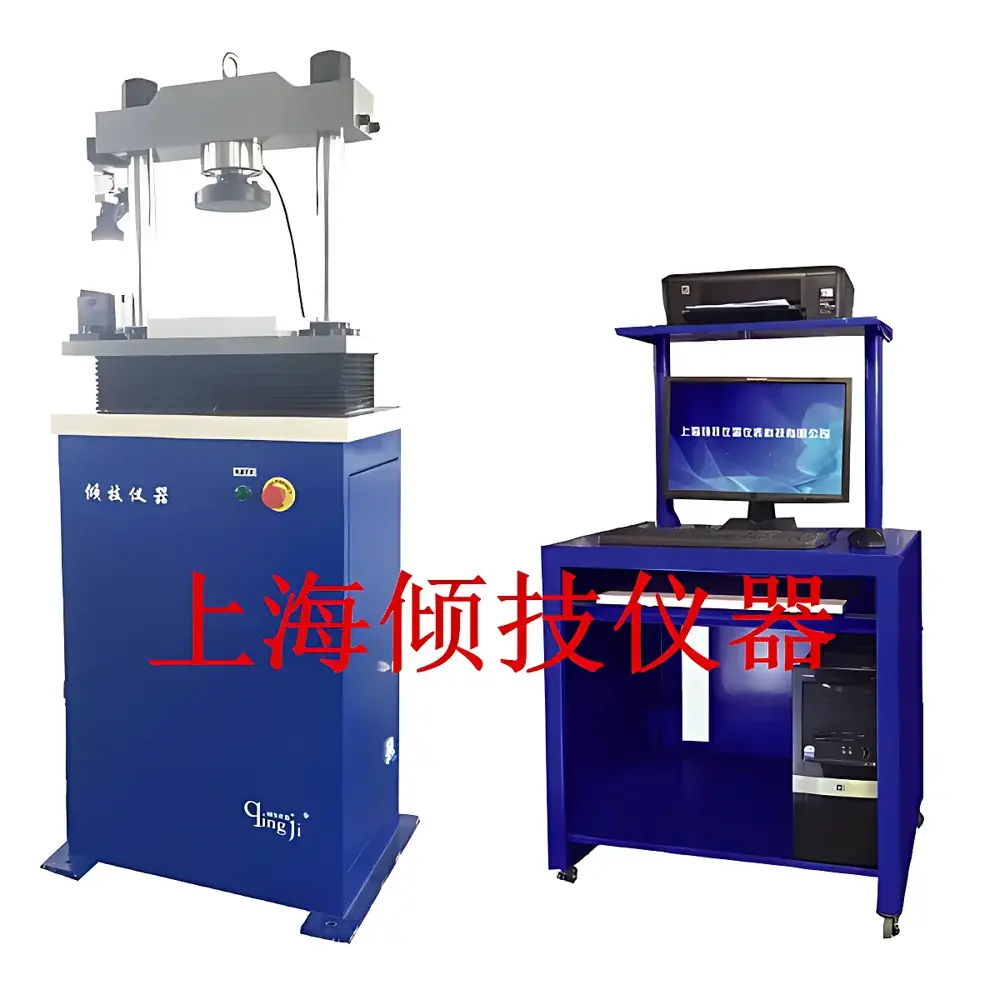
Qinji QJYL872 Universal Compression & Flexural Testing Machine
| Brand | Qinji |
|---|---|
| Origin | Shanghai, China |
| Model | QJYL872 |
| Max. Compression Load | 300 kN |
| Max. Flexural Load | 10 kN |
| Load Accuracy | ±1% (FS) |
| Compression Loading Rate | 0–10 kN/s |
| Flexural Loading Rate | 0–0.075 kN/s |
| Compliance | GB/T 17671–1999, GB/T 50081–2002, GB 13544–2000 |
| Application Scope | Cement mortar, concrete cubes, fired bricks, ceramic tiles, masonry units, and structural precast elements |
Overview
The Qinji QJYL872 Universal Compression & Flexural Testing Machine is an electromechanical universal testing system engineered for standardized mechanical evaluation of construction materials under uniaxial compressive and three-point bending loads. It operates on the principle of controlled displacement- or load-driven actuation via a precision servo-hydraulic or electro-mechanical loading frame—depending on configuration—coupled with high-stability load cells and digital closed-loop control. Designed in strict accordance with Chinese national standards—including GB/T 17671–1999 (cement mortar strength), GB/T 50081–2002 (concrete mechanical properties), and GB 13544–2000 (burnt clay bricks)—the system delivers traceable, repeatable force application and real-time data acquisition essential for quality control laboratories, prefabrication plants, and third-party inspection agencies operating under ISO/IEC 17025 or CNAS-accredited workflows.
Key Features
- Integrated dual-mode testing architecture supporting both compression (up to 300 kN) and flexural (up to 10 kN) protocols within a single frame—eliminating cross-calibration drift between dedicated machines.
- High-fidelity load measurement using temperature-compensated, bridge-type load cells with ≤±1% full-scale error—verified per JJG 139–2014 (Chinese metrological verification regulation for material testing machines).
- Programmable loading rate control: compression range 0–10 kN/s; flexural range 0–0.075 kN/s—enabling precise adherence to ramp-rate requirements defined in GB/T 50081–2002 Annex A and EN 12390–3.
- Modular fixture interface accommodating standardized platens (φ150 mm for cement cubes), flexural supports (100 mm span), brick cradles, and optional accessories for metal tensile coupons or ceramic tile shear fixtures.
- Compact footprint (W×D×H ≈ 850×720×1950 mm) optimized for space-constrained QC labs while maintaining structural rigidity and minimal deflection under peak load.
- Embedded microprocessor controller with LCD interface for manual mode operation—supporting zero-load calibration, peak-hold capture, and pass/fail threshold alerts without PC dependency.
Sample Compatibility & Compliance
The QJYL872 accommodates standard specimen geometries used across civil engineering testing: 40 mm × 40 mm × 160 mm cement mortar prisms (GB/T 17671), 150 mm concrete cubes (GB/T 50081), solid/hollow fired bricks (GB 13544), autoclaved aerated concrete blocks (GB 11968), and ceramic floor tiles (GB/T 4100). Its mechanical design and control logic are validated against metrological and procedural clauses in GB/T 2611–2013 (general requirements for testing machines) and JJF 1103–2003 (verification specification for universal testers). While not certified to ASTM C109/C348 or EN 196–1 by default, its load accuracy, rate linearity, and frame stiffness meet the minimum performance thresholds required for equivalence assessment under ILAC P14 guidelines when operated with NIST-traceable calibration certificates.
Software & Data Management
The system interfaces with Qinji’s proprietary QTestLab v3.2 software (Windows 10/11 compatible) via USB or RS-232. The software provides automated test sequencing, real-time force–displacement curve plotting, statistical reporting (mean, SD, CV%), and export to CSV/PDF formats. Audit trail functionality logs user ID, timestamp, parameter changes, and result modifications—supporting GLP-compliant documentation per CNAS-CL01:2018 requirements. Raw data files include embedded metadata (test standard, specimen ID, operator, environmental conditions), enabling traceability during regulatory review or inter-laboratory comparison studies.
Applications
- Cementitious materials: Compressive strength of OPC, slag cement, and fly ash blends; flexural strength of mortar beams per ISO 679 and GB/T 17671.
- Masonry products: Crushing resistance of clay bricks, concrete blocks, and pavers under uniform loading per GB 13544 and GB/T 2542.
- Prefabricated elements: Quality assurance testing of grouted sleeve connections, UHPC panels, and fiber-reinforced concrete specimens.
- Academic research: Teaching labs conducting ASTM C39/C78-equivalent experiments on early-age concrete behavior and curing regime effects.
- Third-party certification: Routine verification of factory production control (FPC) compliance for CE-marked building products supplied to domestic infrastructure projects.
FAQ
Does the QJYL872 comply with ISO/IEC 17025 requirements for accredited testing?
Yes—when calibrated annually by a CNAS-accredited provider and operated with documented procedures, environmental monitoring, and staff competency records, the system meets Clause 6.4 (Equipment) and 6.5 (Measurement Traceability) of ISO/IEC 17025:2017.
Can it perform split tensile (Brazilian) tests on cylindrical concrete specimens?
Not natively—the machine lacks curved bearing plates and alignment jigs specified in GB/T 50081–2002 Annex B. However, custom adapters may be fabricated upon request for non-standard applications.
Is remote diagnostics supported?
Yes—Qinji offers optional Ethernet-enabled firmware (v4.1+) permitting secure remote access for firmware updates, log retrieval, and basic troubleshooting under IT-managed network policies.
What is the recommended recalibration interval?
Annual verification is mandatory per JJG 139–2014; interim checks using certified reference load cells are advised before each shift in high-throughput QA environments.
Are test reports exportable in bilingual (Chinese/English) format?
Yes—QTestLab v3.2 includes configurable report templates with dual-language field labels and automatic unit conversion (kN → lbf, MPa → psi) for international client deliverables.
Related Products



