
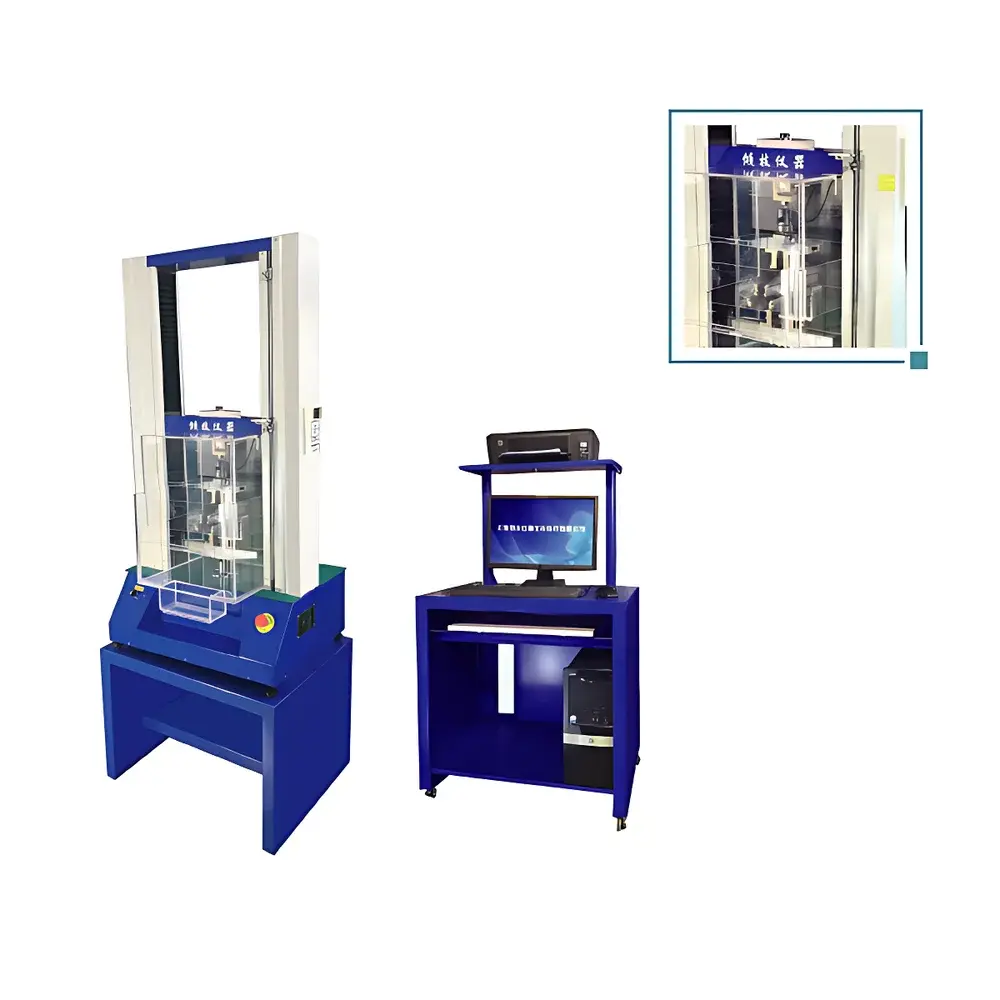
QJ211S2 Microcomputer-Controlled Electronic Puncture Tester
| Origin | Shanghai, China |
|---|---|
| Manufacturer Type | Authorized Distributor |
| Origin Category | Domestic (China) |
| Model | QJ211S2 |
| Price | USD 7,650 (FOB Shanghai) |
| Instrument Type | Electromechanical Universal Testing Machine |
| Load Capacity | 10 kN |
| Accuracy Class | 0.5 |
| Effective Test Width | 320 mm |
| Max. Tensile Stroke | 500 mm (extendable to 800 mm) |
| Speed Range | 0.01–300 mm/min |
| Speed Accuracy | ±0.5% of indicated value |
| Force Resolution | 500,000 counts (full-scale, no range switching) |
| Displacement & Strain Measurement Accuracy | ±0.5% of indicated value |
| Sensor | High-precision load cell (USA-sourced) |
| Controller | Panasonic full-digital AC servo drive system |
| Control System | Full-closed-loop digital control supporting constant-load, constant-strain, and constant-displacement test modes |
| Safety Protection | Software-based overload diagnosis, electronic travel limit, automatic return post-test, mechanical/electronic dual-limit safeguard (10% overcapacity cutoff) |
| Power Supply | 2–5 kW |
| Net Weight | ~145 kg |
Overview
The QJ211S2 Microcomputer-Controlled Electronic Puncture Tester is a high-precision electromechanical universal testing machine engineered for controlled mechanical puncture, flexural (3-point and 4-point), tensile, compressive, shear, and penetration testing of rigid and semi-rigid planar materials. Its core measurement architecture follows ISO 7500-1 and ASTM E4-compliant force calibration principles, utilizing a high-stability, temperature-compensated load cell with 500,000-count resolution and no internal range switching—ensuring consistent sensitivity across the full 10 kN capacity. Designed specifically for evaluating fracture resistance and structural integrity of brittle substrates—including tempered glass panels for smartphones, LCD/LED displays, automotive HUDs, optical lenses, and safety eyewear—the system delivers traceable, repeatable mechanical data under standardized loading conditions. The frame features a rigid dual-column steel structure with precision-ground ball screws and preloaded linear guides, minimizing deflection and ensuring axial alignment within ±0.02 mm over full stroke.
Key Features
- Full-closed-loop digital servo control system integrating Panasonic AC servo motor and driver, enabling precise speed regulation from 0.01 to 300 mm/min (±0.5% accuracy)
- Microcomputer-based real-time monitoring interface with 7-inch high-resolution LCD display showing synchronized force, displacement, strain, and time curves
- Windows-based software platform compliant with GLP/GMP audit trail requirements: supports user-level access control, electronic signatures, data immutability flags, and 21 CFR Part 11-ready configuration options
- Dual-mode operation: standalone mode via front-panel controls or fully integrated PC mode with automated report generation (PDF/Excel), curve overlay, interpolation, and statistical summary (mean, SD, CV%, max/min, yield point detection)
- Modular fixture compatibility: standard configurations include three-point bend, four-point bend, puncture, compression platens, and tensile grips; custom fixtures available per ASTM D638, ISO 527, GB/T 232, and JIS Z 2241 specifications
- Comprehensive safety architecture: hardware-based emergency stop, software-monitored overload cutoff (>110% FS), programmable electronic limits, and auto-return-to-initial-position function post-test
Sample Compatibility & Compliance
The QJ211S2 is validated for flat, isotropic specimens up to 320 mm wide and 500 mm (or optionally 800 mm) in active travel length. It accommodates thicknesses from 0.3 mm (thin cover glass) to 25 mm (structural laminates), with surface flatness tolerance ≤0.1 mm/m. The system meets mechanical verification criteria per ISO 7500-1 (Class 0.5), displacement accuracy per ISO 9513 (±0.5%), and speed stability per ASTM E2309. It supports full compliance workflows for GB/T 1040 (plastics), GB/T 232 (metal bending), GB/T 1449 (composite flexure), ISO 178 (rigidity), ISO 6892-1 (tensile), ASTM C1499 (glass flexural strength), and JIS R3205 (tempered glass impact resistance). Calibration certificates are NIST-traceable and issued with each unit.
Software & Data Management
The embedded Windows 10 IoT Enterprise software provides deterministic real-time data acquisition at ≥1 kHz sampling rate, with lossless storage of raw channel data (force, displacement, extensometer if installed) in HDF5 format. All test parameters—including ramp rates, hold durations, trigger thresholds, and failure criteria—are programmable via intuitive graphical workflow editor. Reports conform to ISO/IEC 17025 documentation standards: metadata includes operator ID, environmental conditions (optional sensor input), calibration dates, instrument serial number, and uncertainty budget per GUM (Guide to the Expression of Uncertainty in Measurement). Export modules support CSV, XML, and PDF/A-2 compliance for long-term archival. Audit logs record all parameter modifications, test executions, and user logins with timestamps and IP addresses.
Applications
- Puncture resistance evaluation of chemically strengthened glass (e.g., Gorilla Glass®, Dragontrail™) using hemispherical indenters per ISO 14577-1
- Flexural modulus and fracture toughness determination of display assemblies under quasi-static loading (ASTM D790, GB/T 9341)
- Adhesion strength testing of optical coatings and AR films via controlled delamination protocols
- Mechanical validation of polymer-laminated safety glazing per ECE R43 and FMVSS 205
- Quality assurance of ophthalmic lens substrates (CR-39, polycarbonate, Trivex®) per ISO 8980-3
- R&D benchmarking of novel transparent ceramics and hybrid composites for aerospace HUD applications
FAQ
What standards does the QJ211S2 support out-of-the-box?
Pre-loaded test methods include ASTM D638, D790, C1499; ISO 527, 178, 7500-1, 9513; GB/T 1040, 232, 1449; JIS Z 2241 and R3205. Custom method templates can be imported via XML.
Is the system compatible with third-party extensometers?
Yes—it features dual analog inputs (±10 V) and digital encoder interfaces compliant with ASTM E83 Class B requirements for clip-on and non-contact extensometers.
Can test data be exported to LIMS or ELN platforms?
Yes—via OPC UA server integration or direct SQL database export (Microsoft SQL Server or SQLite), supporting automated ingestion into LabWare LIMS, Thermo Fisher SampleManager, or Benchling ELN.
What maintenance is required during the first year of operation?
No scheduled maintenance is required; however, biannual verification of force and displacement calibration using certified reference standards is recommended per ISO/IEC 17025 Clause 6.5.
Does the system support multi-user environments with role-based permissions?
Yes—administrator, technician, and reviewer roles are configurable with granular permissions for method editing, test execution, data deletion, and report approval.



