
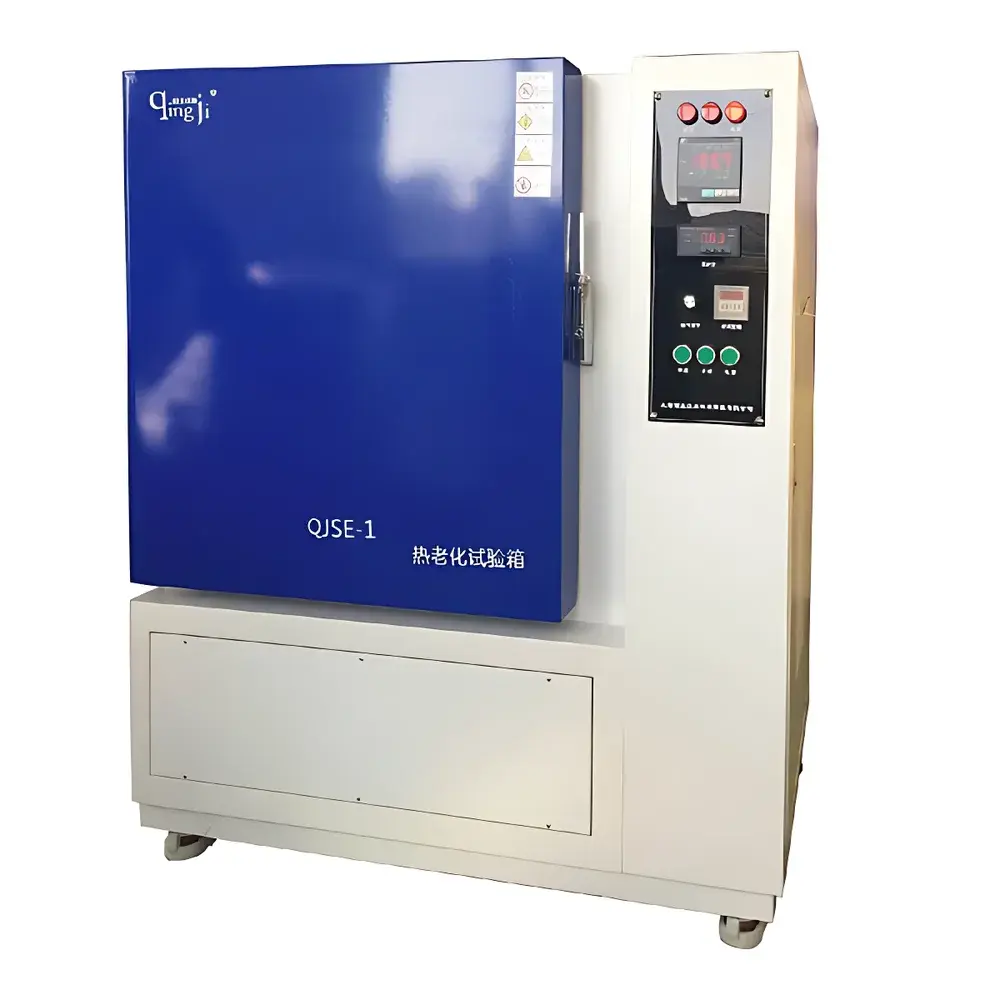
QJSE-1 High Temperature Aging Test Chamber
| Origin | Shanghai, China |
|---|---|
| Manufacturer Type | Authorized Distributor |
| Origin Category | Domestic (China) |
| Model | QJSE-1 |
| Price | USD 7,650 (FOB Shanghai) |
| Max Operating Temperature | 300 °C |
| Product Type | Forced-Air Thermal Aging Chamber |
| Classification | Benchtop Aging Chamber |
| Temperature Range | Ambient +20 °C to 300 °C |
| Temperature Uniformity | ≤ ±0.5 °C |
| Temperature Fluctuation | ≤ ±0.5 °C |
| Temperature Deviation | ≤ ±2.0 °C |
| Heating Rate | ≤60 min (from ambient +20 °C to 200 °C) |
| Total Power Consumption | 6.7 kW (Heating: 6 kW |
| Auxiliary Systems | 0.7 kW) |
| Sound Pressure Level | ≤65 dB(A) |
Overview
The QJSE-1 High Temperature Aging Test Chamber is an engineered environmental test system designed for accelerated thermal aging evaluation of polymeric materials, elastomers, thermoplastics, electrical insulation compounds, and cable sheathing systems. It operates on the principle of controlled forced-air convection heating within a thermally insulated chamber, enabling precise exposure of test specimens to elevated temperatures over defined durations per standardized aging protocols. The chamber complies with core requirements of IEC 60811-501 (formerly IEC 540), ASTM D573, ISO 188, and GB/T 2951.12—standards governing thermal aging behavior, retention of mechanical properties, and degradation kinetics of insulating and protective materials under prolonged thermal stress.
Key Features
- Forced dual-airflow circulation architecture ensures uniform heat distribution across the working volume, minimizing thermal stratification and supporting high reproducibility in aging outcomes.
- Digital programmable temperature controller with imported PID algorithm delivers stable setpoint maintenance and minimizes overshoot during ramp phases.
- Integrated dual-stage safety protection: independent overtemperature cut-off via mechanical thermostat and electronic alarm relay, both triggering audible/visual alerts and automatic heater shutdown.
- Chamber interior constructed from SUS304 stainless steel with seamless welding and electropolished finish to resist oxidation and facilitate cleaning under repeated thermal cycling.
- Insulation layer composed of high-density ceramic fiber (≥100 mm thickness), achieving low external surface temperature rise (<45 °C at 300 °C internal) and reduced energy consumption.
- Front-access observation window with double-layer tempered glass and anti-fog coating enables real-time visual monitoring without compromising thermal integrity.
Sample Compatibility & Compliance
The QJSE-1 accommodates standard test specimens per IEC 60811-501—including dumbbell-shaped tensile strips (Type 1 or 2), wrapped wire samples, and flat sheet coupons—mounted on non-reactive stainless-steel sample racks. Its working volume (W×D×H: 450 × 450 × 500 mm) supports multi-specimen parallel testing while maintaining required airflow clearance. The chamber meets essential design and performance criteria outlined in ISO/IEC 17025-accredited laboratories for thermal aging validation, and its temperature control performance aligns with GLP-compliant aging study execution requirements. Traceable calibration certificates for temperature sensors (Class A Pt100) are available upon request.
Software & Data Management
While the base configuration employs a standalone digital controller with local data logging (up to 100 segments, 999 cycles), optional RS485/Modbus RTU interface enables integration into centralized laboratory data acquisition systems. When paired with compliant SCADA or LIMS platforms, the chamber supports audit-trail-enabled operation logs—including start/stop timestamps, setpoint history, deviation alarms, and operator ID—as required under FDA 21 CFR Part 11 for regulated quality assurance workflows. All temperature records are time-stamped and exportable in CSV format for statistical analysis of aging-induced property decay.
Applications
- Evaluation of long-term thermal stability of PVC, PE, EPR, silicone rubber, and fluoropolymer insulation materials used in power cables and aerospace wiring harnesses.
- Accelerated aging studies for automotive under-hood components, including gaskets, seals, and fluid hoses exposed to sustained engine bay temperatures.
- Pre-qualification testing of printed circuit board (PCB) laminates and conformal coatings per IPC-TM-650 2.6.25.
- Material screening for compliance with UL 1581 Section 1060 (heat aging of wire insulation) and CSA C22.2 No. 0.3.
- Supporting R&D in polymer formulation development, where Arrhenius-based lifetime extrapolation relies on consistent, metrologically traceable aging conditions.
FAQ
What standards does the QJSE-1 chamber comply with for thermal aging testing?
It is configured to meet the thermal control and chamber performance requirements of IEC 60811-501, ASTM D573, ISO 188, and GB/T 2951.12.
Is the temperature uniformity verified across the entire working volume?
Yes—uniformity is validated using a 9-point sensor array per IEC 60068-3-5, with results documented in the factory acceptance test report.
Can the chamber be integrated into a networked lab environment?
Optional Modbus RTU communication allows connection to PLCs, SCADA systems, or LIMS for remote monitoring and electronic recordkeeping.
What maintenance is required to ensure long-term calibration stability?
Annual verification of temperature sensors and controller calibration is recommended; stainless-steel interior and ceramic fiber insulation require no routine replacement under normal operating conditions.
Does the system support ramp-soak-hold profiles for multi-step aging protocols?
Yes—the controller supports up to 100 programmable segments, enabling complex thermal profiles such as pre-heating, dwell, and controlled cooldown sequences.



