
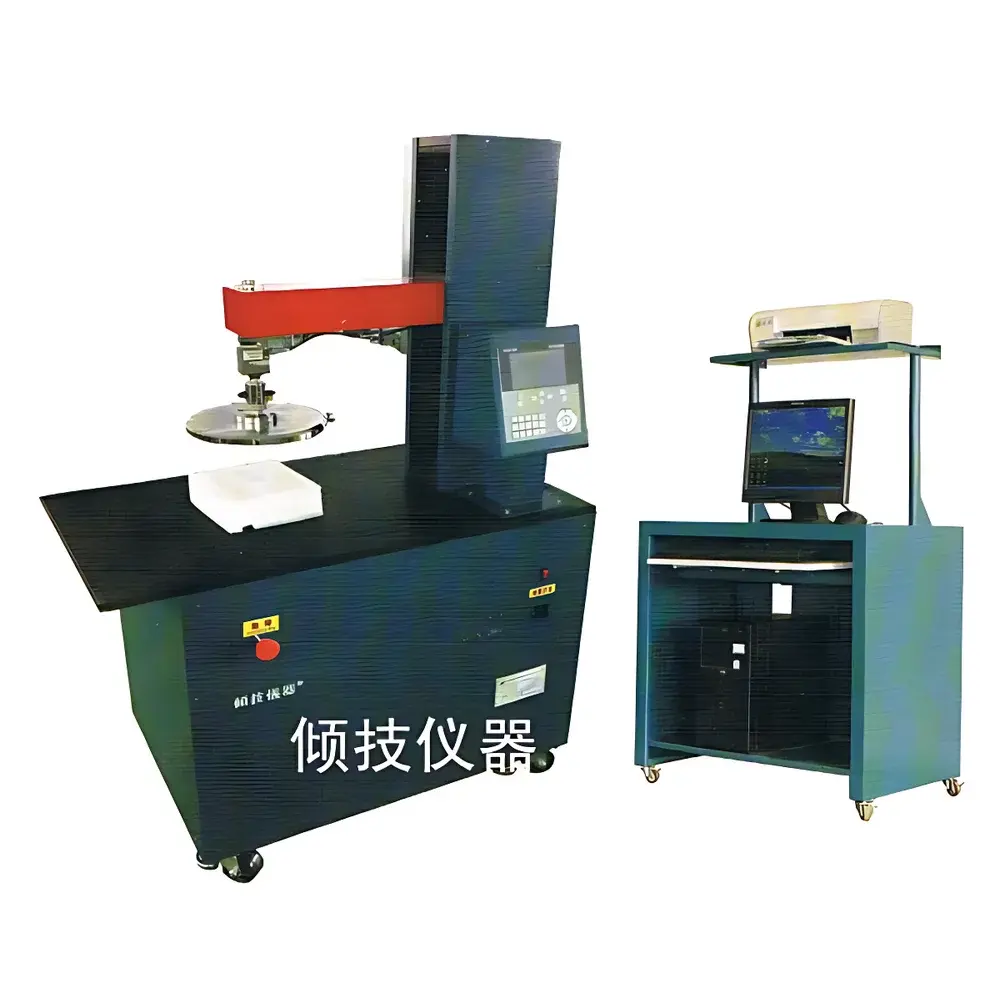
Qinji QJCK Microcomputer-Controlled Foam Compression Stress Tester
| Brand | Qinji |
|---|---|
| Origin | Shanghai, China |
| Model | QJCK |
| Maximum Load Capacity | 2000 N |
| Force Sensor Accuracy | 0.01% FS |
| Test Accuracy | Class 0.5 |
| Repeatability | ≤0.5% |
| Displacement Accuracy | ≤0.2% |
| Deformation Accuracy | ≤0.2% |
| Crosshead Speed Range | 0.01–300 mm/min |
| Compliant Standards | GB/T 6344–1996, GB/T 10807–2006, GB/T 20467–2006 |
Overview
The Qinji QJCK Microcomputer-Controlled Foam Compression Stress Tester is a precision electromechanical testing system engineered for the quantitative mechanical characterization of flexible polymeric foams, sponge elastomers, and low-density cellular materials. Based on servo-controlled uniaxial compression principles, it applies controlled quasi-static or low-cycle loading to specimens while continuously recording force, displacement, and derived deformation metrics. Its architecture integrates a high-stiffness load frame, a digitally regulated AC servo motor drive, and a dual-closed-loop control system (force and displacement) synchronized with real-time microprocessor feedback—ensuring stable load application and minimal thermal drift during extended test sequences. Designed specifically for compliance with Chinese national standards—including GB/T 6344 (tensile strength and elongation at break), GB/T 10807 (indentation hardness via indentation method), and GB/T 20467 (compression set and stress relaxation of molded and extruded sponge rubber products)—the QJCK delivers traceable, reproducible data essential for R&D validation, incoming QC screening, and production lot release in foam manufacturing, automotive seating, packaging engineering, and medical cushioning applications.
Key Features
- Modular load cell options up to 2000 N, calibrated to ISO 376 Class E2 accuracy with verified linearity and hysteresis performance
- Dual-closed-loop control architecture enabling simultaneous force- and displacement-driven test modes (e.g., constant-rate compression, load-hold, or displacement-hold protocols)
- Adjustable crosshead speed range from 0.01 to 300 mm/min, programmable in 0.01 mm/min increments for precise strain-rate control
- High-resolution optical encoder system delivering displacement resolution better than 0.1 µm and positional repeatability ≤0.2% of full scale
- Integrated 7-inch TFT LCD touchscreen interface with embedded test sequence editor, eliminating dependency on external PCs for routine operation
- Robust mechanical design featuring hardened steel guide columns, preloaded ball screws, and overload protection to ensure long-term dimensional stability and operator safety
Sample Compatibility & Compliance
The QJCK accommodates standard foam test geometries per GB/T 10807 (e.g., 50 mm × 50 mm × 25 mm prisms for indentation hardness) and GB/T 20467 (cylindrical or rectangular specimens for compression set evaluation). Fixture adaptability includes flat platens, spherical indenters (φ15 mm, φ20 mm), and custom mandrels for edge-compression or multi-point contact configurations. All test methods are structured to align with internationally recognized metrological frameworks: force measurements conform to ISO 7500-1, displacement to ISO 20282-1, and overall system verification follows JJG 139–2014 (Chinese national verification regulation for universal testing machines). While primarily referenced against GB-series standards, the instrument’s measurement uncertainty budget supports cross-referencing to ASTM D3574 (flexible cellular materials), ISO 1798 (foam tensile properties), and ISO 2439 (indentation hardness), facilitating multiregional regulatory submissions.
Software & Data Management
The embedded firmware provides native support for automated test execution, real-time curve plotting (force vs. displacement, stress vs. strain), and export of raw ASCII data files (.csv) compatible with third-party analysis tools (e.g., MATLAB, OriginLab, Minitab). Audit-trail functionality logs user actions, calibration events, and parameter modifications in accordance with GLP and internal quality management requirements. Optional PC-based software (Qinji TestSuite v4.x) extends capabilities to statistical process control (SPC) charting, batch report generation (PDF/Excel), and 21 CFR Part 11–compliant electronic signatures when deployed in regulated environments. Calibration certificates include as-found/as-left data, uncertainty statements (k=2), and traceability to CNAS-accredited reference standards.
Applications
- Indentation load-deflection profiling for automotive seat foam density grading and comfort optimization
- Compression set evaluation of sponge gaskets and sealing components after 22–72 h exposure at elevated temperatures
- Tensile property mapping of reticulated polyurethane foams used in filtration media
- Stress relaxation quantification in memory foam mattress layers under sustained static loads
- Quality conformance testing of medical-grade silicone foam wound dressings per ISO 10993 biocompatibility support protocols
- Low-cycle fatigue assessment of open-cell foams subjected to repeated compression cycles (10–10,000 cycles)
FAQ
What standards does the QJCK directly support out-of-the-box?
It is factory-configured for GB/T 6344–1996, GB/T 10807–2006, and GB/T 20467–2006; ASTM D3574 and ISO 2439 test templates are available via optional software modules.
Is the system suitable for dynamic or high-speed impact testing?
No—the QJCK is optimized for quasi-static and low-frequency cyclic loading (≤5 Hz); high-strain-rate applications require dedicated impact testers or servo-hydraulic systems.
Can test data be integrated into an enterprise LIMS or MES platform?
Yes—ASCII output and optional OPC UA or Modbus TCP communication protocols enable seamless integration with laboratory information management systems.
What maintenance intervals are recommended for long-term accuracy?
Annual verification of force and displacement metrology is advised; load cell recalibration every 12–24 months depending on usage frequency and environmental conditions.
Does the system include fixtures for non-standard specimen geometries?
Standard configurations include parallel platens and spherical indenters; custom fixtures (e.g., contoured dies, multi-zone compression plates) can be commissioned through Qinji’s engineering services division.



