
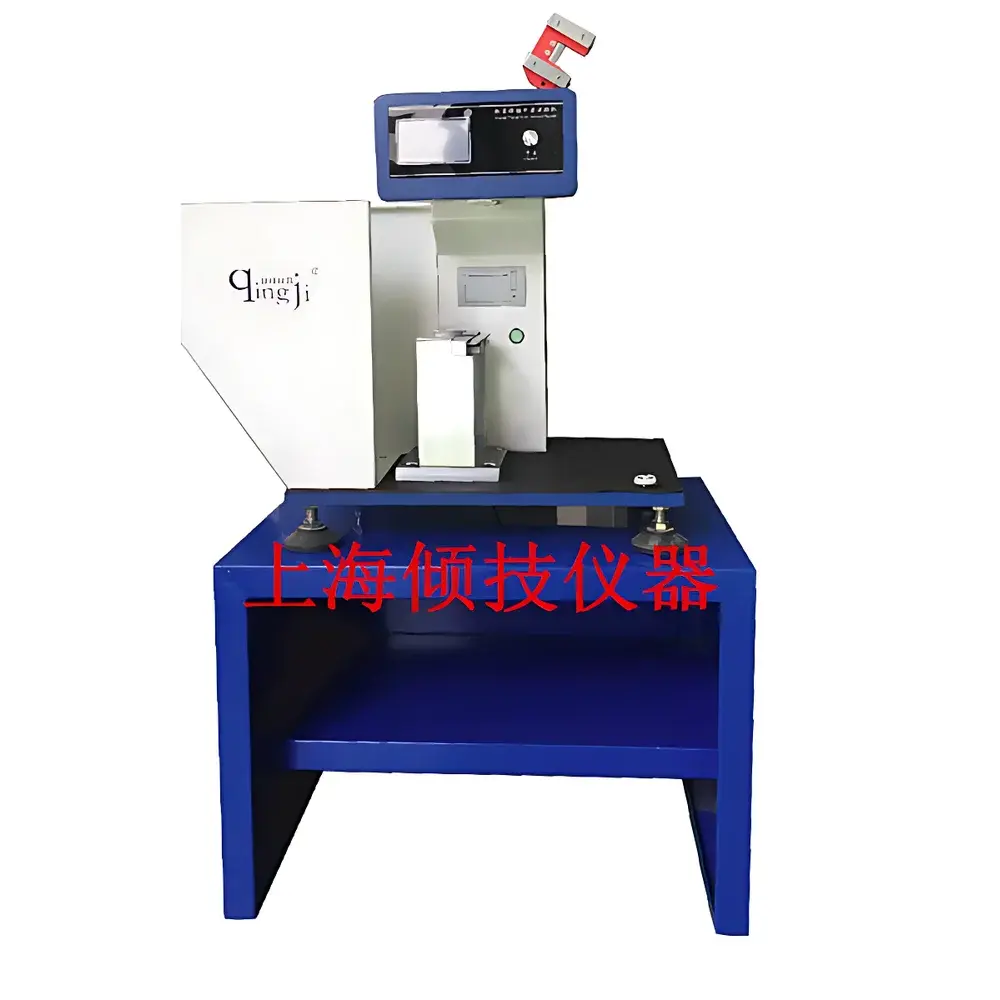
Qinji QJBCJ Charpy/Izod Impact Testing Machine
| Brand | Qinji |
|---|---|
| Origin | Shanghai, China |
| Model | QJBCJ |
| Impact Energy Range | 0–50 J (with selectable pendulum scales: 5 J, 7.5 J, 15 J, 25 J, 50 J) |
| Impact Velocity | 2.9 m/s |
| Pendulum Pre-lift Angle | 160° |
| Distance from Pendulum Axis to Specimen Center | 230 mm |
| Support Span Options | 40 mm, 60 mm, 70 mm, 95 mm |
| Notch Knife Edge Angle | 30° |
| Knife Edge Radius | 2 mm |
| Anvil Radius (Clamp Radius) | 1 mm |
| Dimensions (L×W×H) | 280 × 250 × 500 mm |
| Net Weight | 50 kg |
| Compliance | GB/T 1043, ISO 179-1, ISO 9854-1, DIN 8078, DIN 53453 |
Overview
The Qinji QJBCJ Charpy/Izod Impact Testing Machine is a precision mechanical pendulum impact tester engineered for quantitative determination of impact toughness in rigid non-metallic materials. It operates on the classical principle of conservation of energy in a gravity-driven pendulum system: a calibrated hammer is raised to a defined pre-lift angle (160°), released, and allowed to strike a notched specimen supported in either Charpy (three-point bending) or Izod (cantilever beam) configuration. The energy absorbed during fracture—calculated from the difference between initial potential energy and residual swing height—is reported in joules (J), providing a direct measure of material resistance to sudden loading under standardized geometries. Designed for routine quality control and comparative material evaluation, the QJBCJ delivers high reproducibility across its full 0–50 J energy range, with discrete calibrated pendulum configurations enabling optimal resolution for low- and high-energy applications—from thin plastic films to thick fiber-reinforced composites.
Key Features
- Modular dual-mode testing capability: switchable between Charpy (support span options: 40 mm, 60 mm, 70 mm, 95 mm) and Izod configurations via adjustable anvil and clamp positioning
- Precision-machined pendulum system with hardened steel impact knife (30° included angle, 2 mm tip radius) and standardized anvil (1 mm radius) ensuring strict adherence to ISO and ASTM geometry tolerances
- Robust cast-iron base and rigid column structure minimizing vibration transmission and enhancing measurement stability during high-energy impacts
- Optical angle encoder and digital energy readout provide traceable, repeatable energy calculation without manual scale interpolation
- Ergonomic specimen clamping mechanism with quick-release lever enables rapid sample exchange and consistent notch alignment
- Compact footprint (280 × 250 × 500 mm) and lightweight design (50 kg) facilitate integration into QC labs, teaching laboratories, and limited-space production environments
Sample Compatibility & Compliance
The QJBCJ is validated for use with rigid thermoplastics (e.g., ABS, PC, PP), thermoset composites (glass-fiber reinforced nylon, epoxy-based GFRP), ceramics, cast stone, and electrically insulating polymers. Specimens must conform to standard dimensions specified in GB/T 1043 (10 × 10 × 80 mm), ISO 179-1 (80 × 10 × 4 mm), or relevant material-specific protocols. The instrument meets the mechanical and geometric requirements of ISO 179-1:2010 (Plastics — Determination of Charpy impact properties), ISO 9854-1:2017 (Plastics — Polyethylene — Part 1: General), DIN 8078 (Impact testing of plastics), and DIN 53453 (Izod impact test for plastics). Its design supports GLP-compliant operation when paired with documented calibration records and operator training logs.
Software & Data Management
While the QJBCJ operates as a standalone mechanical tester, optional digital readout modules integrate with PC-based data acquisition software supporting CSV export, statistical reporting (mean, SD, CV%), and pass/fail threshold comparison against internal specifications. Audit trails—including test date/time, operator ID, specimen ID, energy value, and mode selection—are retained per test sequence. The system architecture is compatible with laboratory information management systems (LIMS) via RS-232 or USB virtual COM port, enabling traceability in regulated environments subject to ISO/IEC 17025 or FDA 21 CFR Part 11 requirements when configured with user authentication and electronic signature functionality.
Applications
- Quality assurance of injection-molded plastic components in automotive and consumer electronics supply chains
- Comparative assessment of polymer formulation changes (e.g., plasticizer content, filler loading, impact modifier efficacy)
- Educational demonstration of brittle-to-ductile transition behavior in polymer science curricula
- Pre-qualification screening of composite laminates prior to full-scale mechanical certification (e.g., aerospace prepreg validation)
- Regulatory conformance testing for CE-marked medical device housings requiring ISO 10993-1 biocompatibility support data
- Technical arbitration in materials disputes where third-party verification of claimed impact performance is required
FAQ
What standards does the QJBCJ comply with?
It conforms to GB/T 1043, ISO 179-1, ISO 9854-1, DIN 8078, and DIN 53453 for both Charpy and Izod impact testing methodologies.
Can the machine be used for both Charpy and Izod tests?
Yes—the base frame includes interchangeable fixtures and support anvils enabling rapid reconfiguration between standardized Charpy (three-point bend) and Izod (vertical cantilever) test setups.
Is calibration certification included?
A factory calibration certificate traceable to national metrology institutes is provided with each unit; annual recalibration using NIST-traceable reference pendulums is recommended for ISO/IEC 17025 compliance.
What maintenance is required?
Routine inspection of knife edge wear, anvil surface integrity, and pendulum bearing lubrication is advised every 500 impacts; consumables (replacement knives, anvils, clamps) are available through authorized distributors.
Does the system support automated data logging?
When equipped with the optional digital interface module, it supports real-time data streaming, timestamped storage, and export to spreadsheet or LIMS platforms for audit-ready documentation.



