
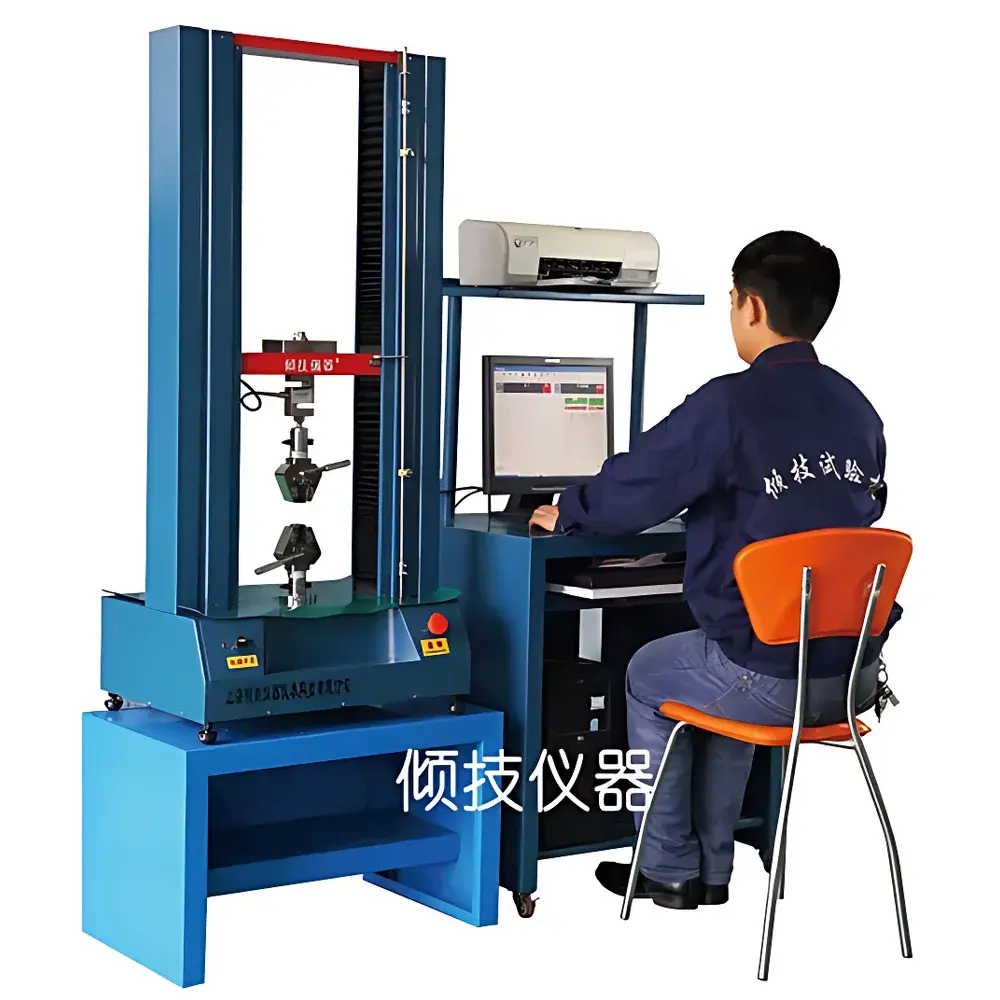
QJ211S2 Carbon Fiber Interfacial Shear Strength Tester – Electronic Universal Testing Machine
| Origin | Shanghai, China |
|---|---|
| Manufacturer Type | Authorized Distributor |
| Origin Category | Domestic (PRC) |
| Model | QJ211S2 |
| Price | USD 7,700 (FOB Shanghai) |
| Instrument Type | Electromechanical Universal Testing Machine |
| Max Load Capacity | 10 kN |
| Accuracy Class | ISO 7500-1 / ASTM E4 Class 0.5 |
| Test Speed Range | 0.01–500 mm/min |
| Effective Test Width | 320 mm |
| Vertical Test Space | 500 mm |
| Force Resolution | 500,000 counts (full-scale, no range switching) |
| Displacement Accuracy | ≤ ±0.2% of reading |
| Speed Accuracy | ±0.5% of set value |
| Safety Features | Electronic travel limit, overload protection (110% FS), emergency stop, motorized return |
| Power | 400 W AC |
| Net Weight | 145 kg |
Overview
The QJ211S2 Carbon Fiber Interfacial Shear Strength Tester is a high-precision electromechanical universal testing machine engineered for quantitative mechanical characterization of fiber–matrix interfaces—particularly in carbon fiber-reinforced polymer (CFRP) composites. It operates on the principle of controlled axial displacement and force feedback to execute standardized interfacial shear strength (IFSS) measurements via microbond, fragmentation, or single-fiber pull-out methodologies per ASTM D7264, ISO 14129, and ASTM D3379. Unlike general-purpose tensile testers, the QJ211S2 integrates hardware and software optimizations for low-force, high-resolution shear interface testing—including sub-newton force stability, micron-level crosshead positioning repeatability, and real-time load–displacement synchronization with <10 ms latency. Its modular load frame accommodates specialized fixtures for fiber embedding, micro-gripping, and embedded-droplet shear loading—enabling direct correlation between interfacial adhesion quality and composite bulk performance.
Key Features
- ISO 7500-1 Class 0.5 certified force measurement system with 500,000-count resolution across full 10 kN range—no auto-ranging or accuracy loss at low loads (e.g., 0.1–5 N typical for single-fiber IFSS)
- Programmable test speed from 0.01 to 500 mm/min, with closed-loop servo control ensuring ±0.5% speed fidelity—critical for strain-rate-sensitive interfacial debonding kinetics
- High-rigidity dual-column frame (320 mm clear width, 500 mm vertical stroke) minimizing lateral deflection during off-axis shear loading
- Integrated electronic travel limits and 110% overload cutoff—preventing fixture damage during brittle interfacial failure events
- Motorized crosshead with dual-speed (coarse/fine) positioning and programmable return-to-start—reducing operator intervention between sequential micro-specimen tests
- Real-time dynamic display of load, displacement, and calculated stress/strain on industrial-grade LCD; synchronized data streaming to PC via USB 2.0 or Ethernet
Sample Compatibility & Compliance
The QJ211S2 supports standardized IFSS specimen geometries including single carbon fibers (5–12 µm diameter) embedded in epoxy droplets (20–100 µm), microbond specimens (diameter-matched polymer cylinders), and short-fiber fragmentation samples. Customizable pneumatic, wedge, or collet-based microgrips ensure slippage-free clamping without fiber damage. The system complies with ISO 14129 (determination of interfacial shear strength by microbond test), ASTM D7264/D3379 (flexural/tensile testing of composites), and supports method validation under GLP and GMP environments. All firmware and control logic are designed for traceability: user actions, calibration logs, and test parameters are timestamped and stored with audit trail capability—aligned with FDA 21 CFR Part 11 requirements when paired with validated software.
Software & Data Management
The included PC-based testing software provides ISO-compliant test method templates (e.g., “ASTM D7264 Microbond IFSS”), automated calculation of interfacial shear strength (τ = F/(π·d·L)), statistical reporting (mean, SD, CV%), and export to CSV, PDF, or XML formats. Raw data streams include time-stamped force (N), displacement (mm), and derived values (MPa, % strain) at up to 100 Hz sampling. Calibration certificates (force, displacement) are digitally embedded and version-controlled. Software supports multi-user role management (operator, supervisor, administrator), electronic signatures, and configurable report headers—enabling integration into LIMS or ELN platforms. Optional API access allows scripted batch testing and third-party data ingestion.
Applications
- Quantitative IFSS evaluation of carbon fiber surface treatments (sizing, plasma, ozone, electrochemical oxidation)
- Interfacial optimization studies in thermoset (epoxy, BMI) and thermoplastic (PEEK, PA6) matrices
- Quality control of incoming carbon fiber batches against specification limits (e.g., τ ≥ 45 MPa)
- Correlation of interfacial properties with composite laminate flexural modulus (ASTM D7264) and ILSS (ASTM D2344)
- Research into moisture/thermal aging effects on fiber–matrix bonding integrity
- Validation of novel sizing chemistries and nanomodified matrix formulations
FAQ
What standards does this tester support for carbon fiber IFSS measurement?
ASTM D7264 (microbond), ISO 14129, and ASTM D3379—fully configurable within software method templates.
Can the system perform both pull-out and fragmentation tests?
Yes—via interchangeable microgrip assemblies and programmable displacement profiles optimized for progressive debonding vs. catastrophic failure modes.
Is force calibration traceable to national standards?
Yes—factory calibration includes NIST-traceable load cell certification with documented uncertainty (≤0.15% FS).
Does the software meet FDA 21 CFR Part 11 requirements?
When deployed with validated installation qualification (IQ) and operational qualification (OQ) protocols, the system supports electronic records and signatures compliant with Part 11.
What maintenance is required for long-term IFSS accuracy?
Annual recalibration of load cell and displacement encoder is recommended; routine verification using certified reference weights and gauge blocks is supported in software.



