
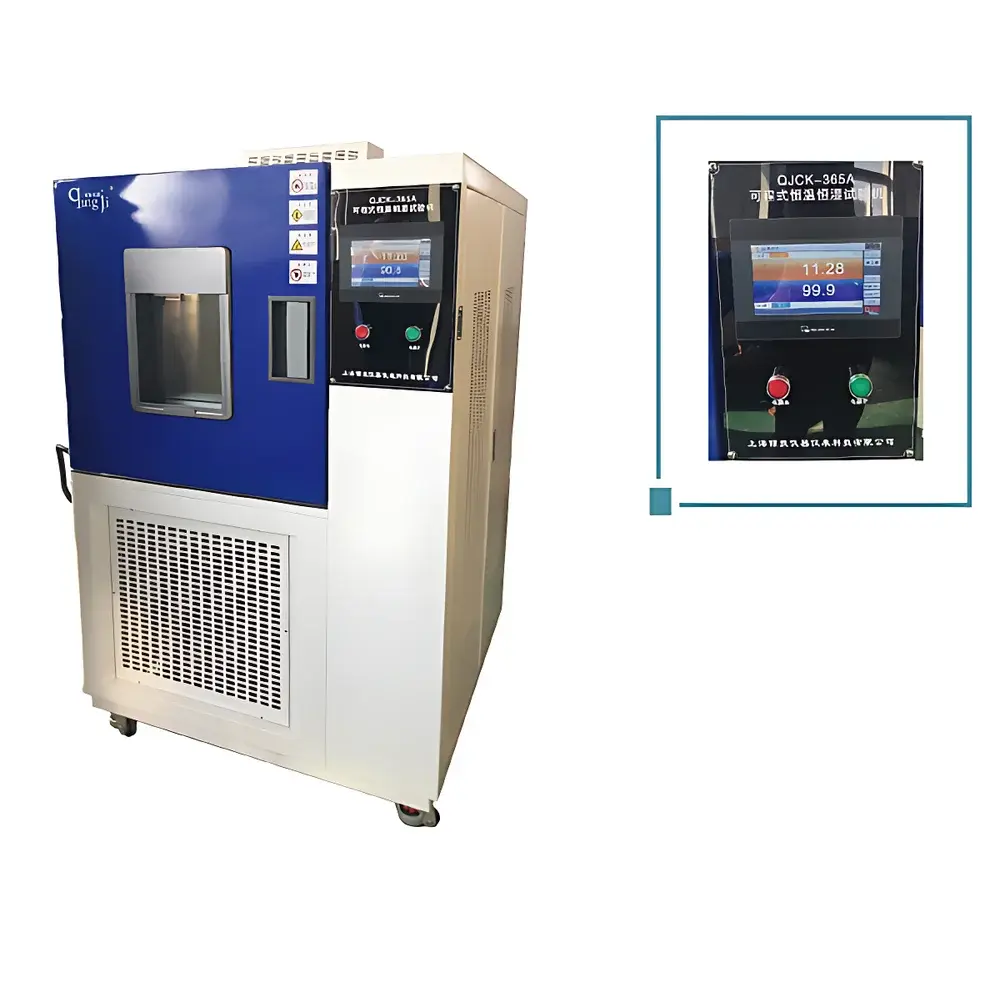
QJCK Rapid Temperature Change Test Chamber with Integrated Mechanical Testing Frame
| Origin | Shanghai, China |
|---|---|
| Manufacturer Type | Authorized Distributor |
| Origin Category | Domestic (China) |
| Model | QJCK Rapid Temperature Change Test Chamber |
| Price | USD 7,000 (FOB Shanghai) |
Overview
The QJCK Rapid Temperature Change Test Chamber is an integrated environmental-mechanical testing system engineered for concurrent thermal cycling and uniaxial mechanical loading. Unlike conventional standalone thermal chambers, this platform combines a high-performance temperature conditioning enclosure with a precision universal testing frame—enabling real-time mechanical property evaluation (tensile, peel, tear, compression, flexure, shear, puncture, and low-cycle fatigue) under dynamically controlled thermal conditions. The system operates on the principle of forced-air convection with dual-stage refrigeration and PID-controlled resistive heating, achieving rapid thermal transitions across a wide operational envelope. Its design supports standardized material qualification workflows in R&D labs, quality control departments, and certification bodies where thermomechanical coupling must be quantified per ASTM D695, ISO 6892-2, JIS K7127, GB/T 1040.2, and DIN EN ISO 527-2.
Key Features
- Wide thermal operating range: −70 °C to +350 °C (sustained isothermal hold at 350 °C)
- Minimum average ramp rate: ≥5 °C/min over full temperature span (verified per IEC 60068-3-5)
- High-resolution temperature control: 0.1 °C setpoint resolution with ±0.3 °C uniformity (±0.5 °C at extremes)
- Modular mechanical frame: Load capacity configurable up to 30 kN; compatible with standard load cells (0.01% FS accuracy)
- Dual-mode operation: Fully computer-controlled via Ethernet-connected test software; local numeric keypad interface available for manual setup
- Adjustable test zone: 420 mm effective width and 800 mm standard stroke (extendable upon request)
- Precision motion control: Crosshead speed range 0.001–500 mm/min (optional 1000 mm stroke), with speed accuracy ≤±0.5% of set value
- Comprehensive safety architecture: Dual-channel electronic travel limits, hardware emergency stop circuit, and thermal runaway monitoring
- Thermal chamber detachability: Enables conversion to ambient-temperature mechanical testing mode without recalibration
Sample Compatibility & Compliance
The QJCK chamber accommodates specimens in sheet, rod, film, composite laminate, elastomer, and metallic forms—up to 300 mm in height and 400 mm in planar dimension. Internal chamber dimensions (W×D×H) are optimized for ASTM E8/E8M, ISO 6892-1, and GB/T 228.1 specimen geometries. All thermal and mechanical subsystems comply with CE marking requirements (2014/30/EU EMC Directive, 2014/35/EU LVD Directive) and meet essential safety provisions of ISO 12100. Data acquisition and reporting support audit-ready traceability per GLP and GMP environments, including optional 21 CFR Part 11-compliant user access controls and electronic signature modules.
Software & Data Management
Control and analysis are performed using QTest Pro v4.2—a Windows-based application supporting synchronized acquisition of load, displacement, strain, and real-time chamber temperature. The software enables programmable thermal profiles (ramp-hold-ramp, step cycles, dwell sequences) concurrently with mechanical test protocols (load-controlled, displacement-controlled, or closed-loop strain rate). Raw data is stored in .qtd binary format with embedded metadata (operator ID, timestamp, calibration IDs, environmental logs). Export options include CSV, Excel, PDF reports with customizable templates aligned to ISO/IEC 17025 laboratory documentation standards. Optional cloud synchronization allows secure remote monitoring and centralized fleet management across multi-site operations.
Applications
- Evaluation of polymer glass transition behavior under tensile stress (e.g., Tg shift under load per ASTM D4065)
- Thermomechanical fatigue life assessment of solder joints and adhesive bonds
- High-temperature creep compliance testing of aerospace composites (ISO 899-1)
- Cryogenic embrittlement screening of elastomeric seals and O-rings (ASTM D1415)
- Validation of thermal expansion coefficient (CTE) via in-situ strain measurement during ramping
- Pre-certification testing for automotive component specifications (e.g., GMW14872, Ford WSS-M99P1111-A)
- Material qualification for medical device packaging per ISO 11607-2 accelerated aging protocols
FAQ
What is the maximum sustained temperature for isothermal testing?
The chamber maintains stable isothermal conditions up to +350 °C for indefinite duration, verified by Class A PT100 sensors and independent NIST-traceable validation.
Can the system perform simultaneous temperature ramping and cyclic loading?
Yes—the controller synchronizes thermal profile execution with waveform-defined mechanical loading (e.g., sinusoidal, triangular, block cycles) at user-defined phase offsets.
Is third-party calibration certification included?
A factory-issued calibration certificate (traceable to CNAS-accredited labs) is provided with shipment; optional UKAS or A2LA-certified calibration available upon order.
How is software validation handled for regulated environments?
QTest Pro includes IQ/OQ documentation packages and supports 21 CFR Part 11 compliance when deployed with domain-authenticated Windows Server infrastructure and role-based access configuration.
What maintenance intervals are recommended?
Refrigerant pressure verification and load cell zero-check every 6 months; full preventive maintenance—including bearing lubrication, sensor recalibration, and thermal insulation integrity check—annually.



