
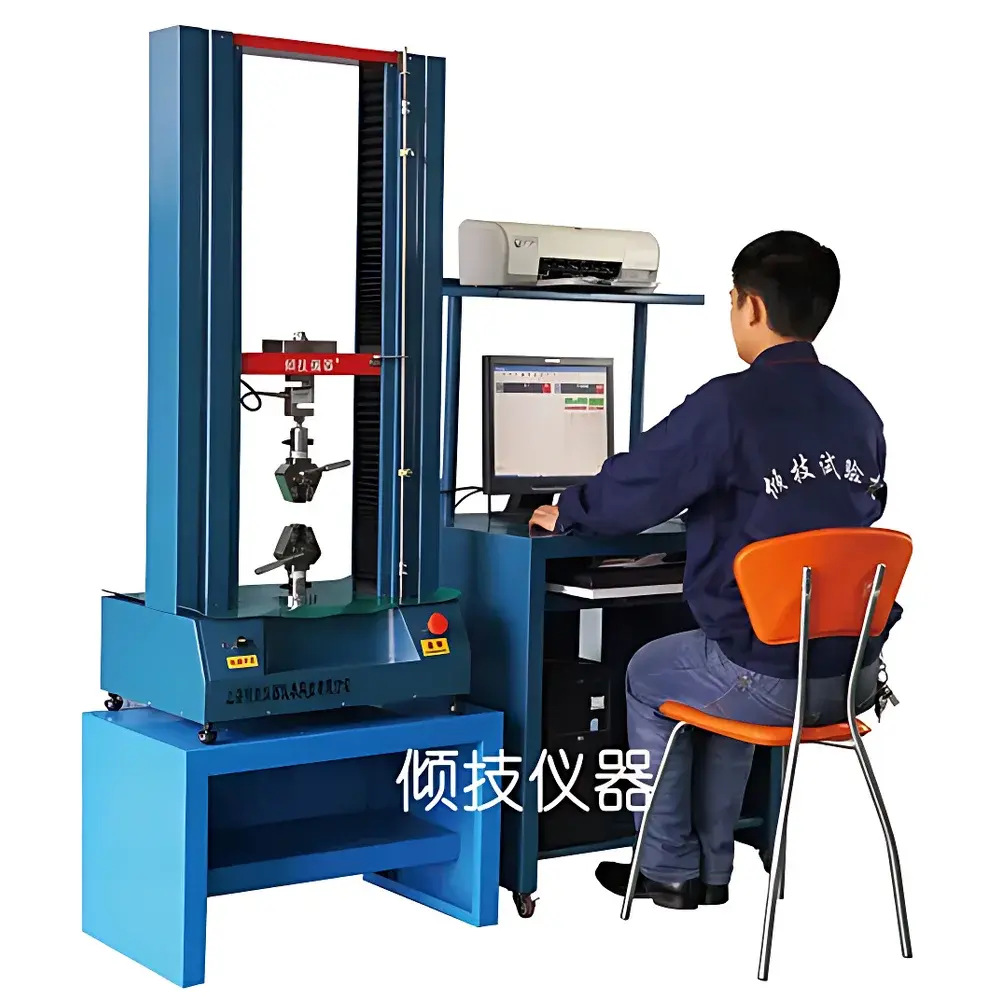
Qingji QJ211S Universal Testing Machine for Coating Flexibility and Cement Bag Tensile Testing
| Brand | Qingji |
|---|---|
| Model | QJ211S Series |
| Type | Electromechanical Universal Testing Machine |
| Max Load Capacity | 10 kN |
| Accuracy Class | 0.5 |
| Effective Test Width | 320 mm |
| Effective Stroke (Tensile) | 500 / 800 mm |
| Speed Range | 0.01–300 mm/min |
| Speed Accuracy | ±0.5% of reading |
| Force Resolution | 500,000 counts (full-scale, no range switching) |
| Displacement & Strain Accuracy | ±0.5% of reading |
| Load Cell | High-precision U.S.-sourced sensor |
| Controller | Panasonic full-digital AC servo system |
| Control Mode | Closed-loop control of stress, strain, and displacement |
| Compliance | GB, ISO, ASTM, JIS, DIN, EN, YB, JT, JG, SY, SL, HG, YY, QC, QB, YD, BB standards |
| Weight | ~145 kg |
Overview
The Qingji QJ211S Universal Testing Machine is an electromechanical static materials tester engineered for precision mechanical characterization of rigid and flexible specimens under uniaxial loading conditions. It operates on the fundamental principle of controlled displacement or force application via a high-stiffness dual-column frame, driven by a digitally regulated AC servo motor and coupled to a calibrated load cell and optical encoder-based displacement measurement system. Designed for routine quality control and R&D-grade mechanical testing, the QJ211S supports standardized tensile, compression, and three-point bending protocols—specifically optimized for evaluating the flexibility resistance of protective coatings (e.g., epoxy, polyurethane, or fusion-bonded epoxy layers on steel pipelines) and the tensile integrity of cement packaging materials (e.g., multi-ply paper, laminated polypropylene, or coated woven sacks). Its modular architecture enables rapid reconfiguration between test modes through interchangeable fixtures and software-defined test sequences, ensuring repeatability across production batches and compliance with internationally recognized mechanical testing methodologies.
Key Features
- Full digital closed-loop control system supporting simultaneous or independent regulation of stress, strain, and crosshead displacement—enabling precise execution of ISO 527-1, ASTM D638, GB/T 2567, and ISO 1519 for coating flexibility.
- 0.5-class accuracy certified force measurement using a traceable, temperature-compensated U.S.-manufactured load cell with 500,000 internal resolution counts—no auto-ranging required across the full 10 kN capacity.
- Panasonic full-digital AC servo drive delivering stable, low-noise motion from 0.01 to 300 mm/min with speed fidelity within ±0.5% of setpoint—critical for creep, relaxation, and rate-dependent property evaluation.
- Dual-mode crosshead actuation: programmable fast/slow positioning for setup efficiency and fine-step loading during critical deformation phases.
- Integrated hardware and software safety architecture—including electronic limit switches, real-time overload detection (>110% FS), automatic emergency stop, and software-based diagnostic self-check at startup.
- Modular fixture interface compatible with standard wedge-action grips, compression platens, and custom three-point bend assemblies—facilitating rapid adaptation to diverse specimen geometries and industry-specific jigs.
Sample Compatibility & Compliance
The QJ211S accommodates flat, sheet-like, and prismatic specimens up to 320 mm wide and 500 mm (standard) or 800 mm (extended) in active gauge length. It is routinely deployed for testing polymer-coated pipe coupons per ISO 15590-2 Annex B (coating bendability), ASTM D522 (mandrel bend test), and GB/T 232 (metallic material bending). For cement sack evaluation, it meets the dimensional and loading requirements of GB/T 8946 (plastic woven sacks), GB/T 24453 (paper cement sacks), and ISO 21620 (flexural performance of packaging films). All test procedures are fully traceable to ISO/IEC 17025–accredited calibration practices; force and displacement transducers are calibrated per ISO 7500-1 and ISO 9513, respectively. The system supports audit-ready documentation aligned with GLP and GMP environments, including user-accessible calibration logs and instrument history tracking.
Software & Data Management
The QJ211S is operated via a Windows-based, FDA 21 CFR Part 11–compliant test control and analysis suite. The software provides real-time graphical display of force–displacement, stress–strain, and time-based curves with configurable sampling rates up to 1 kHz. Users may define multi-step test profiles (e.g., preload → ramp → hold → unload), apply automatic yield point detection per ASTM E8/E21, and compute standardized metrics—including tensile strength, yield offset (0.2%), modulus of elasticity, elongation at break, flexural modulus, and fracture energy. Data export is supported in CSV, XLSX, and PDF formats; reports include embedded metadata (operator ID, timestamp, environmental conditions, calibration status). Curve manipulation tools enable overlay, differential analysis, baseline correction, and statistical batch comparison—without requiring external post-processing platforms.
Applications
- Mechanical validation of anti-corrosion coatings on carbon steel substrates under cold-bend conditions—assessing cracking onset, delamination resistance, and ductility retention after thermal cycling.
- Tensile strength and elongation profiling of cement packaging materials under varying humidity and temperature preconditioning—supporting shelf-life modeling and transport simulation.
- Quality assurance of geotextiles, filtration membranes, and composite laminates used in civil infrastructure projects per ASTM D4595 and ISO 10319.
- Routine verification of weld joint integrity, adhesive bond strength, and fiber-reinforced polymer (FRP) laminate stiffness in manufacturing QA labs.
- Academic and industrial research into viscoelastic behavior of thermoplastics, elastomers, and biodegradable packaging films using controlled-rate and constant-load protocols.
FAQ
What standards does the QJ211S support for coating flexibility testing?
It complies with ISO 15590-2, ASTM D522, GB/T 232, and JIS Z 2241 for mandrel bending, wrap-around, and guided bend tests on coated metallic substrates.
Can the system be integrated into a laboratory LIMS or MES environment?
Yes—the software exposes OPC UA and TCP/IP interfaces for bidirectional data exchange with enterprise systems, including sample ID synchronization, result auto-upload, and electronic signature capture.
Is third-party calibration certification available?
Qingji provides optional NIST-traceable calibration certificates issued by CNAS-accredited laboratories, valid for 12 months and including uncertainty budgets per ISO/IEC 17025.
How is operator training delivered?
On-site installation commissioning includes 8 hours of hands-on instruction covering test method setup, fixture alignment, troubleshooting diagnostics, and report generation workflows.
What maintenance intervals are recommended?
Preventive maintenance is advised every 12 months or after 2,000 test cycles—covering load cell verification, screw lubrication, encoder alignment, and firmware updates.
Related Products



