
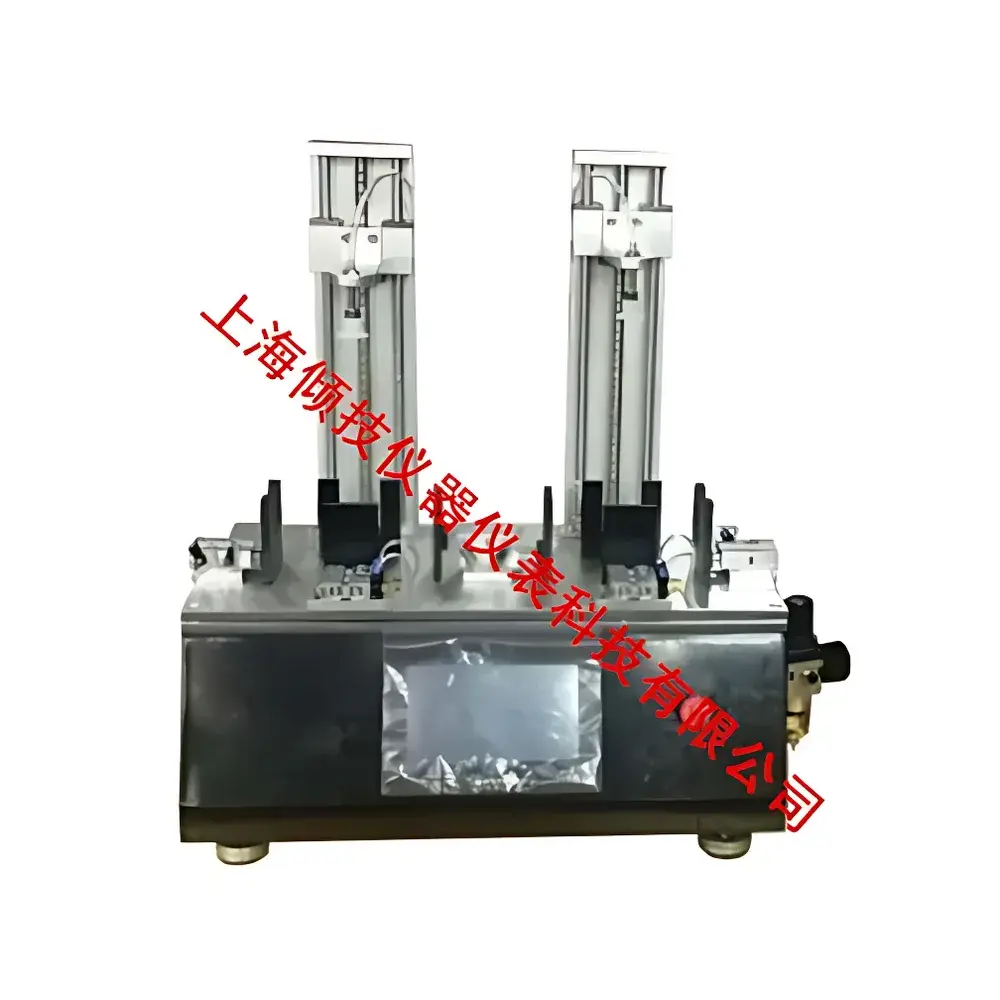
Qinji QJLCSW-86 Dual-Station Micro-Drop Tester for Mobile Devices
| Brand | Qinji |
|---|---|
| Origin | Shanghai, China |
| Manufacturer Type | Authorized Distributor |
| Country of Origin | China |
| Model | QJLCSW-86 |
| Price Range | USD 7,000–14,000 (FOB Shanghai) |
| Drop Height Range | 10–200 mm |
| Max. Specimen Weight | 2 kg per station (4 kg total dual-station capacity) |
| Max. Specimen Dimensions | 550 mm (W) × 750 mm (H) × 650 mm (D) |
| Drop Surface Dimensions | 550 mm (W) × 750 mm (H) × 650 mm (D) |
| Test Cycle Rate | 6–20 drops/min |
| Control System | PLC + 7-inch HMI touchscreen interface |
| Power Supply | AC 220 V ±10%, 50/60 Hz |
| Pneumatic Supply | ≥0.5 MPa |
| Machine Weight | ~40 kg |
| Footprint | 550 mm (W) × 750 mm (H) × 650 mm (D) |
Overview
The Qinji QJLCSW-86 Dual-Station Micro-Drop Tester is an electromechanical precision drop testing system engineered for accelerated mechanical durability assessment of compact consumer electronics—particularly smartphones, display modules, handsets, two-way radios, portable audio devices (MP3/CD players), and electronic dictionaries. Unlike conventional free-fall drop testers designed for large appliances or packaging, this instrument implements controlled, repeatable micro-drop methodology based on vertically actuated pneumatic lift-and-release mechanics. Each station operates independently with synchronized height calibration, enabling comparative fatigue analysis across identical or heterogeneous samples under identical environmental and kinematic conditions. The system complies with core principles outlined in IEC 60068-2-32 (Environmental testing – Part 2-32: Tests – Test Ed: Free fall) and supports test protocol development aligned with internal reliability standards such as those used in ISO/IEC 17025-accredited QC laboratories.
Key Features
- Dual independent test stations—each configured with dedicated height adjustment, release timing control, and specimen retention fixtures—allow parallel execution of two distinct test sequences without cross-interference.
- Precise drop height adjustment from 10 mm to 200 mm in 1 mm increments via calibrated linear actuator, verified by integrated optical position feedback for traceable repeatability.
- PLC-based control architecture with 7-inch resistive touchscreen HMI enables intuitive programming of drop count, interval timing, height ramping profiles, and pass/fail logic thresholds.
- Robust aluminum-alloy frame with vibration-damped base minimizes energy coupling between stations and ensures structural stability during high-frequency cycling (up to 20 drops/min per station).
- Modular specimen fixture design accommodates standardized smartphone form factors (max. 80 × 140 mm footprint per unit) while permitting custom adapter plates for non-standard geometries.
- Integrated pneumatic circuit with pressure regulator and filter-lubricator ensures consistent release velocity and eliminates mechanical hysteresis associated with solenoid-only systems.
Sample Compatibility & Compliance
The QJLCSW-86 is validated for specimens up to 2 kg per station, with maximum dimensional envelope of 550 mm (W) × 750 mm (H) × 650 mm (D)—sufficient to accommodate stacked multi-unit fixtures or auxiliary support jigs. Its micro-drop regime targets surface-level impact integrity: screen crack propagation, housing seam deformation, button actuation consistency, and internal component solder joint fatigue. While not intended for full-system drop certification per MIL-STD-810H Method 516.8, it serves as a critical screening tool in early-stage design validation (DVT), incoming component qualification (IQC), and production line process capability studies. Test logs generated by the system support GLP-compliant documentation when paired with external audit-trail-enabled data export protocols.
Software & Data Management
The embedded HMI firmware records all operational parameters—including actual drop height (±0.3 mm accuracy), cycle timestamp, cumulative drop count per station, and pneumatic pressure trace—for each executed test sequence. Data exports via USB 2.0 to CSV format enable post-processing in MATLAB, JMP, or Minitab for Weibull analysis, failure mode trending, and SPC charting. Optional RS-485 Modbus RTU interface allows integration into factory MES platforms for real-time test status monitoring and automated pass/fail flagging. All firmware versions are digitally signed and version-locked to prevent unauthorized modification—supporting FDA 21 CFR Part 11 readiness when deployed in regulated manufacturing environments.
Applications
- Smartphone OEM R&D labs conducting iterative drop robustness benchmarking across successive prototype iterations.
- Contract manufacturers performing first-article inspection (FAI) and batch-level reliability sampling per AQL Level II (ISO 2859-1).
- Display module suppliers validating edge-seal integrity and polarizer adhesion under repeated low-energy impact.
- Audio device QA teams assessing mechanical shock resistance of speaker diaphragms and MEMS microphone housings.
- Third-party testing laboratories offering accredited micro-drop services compliant with customer-specific reliability specifications (e.g., Apple Spec. 2200-001, Samsung RAS-001).
FAQ
What is the minimum measurable drop height?
The system achieves precise positioning down to 10 mm, with mechanical repeatability of ±0.2 mm over 10,000 cycles.
Can the tester accommodate irregularly shaped samples?
Yes—customizable fixture plates and adjustable clamping mechanisms support non-rectangular geometries, provided mass distribution remains within center-of-gravity limits specified in the user manual.
Is remote diagnostics supported?
Standard Ethernet connectivity is not included; however, optional Wi-Fi-enabled gateway modules (QJ-EMG-W1) provide secure SSH access and firmware OTA updates under IT-managed VLAN segmentation.
Does the system meet CE or UL safety directives?
The QJLCSW-86 conforms to EN 61000-6-2 (immunity) and EN 61000-6-4 (emissions); UL 61010-1 certification is available upon request for North American deployment.
How is calibration traceability maintained?
Each unit ships with a factory calibration certificate referencing NIST-traceable height gauges and load cells; annual recalibration service is offered through Qinji’s ISO/IEC 17025-accredited metrology center in Shanghai.



