
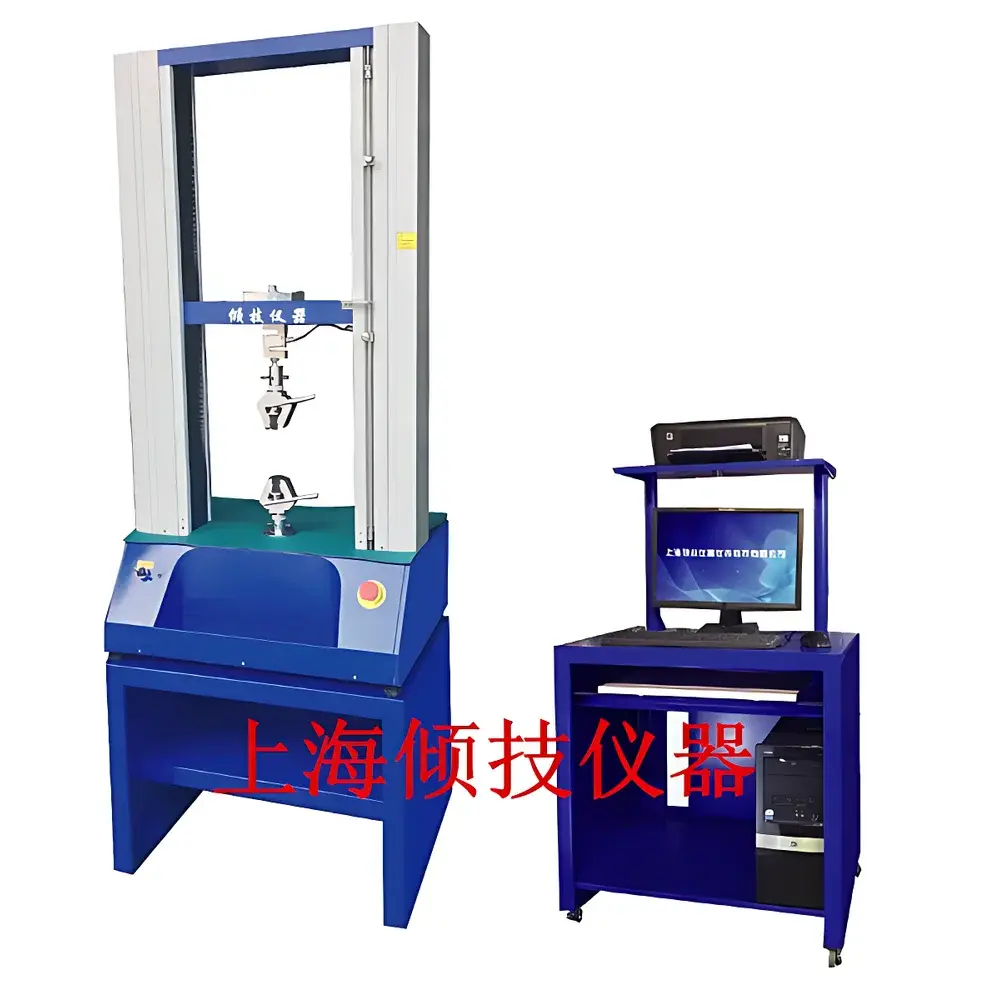
Qinji QJ211 PVC Pipe Tensile Testing Machine
| Brand | Qinji |
|---|---|
| Origin | Shanghai, China |
| Model | QJ211 |
| Load Capacity | 30 kN (selectable) |
| Force Sensor Accuracy | 0.01% |
| Measurement Accuracy | < ±0.5% |
| Control System | Full PC-based Windows interface |
| Effective Test Width | ~420 mm |
| Effective Stroke | ~800 mm |
| Test Speed Range | 0.001–500 mm/min |
| Speed Accuracy | ±0.5% |
| Displacement Accuracy | ±0.5% |
| Strain Measurement Accuracy | ±0.5% |
| Safety Features | Electronic stroke limit protection, emergency stop button |
| Machine Weight | ~140 kg |
Overview
The Qinji QJ211 PVC Pipe Tensile Testing Machine is a precision-engineered universal testing system designed for static mechanical characterization of rigid and semi-rigid polymeric pipe materials—particularly unplasticized polyvinyl chloride (uPVC) and chlorinated polyvinyl chloride (CPVC) pressure pipes used in municipal water distribution, industrial fluid conveyance, and building infrastructure applications. Operating on the fundamental principle of uniaxial tensile loading under controlled displacement or load control, the system complies with standardized test methodologies defined in ISO 6259 (plastics—determination of tensile properties), ASTM D638 (standard test method for tensile properties of plastics), and GB/T 8804 (Chinese national standard for thermoplastic piping systems). Its modular load frame architecture supports both axial tension and compression modes, enabling full stress–strain curve acquisition—including yield strength, ultimate tensile strength, elongation at break, and modulus of elasticity—with high reproducibility across batch-to-batch quality verification workflows.
Key Features
- High-accuracy 30 kN load cell with 0.01% full-scale resolution, traceable to national metrological standards
- Adjustable crosshead travel (up to 800 mm) and wide test width (420 mm) accommodating standard PVC pipe specimens per ISO 1167 and ASTM D1598
- Precision servo-controlled drive system delivering stable velocity control from 0.001 to 500 mm/min, with speed accuracy maintained within ±0.5%
- Dual-channel digital signal acquisition supporting simultaneous measurement of load, displacement, and optional extensometer-derived strain
- Integrated safety architecture including programmable electronic stroke limits, hardware-based emergency stop circuitry, and safeguard stroke monitoring
- Robust steel frame construction (approx. 140 kg) optimized for low-vibration operation in QC laboratories and production floor environments
Sample Compatibility & Compliance
The QJ211 accommodates a broad range of specimen geometries relevant to pipe material qualification, including dog-bone tensile bars cut from extruded pipe walls, ring-tensile specimens per ISO 1167-2, and flattened pipe sections prepared according to ASTM D2122. It supports standardized夹具 configurations for axial pull-off tests on solvent-welded joints, hoop tensile tests on pipe rings, and longitudinal tensile evaluation of pipe wall material. All test routines are fully configurable to meet requirements specified in ISO 9001-certified quality management systems, and data reporting aligns with GLP/GMP documentation practices. The system facilitates compliance with regulatory frameworks including China’s GB/T 5836 series for PVC drainage pipes, EU EN 1452-2 for pressure pipes, and U.S. NSF/ANSI 14 certification protocols.
Software & Data Management
Controlled via a dedicated Windows-based application, the QJ211 software enables real-time graphical display of force–displacement, stress–strain, and time-dependent creep curves. Users may perform post-test operations including curve traversal, overlay comparison of multiple datasets, dynamic scaling, annotation, and export to CSV, Excel, or PDF formats. Audit-trail functionality records operator ID, timestamp, test parameters, calibration history, and raw data file integrity—supporting alignment with FDA 21 CFR Part 11 requirements where electronic records are subject to regulatory review. Calibration coefficients are digitally stored and protected against unauthorized modification; firmware updates and parameter backups are managed through secure local network protocols.
Applications
- Tensile property verification of uPVC and CPVC pipe extrusions per GB/T 5836.2 and ISO 1452-2
- Quality assurance testing during pipe manufacturing process validation and incoming raw material inspection
- Mechanical performance assessment of pipe fittings, gasketed joints, and solvent-cemented assemblies
- Long-term hydrostatic strength (LTHS) pre-screening via short-term tensile data correlation
- Research-grade evaluation of polymer formulation effects on ductility, yield behavior, and thermal aging resistance
- Third-party certification testing for CE marking, WRAS approval, and ISO 4427 compliance
FAQ
Does the QJ211 support automatic calculation of Young’s modulus and Poisson’s ratio?
Yes—the software computes initial tangent modulus, secant modulus, and chord modulus based on user-defined strain ranges; Poisson’s ratio requires optional biaxial extensometry.
Can test methods be saved as reusable templates for routine QC checks?
Yes—predefined test sequences (including speed profiles, trigger conditions, and pass/fail criteria) can be stored, version-controlled, and recalled with one click.
Is the system compatible with external environmental chambers for temperature-controlled testing?
Yes—it features analog and digital I/O interfaces for synchronization with commercial environmental chambers operating between –40 °C and +150 °C.
What calibration documentation is provided upon delivery?
A factory-issued calibration certificate traceable to CNAS-accredited reference standards is included, along with instructions for periodic user verification using certified reference load cells.
How is data integrity ensured during power interruption or system crash?
The software implements auto-save checkpoints every 500 ms and maintains an immutable journal file that preserves all raw acquisition timestamps and sensor readings prior to recovery.



