
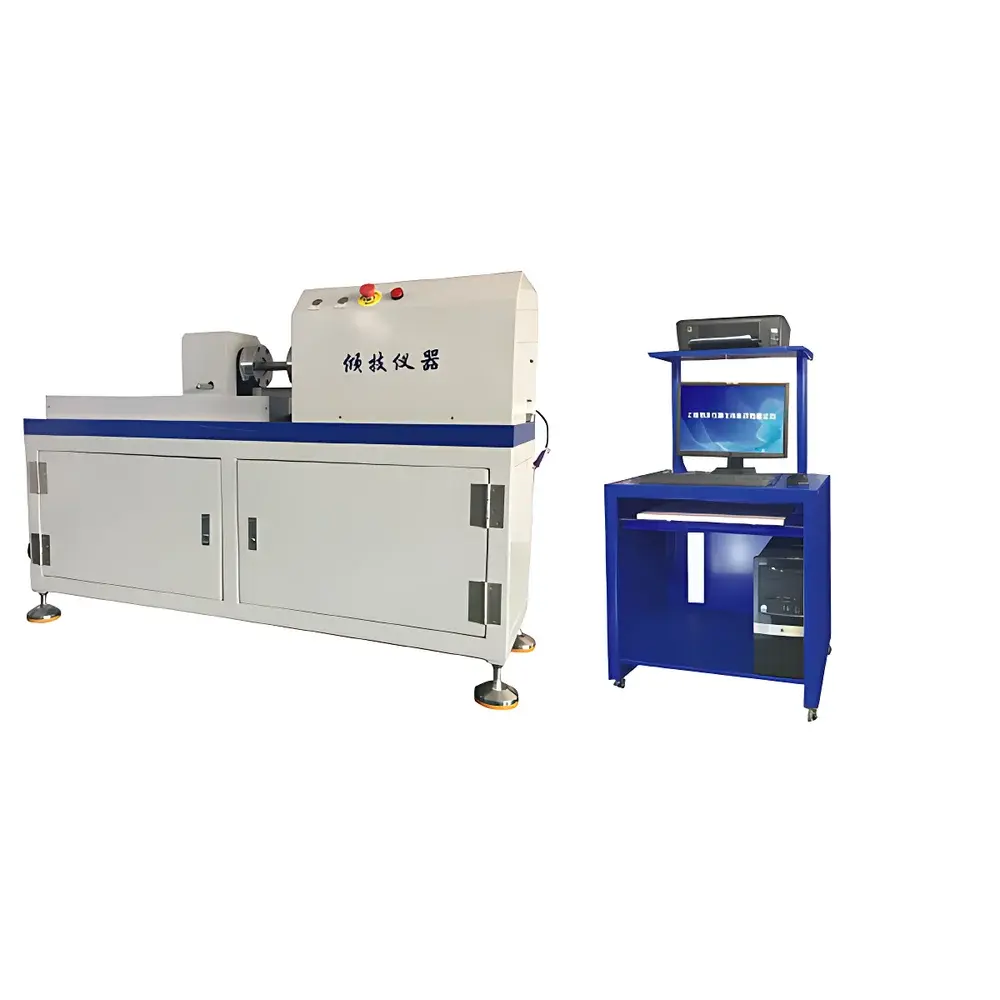
Qingji QT-10kN·m Advanced Torsion Testing Machine for Non-Metallic Materials
| Brand | Qingji |
|---|---|
| Origin | Shanghai, China |
| Model | QT-10kN·m |
| Max Torque Capacity | 0–10,000 N·m |
| Torque Measurement Accuracy | ±0.5% FS |
| Torque Resolution | 1/350,000 (full-scale, no range switching) |
| Angular Displacement Range | 0 to ±100,000° |
| Angular Resolution | ±0.001° |
| Angular Accuracy | ±0.009° |
| Twist Speed Range | 0.01–1000 °/min (infinitely variable) |
| Speed Accuracy | ±0.2% of indicated value |
| Gauge Length | 1500 mm |
| Specimen Clamping Diameter | Φ8–Φ40 mm (expandable) |
| Overall Dimensions (L×W×H) | 2800 × 4700 × 1250 mm |
| Weight | 1500 kg |
| Compliance | GB/T 9370–1999, JJG 269–1981, GB/T 239–1999 |
Overview
The Qingji QT-10kN·m Advanced Torsion Testing Machine is an electromechanical testing system engineered for high-fidelity static and quasi-static torsional characterization of non-metallic materials—including thermoplastics, composites, elastomers, fiber-reinforced polymers, and advanced ceramics—as well as structural components such as drive shafts, fasteners, couplings, and biomedical implants. It operates on the principle of controlled angular displacement or torque-controlled loading, enabling precise determination of torsional yield strength, ultimate torsional strength, shear modulus (G), non-proportional torque (Tp), and torsional stiffness under ISO 7500-1 and ASTM E143-compliant test protocols. The machine integrates a high-rigidity dual-column frame with servo-controlled precision angular actuation, ensuring minimal parasitic bending and axial deviation during test execution—critical for valid shear property derivation in low-modulus, anisotropic, or viscoelastic specimens.
Key Features
- Full-scale torque capacity up to 10,000 N·m with resolution of 1/350,000—maintained continuously across the entire range without manual range switching or hardware reconfiguration.
- High-resolution angular measurement system with ±0.001° resolution and ±0.009° absolute accuracy over ±100,000° total rotation, validated per JJG 269–1981 metrological traceability requirements.
- Infinitely variable twist speed control from 0.01 to 1000 °/min, with speed stability maintained within ±0.2% of setpoint—enabling compliance with strain-rate-sensitive test standards including ISO 527-2 (plastics) and ASTM D3518 (composite laminates).
- Dual-mode operation: torque-controlled (closed-loop) and angle-controlled (position-controlled) testing, supporting both monotonic and cyclic torsion protocols (e.g., fatigue pre-conditioning prior to static failure testing).
- Modular fixture interface accommodating cylindrical specimens from Φ8 mm to Φ40 mm (with optional extensions for larger diameters), coupled with 1500 mm adjustable gauge length to meet specimen geometry requirements per GB/T 239–1999.
- Integrated micro-angle measurement capability for high-precision elastic region analysis—enabling reliable calculation of shear modulus G and proportional limit torque via linear regression of initial torque–angle response.
Sample Compatibility & Compliance
The QT-10kN·m is validated for use with non-metallic engineering materials exhibiting wide-ranging torsional behaviors—from brittle fracture in carbon-fiber epoxy laminates to large-strain yielding in polyurethane elastomers. Its mechanical architecture minimizes moment arm errors and rotational inertia effects, ensuring data integrity for low-stiffness specimens where conventional torsion testers often introduce significant measurement uncertainty. The system conforms to national and international standards governing torsion testing methodology and instrument verification: GB/T 9370–1999 (torsion testing machines—verification), JJG 269–1981 (metrological verification of torsion testing instruments), and GB/T 239–1999 (torsion testing methods for metallic and non-metallic materials). Calibration certificates are provided with NIST-traceable reference torque transducers and angular encoders.
Software & Data Management
The embedded virtual instrumentation software platform supports real-time closed-loop control, synchronized multi-channel data acquisition (torque, angle, time, temperature if interfaced), and automated report generation compliant with GLP and internal QA documentation requirements. Raw test data is stored in ASCII-delimited format for third-party statistical analysis (e.g., Weibull modulus evaluation) and includes full audit trail metadata: operator ID, calibration timestamp, environmental conditions (optional sensor input), and firmware version. Software features include programmable test sequences, automatic yield point detection using ASTM E1820-based tangent offset methods, and export-ready templates aligned with ISO/IEC 17025 reporting guidelines. No proprietary binary formats are used—ensuring long-term data accessibility and interoperability with LIMS environments.
Applications
- Shear modulus (G) and torsional yield strength determination in polymer matrix composites per ASTM D3410/D3410M.
- Quality assurance of extruded plastic rods, pultruded profiles, and rubber bushings in automotive and aerospace supply chains.
- Validation of torsional fatigue life in biomedical polymer implants (e.g., spinal fusion cages, orthopedic screws) under simulated physiological loading.
- R&D-level characterization of novel bio-based thermoplastics, recycled polymer blends, and nanocomposites for mechanical design validation.
- Calibration and verification of torque sensors and transducers in metrology laboratories accredited to ISO/IEC 17025.
FAQ
Does the QT-10kN·m support cyclic torsion testing?
Yes—the system supports programmable sinusoidal, triangular, and trapezoidal waveforms with user-defined frequency, amplitude, and mean torque offset, enabling S–N curve development and hysteresis loop analysis.
Is the software compatible with FDA 21 CFR Part 11 requirements?
While the base software does not include electronic signature modules or role-based access control out-of-the-box, it supports integration with validated third-party e-signature and audit trail add-ons for regulated environments.
Can the machine be calibrated in-house using certified reference standards?
Yes—calibration procedures and traceable reference torque artifacts (up to 10,000 N·m) are supplied with documented uncertainty budgets; annual recalibration is recommended per ISO/IEC 17025 clause 6.4.10.
What maintenance intervals are recommended for long-term reliability?
Lubrication of lead screws and bearing assemblies every 500 operational hours; torque transducer zero-check and angular encoder verification every 3 months; full mechanical and metrological recalibration annually or after impact events.



