
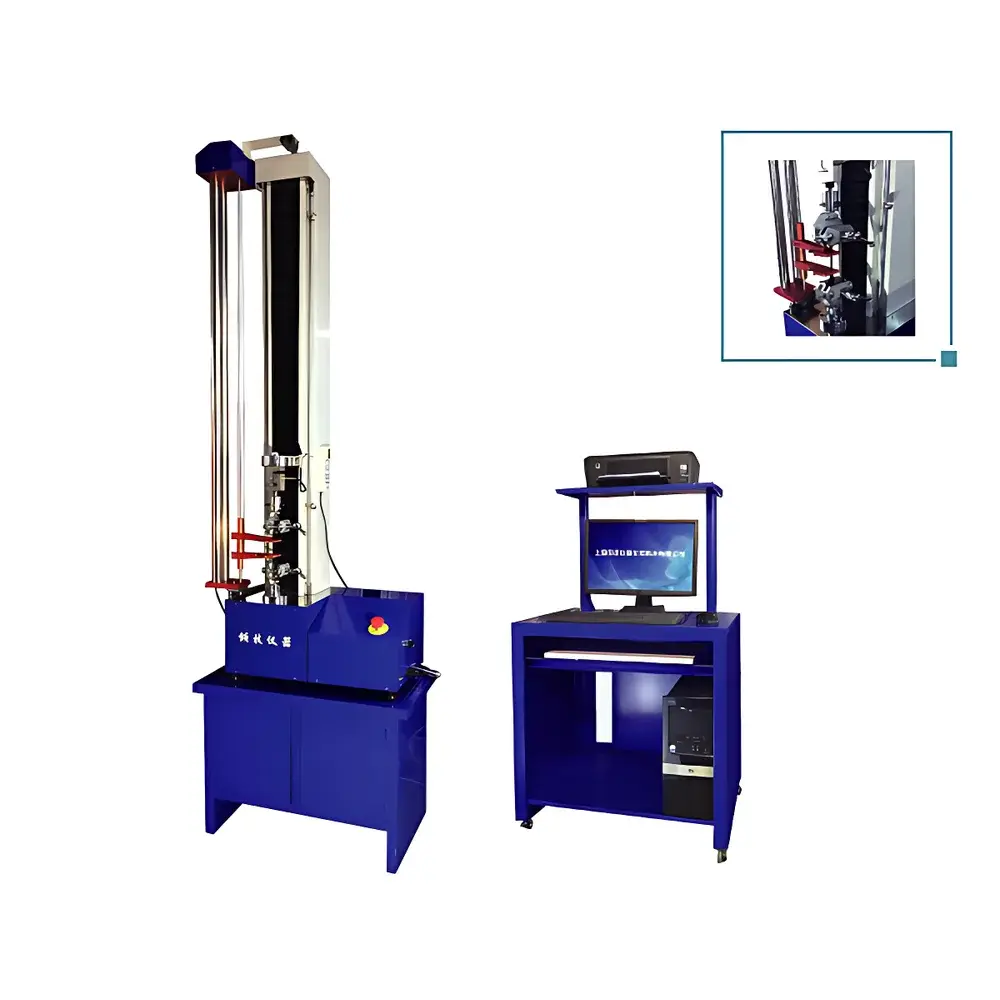
Qinji QJ210A Electronic Tensile Testing Machine
| Brand | Qinji |
|---|---|
| Origin | Shanghai, China |
| Model | QJ210A |
| Maximum Test Load | 5 kN |
| Force Accuracy | ±0.5% or ±1% |
| Test Stroke | 150 mm |
| Displacement Resolution | ±0.5% of reading |
| Load Cell | High-precision U.S.-sourced sensor |
| Control System | Panasonic full-digital AC servo controller |
| Speed Range | 0.01–500 mm/min |
| Speed Accuracy | ±0.5% of set value |
| Effective Test Width | 150 mm |
| Effective Tensile Travel | 800 mm |
| Load Range | 5 N to 5 kN (multi-range, auto-switching) |
| Force Resolution | 500,000 counts, no internal range switching |
| Units | gf, kgf, N, kN, lb |
| Compliance | ASTM D638, ISO 527, GB/T 1040, JIS K7113, DIN 53455, YY/T 0149, QB/T 2471 |
| Power Supply | 200 V, 400 W |
| Dimensions (L×W×H) | 590 × 355 × 1640 mm |
| Weight | ~85 kg |
Overview
The Qinji QJ210A Electronic Tensile Testing Machine is a precision-engineered universal testing system designed for static mechanical characterization of polymeric materials, including thermoplastics, thermosets, elastomers, films, fibers, and composite laminates. Operating on the principle of controlled uniaxial force application under displacement- or load-controlled conditions, the instrument conforms to standardized tensile, compression, flexural, shear, puncture, and peel test protocols. Its modular architecture supports rapid fixture interchangeability—enabling consistent execution of ASTM D638 (tensile properties of plastics), ISO 527 (determination of tensile properties), GB/T 1040 (Chinese national standard for plastic tensile testing), and other internationally recognized methods. The machine integrates a high-stiffness dual-column frame, precision-ground lead screws, and a rigid crosshead assembly to minimize deflection and ensure axial alignment—critical for maintaining measurement fidelity across low-force (5 N) and high-force (5 kN) regimes.
Key Features
- Full-digital closed-loop control via Panasonic AC servo drive system, delivering stable speed regulation from 0.01 to 500 mm/min with ≤±0.5% speed accuracy.
- High-resolution load measurement using a U.S.-sourced precision load cell, offering 500,000-count resolution across the entire 5 N–5 kN range without manual range switching.
- Real-time dynamic display of force, displacement, and stress–strain curves on an integrated LCD interface; simultaneous data streaming to PC via USB or RS232.
- Dual-mode return function: manual jog control for precise positioning and programmable automatic return post-test.
- Comprehensive safety architecture including electronic limit switches, software-based overload protection (triggers at 110% of full scale), and real-time diagnostic monitoring.
- Ergonomic design with extruded aluminum enclosure panels and industrial-grade powder coating for durability and laboratory compatibility.
- Modular fixture interface supporting custom-designed grips for film clamping, rod tensile, compression platens, puncture probes, and peel fixtures per specimen geometry and standard requirements.
Sample Compatibility & Compliance
The QJ210A accommodates specimens ranging from thin polymer films (≥10 µm thickness) to rigid plastic bars (up to 150 mm wide × 800 mm gauge length). It meets essential metrological and procedural requirements for GLP-compliant laboratories, including traceable calibration paths aligned with ISO/IEC 17025. Test method execution adheres to key regulatory frameworks: ASTM D638 (Type I–V specimens), ISO 527-2 (plastics—tensile properties), GB/T 1040.2 (Chinese equivalent), JIS K7113 (Japanese tensile standard), YY/T 0149 (medical device plastics), and QB/T 2471 (packaging films). All force and displacement outputs are traceable to national standards through factory-certified calibration certificates (NIST-traceable where applicable). The system supports audit-ready data logging with time-stamped event markers and user-accessible raw ASCII output for third-party statistical analysis.
Software & Data Management
The embedded control software provides intuitive test setup, real-time curve overlay, and automated report generation compliant with ISO 14644-1, ASTM E29, and FDA 21 CFR Part 11 (when paired with optional electronic signature module). Data files include force–displacement, stress–strain, modulus calculation (secant, tangent, chord), yield point detection (0.2% offset), and elongation-at-break metrics—all exportable in CSV, PDF, or XML formats. Optional PC software enables multi-user permission levels, audit trail activation, electronic signatures, and integration with LIMS platforms via ODBC or RESTful API. Calibration parameters are password-protected and digitally signed to prevent unauthorized modification.
Applications
- Quality control of injection-molded ABS, PP, PC, and PET components in automotive and consumer electronics supply chains.
- R&D evaluation of biodegradable polymers (e.g., PLA, PHA) under varying humidity and temperature preconditioning.
- Mechanical validation of medical-grade polyurethane tubing per ISO 10993-1 biological evaluation guidelines.
- Tensile strength and elongation mapping of multilayer packaging films used in food and pharmaceutical blister packaging.
- Compression testing of foam cores and structural sandwich composites per ASTM D1621.
- Puncture resistance assessment of protective gloves and surgical drapes per ASTM F1342.
FAQ
What standards does the QJ210A support out-of-the-box?
It natively supports ASTM D638, ISO 527, GB/T 1040, JIS K7113, DIN 53455, YY/T 0149, and QB/T 2471. Custom test templates can be configured for additional standards upon request.
Is the system compliant with FDA 21 CFR Part 11 requirements?
Yes—when equipped with the optional audit-trail and electronic signature package, the software meets Part 11 criteria for electronic records and signatures in regulated environments.
Can the machine perform cyclic or fatigue testing?
No—the QJ210A is optimized for static monotonic testing only. For dynamic or fatigue applications, consider the Qinji QJ212 series with electrodynamic actuation.
How is force calibration verified?
Calibration is performed using certified deadweight standards traceable to NIM (National Institute of Metrology, China) or NIST. A full calibration certificate with uncertainty budget is provided with each unit.
What maintenance is required during the first year of operation?
Routine maintenance includes monthly lubrication of lead screws, quarterly verification of load cell zero drift, and annual full-system recalibration—covered under the standard one-year warranty and lifetime technical support agreement.



