
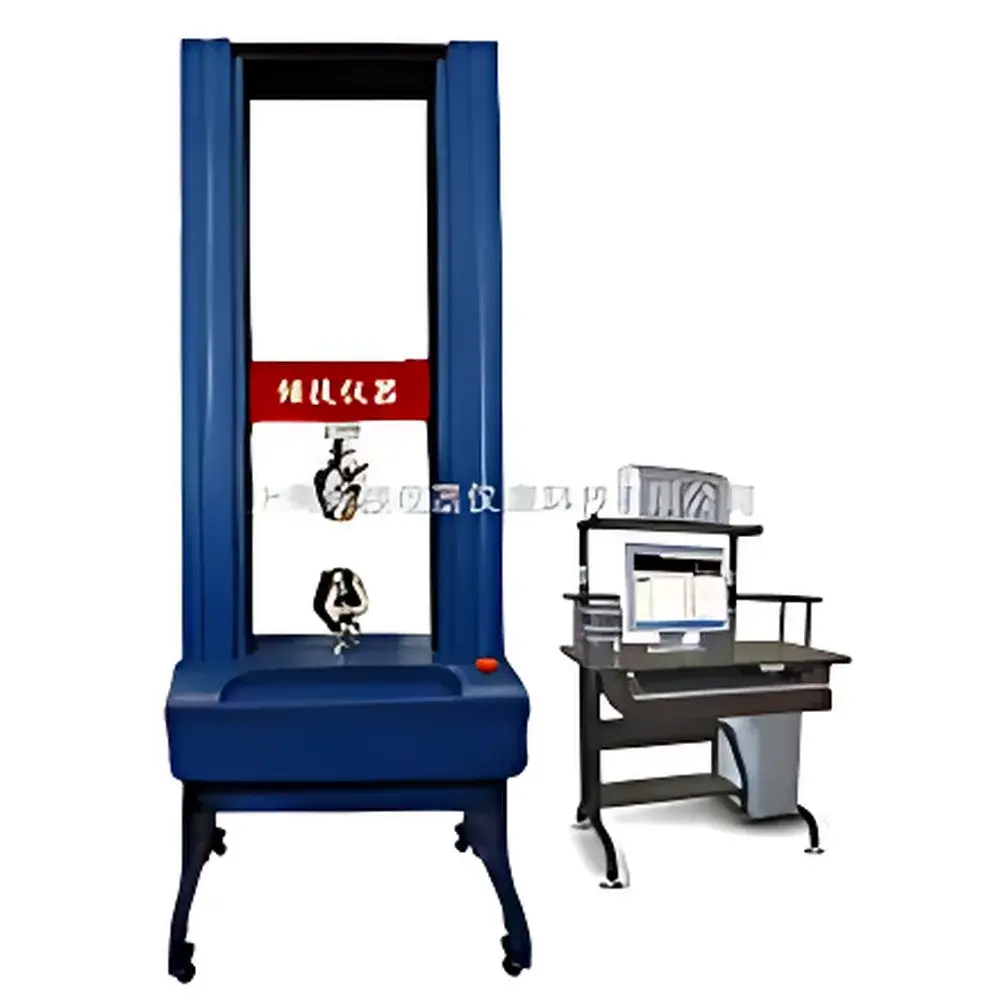
QJ211S Four-Point Static Pressure Testing Machine by Qingji
| Brand | Qingji |
|---|---|
| Model | QJ211S |
| Max Load Capacity | 10 kN |
| Accuracy Class | 0.5 |
| Effective Test Width | 320 mm |
| Stroke (Tensile Space) | 500 / 800 mm |
| Speed Range | 0.01–300 mm/min |
| Speed Accuracy | ±0.5% of indicated value |
| Force Resolution | 500,000 counts (full-scale, no range switching) |
| Force Measurement Range | 0.02–100% of full scale |
| Displacement & Strain Accuracy | ±0.5% of indicated value |
| Load Cell | High-precision sensor (USA-made) |
| Controller | Panasonic全数字交流伺服控制系统 |
| Control Mode | Full-digital closed-loop control (constant stress/strain/displacement) |
| Safety Protection | Software diagnosis, electronic limit switches, overload protection at 110% FS |
| Weight | ~145 kg |
| Power | 2–5 kW |
Overview
The QJ211S Four-Point Static Pressure Testing Machine is a precision-engineered universal testing system designed specifically for evaluating the flexural strength and fracture resistance of brittle and semi-brittle planar materials under controlled four-point bending conditions. Unlike three-point bending, the four-point configuration generates a uniform moment region between the two inner loading points—eliminating shear-force interference and enabling accurate determination of flexural modulus and bending strength per ASTM C1161, ISO 178, GB/T 9341, and JIS K7203. The machine employs a dual-actuator loading architecture with high-rigidity crosshead guidance, ensuring minimal deflection and optimal load train alignment during static indentation tests on glass substrates—including smartphone cover glass (e.g., Gorilla Glass), display panels, tempered architectural glazing, optical lenses, PMMA sheets, and specialty ceramics. Its modular frame accommodates interchangeable fixture sets, allowing seamless transition between standardized four-point static pressure, three-point bend, tensile, compression, shear, and puncture test modes without mechanical recalibration.
Key Features
- High-accuracy force measurement system compliant with ISO 7500-1 Class 0.5, featuring a USA-sourced precision load cell with 500,000-count resolution and no internal range switching—maintaining consistent sensitivity across the entire 0.02–100% FS span.
- Full-digital closed-loop servo control (Panasonic AC servo drive + digital controller) enabling precise execution of constant-rate, constant-stress, or constant-strain protocols with real-time feedback compensation.
- Adjustable crosshead travel (500 mm standard / 800 mm optional) and wide effective test width (320 mm), optimized for large-format display panels and architectural glass specimens up to 300 × 300 mm.
- Dual-speed motorized crosshead actuation (fast positioning + fine-load ramping), integrated with software-based electronic limit detection and automatic return-to-start functionality post-test.
- Overload protection triggered at 110% of full-scale capacity (10 kN), coupled with real-time diagnostic monitoring of actuator status, thermal load, and encoder integrity.
- Modular fixture interface supporting ISO/GB-compliant four-point bend tooling (support span: 50–100 mm; loading span: 20–50 mm), plus customizable grips for tensile bars, compression platens, and puncture probes.
Sample Compatibility & Compliance
The QJ211S is validated for use with flat, rigid, isotropic sheet materials ranging from 0.3 mm to 25 mm in thickness and up to 300 mm in lateral dimension. Typical applications include chemically strengthened aluminosilicate glass (Corning Gorilla Glass, Dragontrail), soda-lime float glass, borosilicate optical glass, polycarbonate and acrylic laminates, sapphire wafers, and ceramic substrates used in electronics packaging. All mechanical test routines conform to international regulatory and quality assurance frameworks—including ASTM E337 (static load testing of glass), ISO 14125 (fiber-reinforced composites), GB/T 1040.2 (plastics tensile), GB/T 1449 (flexural properties), and JG/T 476 (architectural glass safety standards). System-level traceability supports GLP/GMP documentation requirements via audit-trail-enabled software logging.
Software & Data Management
The QJ211S operates under a Windows-based proprietary test platform that delivers real-time graphical visualization of force–displacement, stress–strain, and time-series curves. Data acquisition occurs at ≥1 kHz sampling rate, with timestamped metadata (operator ID, environmental temperature/humidity if external sensors are connected), and full compliance with FDA 21 CFR Part 11 for electronic records and signatures when configured with user authentication and audit trail modules. Test reports are exportable in PDF, Excel, and XML formats—with customizable templates aligned to ISO/IEC 17025 reporting guidelines. Curve manipulation functions include overlay comparison, differential analysis, tangent modulus calculation, yield point detection (0.2% offset method), and automatic peak-hold identification. Raw data files are stored in binary format with checksum verification to ensure long-term integrity.
Applications
- Four-point static pressure testing of cover glass for mobile devices and automotive displays per ISO 178 and GB/T 9341.
- Evaluation of flexural strength and elastic modulus in tempered and laminated architectural glass assemblies (EN 1288-3, JGJ 102).
- Mechanical qualification of optical lens substrates subjected to mounting-induced bending stresses.
- Quality control of polymer-based touch panel overlays and OLED encapsulation layers under quasi-static indentation loads.
- Research-grade characterization of fracture initiation thresholds in thin-film coated glass systems using controlled displacement ramping.
- Validation of adhesive bondline integrity in glass-to-metal or glass-to-plastic hybrid assemblies via interfacial shear testing.
FAQ
What standards does the QJ211S support for four-point bending tests?
ASTM C1161, ISO 178, GB/T 9341, JIS K7203, EN 1288-3, and DIN 53455—covering both material property extraction and structural safety assessment.
Can the system perform automated pass/fail evaluation based on preset criteria?
Yes—the software allows definition of acceptance thresholds (e.g., maximum allowable deflection at 50 N, minimum fracture load ≥ 800 N), with automatic flagging and report annotation upon deviation.
Is third-party calibration certification available?
Calibration certificates traceable to NIM (National Institute of Metrology, China) or UKAS-accredited labs can be provided upon request, including as-found/as-left data and uncertainty budgets.
Does the machine support integration with LIMS or MES platforms?
Via OPC UA or TCP/IP API interface (optional add-on module), enabling bidirectional data exchange with laboratory information management systems and enterprise manufacturing execution systems.
What maintenance intervals are recommended for long-term accuracy retention?
Biannual verification of force transducer linearity and crosshead alignment is advised; annual full-system recalibration is recommended for GLP/GMP environments.



