
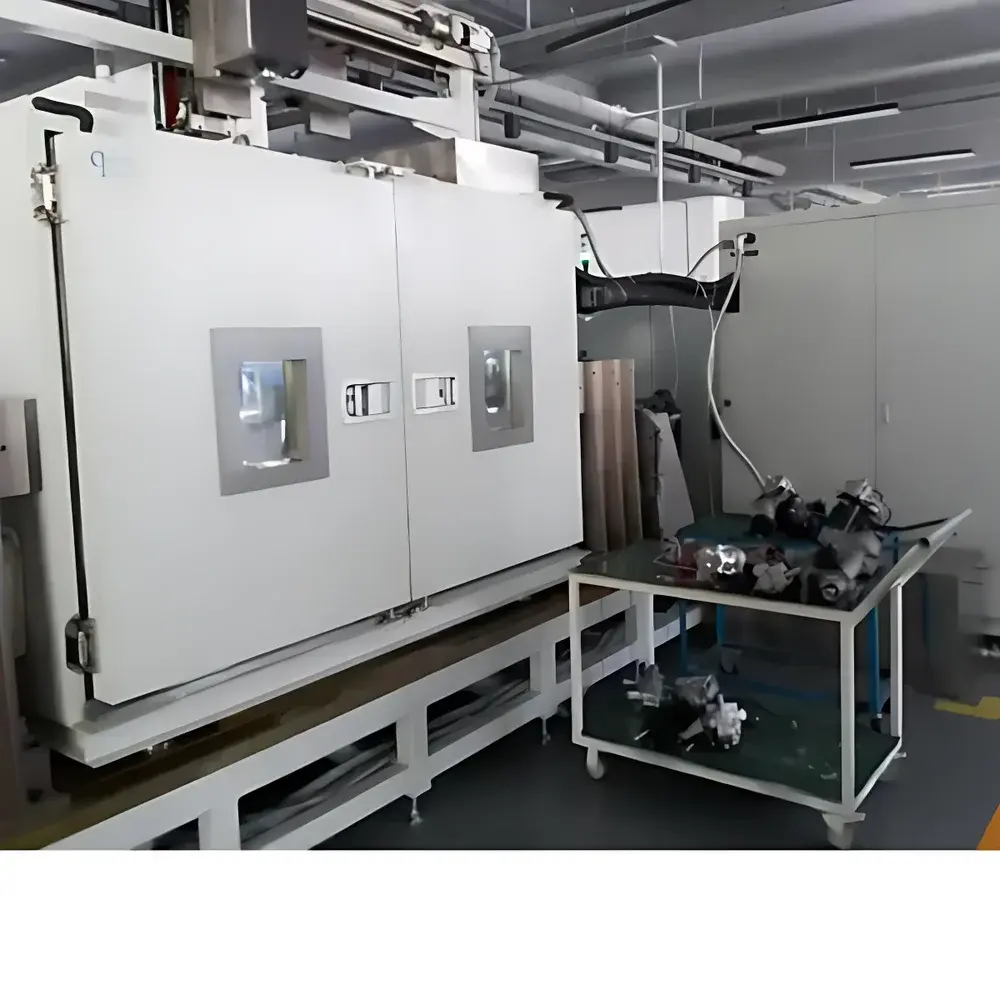
Qinji QJCK395A Ice-Water Immersion & Environmental Stress Test Chamber
| Brand | Qinji |
|---|---|
| Origin | Shanghai, China |
| Model | QJCK395A |
| Type | Integrated Ice-Water Immersion / Temperature-Humidity Cycling Chamber |
| Compliance | GB/T 28046.4–2011, VW 80000:2009-10 |
| Application Scope | Automotive components, aerospace hardware, consumer electronics, and industrial electrical enclosures |
Overview
The Qinji QJCK395A Ice-Water Immersion & Environmental Stress Test Chamber is an integrated reliability testing platform engineered to replicate combined thermal, humidity, and dynamic liquid exposure stresses in a single test volume. It operates on the principle of controlled environmental cycling—simultaneously subjecting specimens to programmable temperature-humidity profiles (−40 °C to +150 °C; 10–98% RH) while enabling timed, pressurized ice-water immersion or simulated splash events. Unlike standalone thermal chambers or water ingress testers, the QJCK395A eliminates sequential test setups by synchronizing thermal preconditioning, cold soak, and rapid water impact within one calibrated enclosure. This architecture supports accelerated life-cycle validation per automotive and aerospace environmental qualification protocols, where sequential exposure to low-temperature storage followed by sudden water contact mimics real-world conditions such as winter road splash onto under-hood electronics or cargo bay exposure during maritime transport.
Key Features
- Single-chamber dual-function design: Combines full-spectrum climatic conditioning (temperature/humidity) with programmable ice-water immersion, spray, and drip simulation
- Integrated stainless-steel immersion basin with chilled water circulation system capable of maintaining ≤0 °C water temperature during exposure cycles
- Adjustable water delivery: Supports static immersion, pulsed jet (up to 300 kPa), and oscillating spray modes with precise timing resolution (±0.1 s)
- Uniform chamber temperature distribution: ±1.5 °C tolerance across working volume per IEC 60068-3-5; humidity control accuracy ±3% RH (20–80% RH range)
- Robust construction: Double-wall insulated chamber with corrosion-resistant interior cladding and IP54-rated electrical compartment
- Compliance-ready control architecture: Supports audit trails, user-level access control, and calibration lockout per GLP/GMP requirements
Sample Compatibility & Compliance
The QJCK395A accommodates test specimens up to 600 mm × 600 mm × 600 mm (W×D×H) with maximum weight load of 50 kg. It is routinely deployed for validating sealing integrity, material dimensional stability, and functional performance of automotive ECUs, battery enclosures, lighting assemblies, avionics housings, and household appliance control modules. The system meets the mechanical and procedural requirements of GB/T 28046.4–2011 (Road vehicles — Environmental conditions and testing for electrical and electronic equipment — Part 4: Climatic loads), VW 80000:2009-10 (Environmental testing of components), and ISO 16750-4 (Road vehicles — Environmental conditions and testing for electrical and electronic equipment — Part 4: Climatic loads). While not certified to IEC 60529 for IP rating verification, its operational envelope aligns with test methods referenced in IPX5/IPX6/IPX9K prequalification workflows.
Software & Data Management
The chamber is operated via a Windows-based control interface with deterministic real-time scheduling engine. Test profiles are defined using hierarchical step logic—including ramp rates, dwell durations, water activation triggers, and safety interlocks. All system variables (chamber temperature, humidity, water temperature, pressure, valve status, door position) are logged at user-configurable intervals (minimum 1 Hz) and stored in encrypted CSV/SQLite format. Audit trail functionality records operator ID, parameter changes, manual overrides, and alarm events with timestamp and digital signature—fully traceable for FDA 21 CFR Part 11 and ISO/IEC 17025 compliance. Remote monitoring is supported via Modbus TCP and optional OPC UA gateway for integration into enterprise MES or LIMS platforms.
Applications
- Automotive: Validation of connector seals, sensor housings, and ADAS module enclosures against thermal shock-induced cracking followed by ice-water intrusion
- Aerospace: Testing of non-pressurized avionics bays exposed to ground de-icing fluid and sub-zero ambient transitions
- Consumer Electronics: Assessing moisture resistance of smart home controllers after cold storage and simulated outdoor rainfall exposure
- Industrial Equipment: Qualifying NEMA 4X-rated motor drives subjected to cyclic condensation and washdown scenarios
- Research & Development: Correlating polymer creep behavior under hygrothermal stress with post-immersion dielectric loss measurements
FAQ
Does the QJCK395A support automated IPX9K testing per ISO 20653?
It implements the nozzle geometry, water temperature (80 ±5 °C), and pressure (8–10 MPa) parameters required for IPX9K, but final certification requires third-party verification per IEC 60529 Annex B.
Can the chamber maintain −40 °C while actively spraying ice water?
Yes—the refrigeration system and immersion basin operate independently; simultaneous sub-zero chamber air temperature and ≤0 °C water delivery is fully supported.
Is calibration documentation provided with shipment?
Each unit ships with NIST-traceable calibration certificates for temperature, humidity, and pressure sensors, valid for 12 months from date of manufacture.
What is the minimum immersion duration controllable via software?
Programmable immersion onset and termination are resolved to 0.1-second increments, with no lower bound other than mechanical valve response time (~0.3 s).
Are custom test profiles exportable between instruments?
Yes—profile files (.qjp) are portable across QJCK-series chambers and retain all step logic, safety limits, and data logging configurations.



