
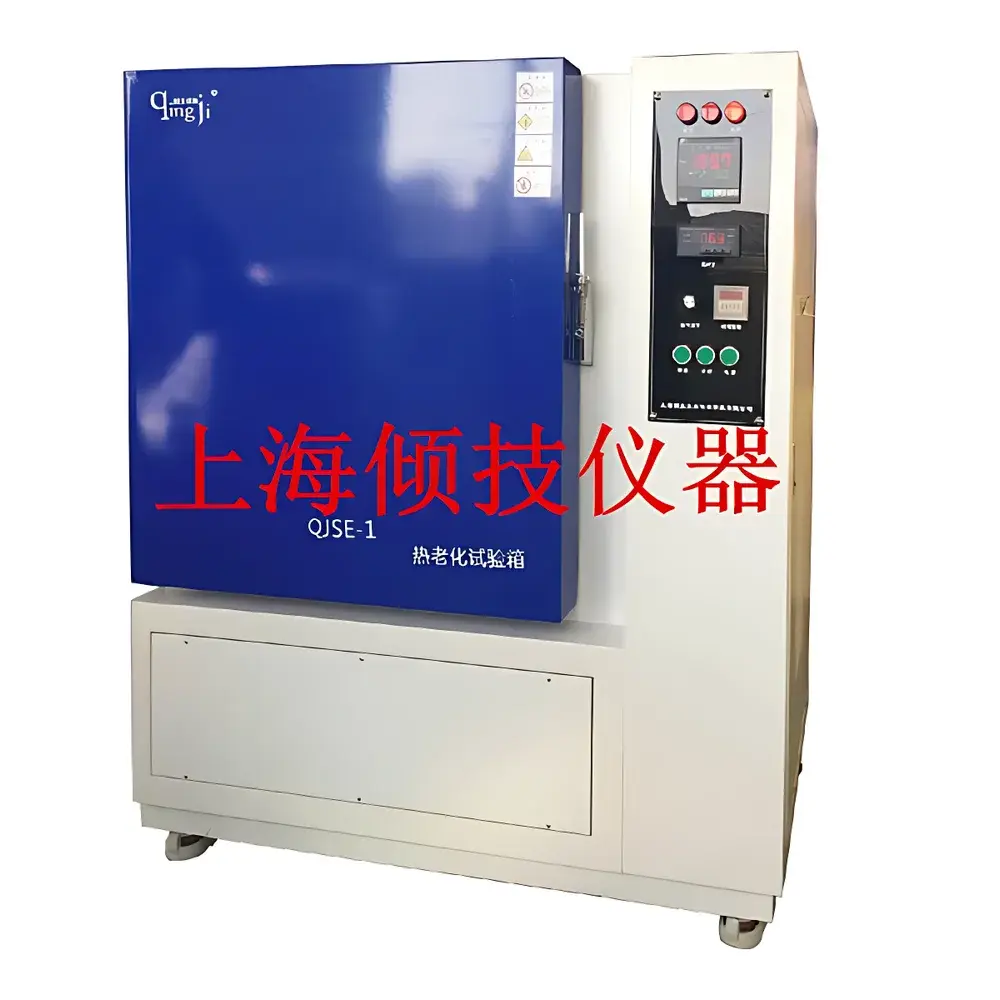
Qinji QJSE-1 Thermal Aging Test Chamber
| Brand | Qinji |
|---|---|
| Origin | Shanghai, China |
| Manufacturer Type | Authorized Distributor |
| Country of Origin | China |
| Model | QJSE-1 |
| Price | USD 8,600 (FOB Shanghai) |
| Temperature Range | RT+20 °C to 300 °C |
| Temperature Uniformity | ≤ ±2 °C |
| Temperature Fluctuation | ≤ ±0.5 °C |
| Heating Rate | ≤60 min from RT+20 °C to 200 °C |
| Total Power Consumption | 6.7 kW (Heating: 6 kW |
| Auxiliary Systems | 0.7 kW) |
| Sound Pressure Level | ≤65 dB(A) |
| Compliance | IEC 60540 (formerly IEC 540), ASTM D573, ISO 188, GB/T 3512 |
Overview
The Qinji QJSE-1 Thermal Aging Test Chamber is an engineered environmental simulation system designed for accelerated thermal aging evaluation of elastomeric and thermoplastic materials—particularly rubber compounds, polymer-insulated cables, wire sheathing, and electrical insulation components. It operates on the principle of controlled isothermal exposure, maintaining precise, stable temperature profiles over extended durations to replicate long-term thermal degradation mechanisms under standardized laboratory conditions. The chamber employs a dual-airflow circulation architecture with tangential fan distribution and optimized baffle design to ensure uniform thermal field distribution across the working volume, minimizing axial and radial gradients. Its core function supports predictive service life modeling, material formulation validation, and compliance-driven qualification per international electrotechnical and polymer standards.
Key Features
- Microprocessor-based digital temperature controller with imported PID algorithm and real-time deviation compensation, enabling stable setpoint maintenance within ±0.5 °C fluctuation.
- Dual independent air circulation channels with adjustable directional vanes and pre-heated recirculation ducts—enhancing thermal homogeneity (≤±2 °C deviation across test zone) and reducing overshoot during ramp phases.
- Redundant safety architecture: dual-limit mechanical thermostat + solid-state electronic overtemperature cut-off, coupled with visual/audible alarm activation at 5 °C above setpoint.
- Insulated double-wall construction with high-density mineral wool (≥100 mm thickness) and seamless stainless-steel inner chamber (SUS304, passivated finish) for corrosion resistance and thermal inertia control.
- Front-access observation window with double-layer heat-resistant glass and integrated anti-fog heating film for uninterrupted visual monitoring without thermal leakage.
- Modular heater array with distributed ceramic-sheathed tubular elements and automatic load balancing—ensuring consistent power delivery and extended element service life.
Sample Compatibility & Compliance
The QJSE-1 accommodates standard test specimens per IEC 60540 Clause 8.2 (flat strips, dumbbell tensile pieces, and insulated wire segments up to 300 mm length), ASTM D573 Type A/B fixtures, and ISO 188 Method A hanging racks. Chamber dimensions support multi-tier sample staging with adjustable stainless-steel shelves (load capacity: 15 kg per shelf). All operational protocols align with GLP documentation requirements: temperature logging intervals configurable from 1–60 minutes, with optional external RS485/Modbus RTU interface for integration into centralized LIMS or SCADA systems. Validated compliance includes IEC 60540 (ed. 3.0, 2021), ASTM D573-22, ISO 188:2019, and GB/T 3512–2014. Full traceability is supported via optional audit-trail-enabled data logger compliant with FDA 21 CFR Part 11 Annex 11 principles.
Software & Data Management
While the base unit operates via standalone front-panel control, optional PC-based software (Qinji TempLog Pro v3.2) provides extended functionality: automated test sequence programming (ramp-hold-cool cycles), real-time graphing of chamber vs. reference sensor data, CSV export with ISO 8601 timestamps, and PDF report generation with embedded calibration certificate metadata. All logged datasets include operator ID, test ID, ambient conditions (via optional external hygrothermograph input), and event-tagged alarms. Data integrity safeguards include write-protected storage, SHA-256 hash verification of archived files, and user-level access control (admin/operator/viewer roles).
Applications
- Evaluation of oxidative degradation kinetics in vulcanized rubber formulations under elevated temperature stress.
- Service life extrapolation of cross-linked polyethylene (XLPE) and ethylene propylene rubber (EPR) cable insulation per IEEE 98 and IEC 60811-503.
- Comparative aging studies of thermoplastic elastomers (TPEs) and halogen-free flame-retardant (HFFR) compounds.
- Pre-qualification screening of adhesives, encapsulants, and potting resins used in automotive electronics modules.
- Supporting ISO/TS 16949 and IATF 16949 process validation requirements for Tier-1 automotive suppliers.
FAQ
What standards does the QJSE-1 explicitly support for cable insulation testing?
IEC 60540 (all editions), ASTM D573, and ISO 188 are fully implemented in its thermal uniformity profile, ramp rate certification, and specimen fixture compatibility.
Is third-party temperature mapping validation available?
Yes—Qinji provides optional IQ/OQ documentation packages with 9-point thermal mapping reports (per ISO 17025-accredited partner labs) and uncertainty budgets traceable to NIM (China National Institute of Metrology).
Can the chamber be integrated into an existing MES or LIMS environment?
Via RS485 Modbus RTU or optional Ethernet/IP gateway module, enabling real-time setpoint synchronization, alarm forwarding, and raw temperature stream ingestion.
What is the recommended recalibration interval for routine GLP use?
Annual calibration against NIST-traceable reference thermometers is advised; internal sensor verification checks should be performed before each critical test series using Class A PRT probes.
Does the warranty cover replacement of heating elements due to normal aging?
Yes—the 12-month comprehensive warranty includes labor and parts for heater assembly failure under documented proper operating conditions; consumables (e.g., door gaskets) are excluded but available under extended service contracts.



