
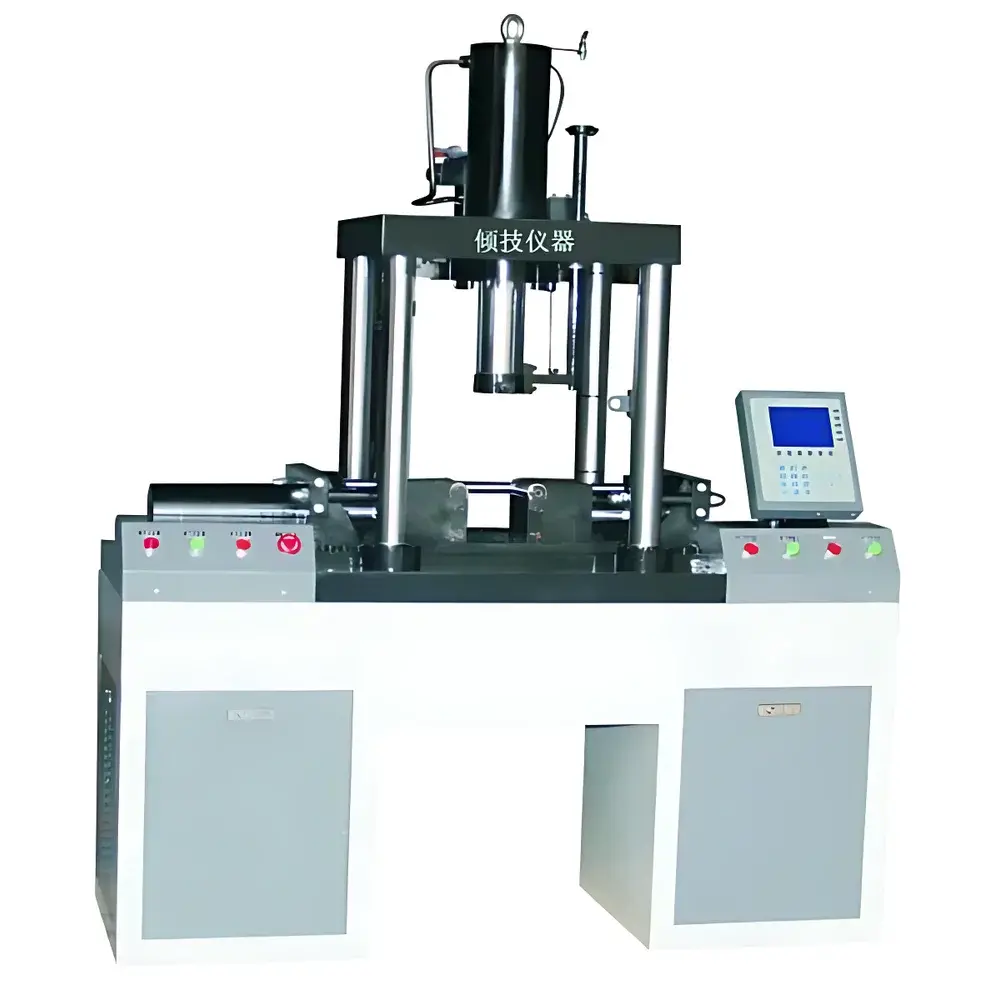
QJWQ-2A Dual-Station Steel Plate Bending Testing Machine
| Brand | Qingji |
|---|---|
| Origin | Shanghai, China |
| Model | QJWQ-2A |
| Max Bending Thickness | 40 mm |
| Bending Angle Range | 0–180° |
| Dual-Station Clamping Force | 160 kN × 2 |
| Max Bending Load Capacity | 380 kN (triplex hydraulic system) |
| Main Piston Stroke | 270 mm |
| Individual Station Piston Stroke | 200 mm |
| Piston Advancing Speed | 80 mm/min |
| Piston Retracting Speed | 160 mm/min |
| Motor Power | 2.2 kW |
| Operating Voltage | 380 V / 220 V |
| Net Weight | 2200 kg |
| Overall Dimensions | 1500 × 650 × 1750 mm |
Overview
The QJWQ-2A Dual-Station Steel Plate Bending Testing Machine is a precision-engineered mechanical testing system designed for standardized static bending evaluation of metallic plates—particularly welded joints and base metal specimens—according to internationally recognized metallurgical and structural testing protocols. It operates on the principle of three-point or four-point bending under controlled displacement, utilizing dual independent hydraulic loading stations to enable parallel or sequential testing of two specimens without cross-interference. The machine complies with key national and industrial standards including GB/T 232–1999 (Metallic Materials – Bend Test), GB/T 19869.1–2005 (Clause 7.4.3 – Welding Procedure Qualification: Bend Testing), and GB/T 2653–2008 (Methods of Bend Testing of Welded Joints). Its robust frame, synchronized dual-cylinder architecture, and modular bending tooling support high-reproducibility assessment of ductility, crack initiation resistance, and weld integrity in structural steel components up to 40 mm thickness.
Key Features
- Dual-station hydraulic actuation system enables simultaneous or staggered bending tests on two specimens, improving laboratory throughput and inter-test consistency.
- Adjustable support roller and flipping-type bending dies—actuated via lateral auxiliary cylinders—allow rapid reconfiguration for varying specimen widths (up to 40 mm) and bend diameters per standard requirements.
- Triplex hydraulic circuit delivers a maximum bending force of 380 kN with precise load regulation and pressure stability across full stroke range.
- Independent piston control per station ensures decoupled force application; each station provides 160 kN clamping force and 200 mm stroke, while the main piston offers 270 mm travel for deep-draw bending configurations.
- Programmable displacement rates: advancing speed at 80 mm/min and retracting speed at 160 mm/min ensure compliance with strain-rate-sensitive test procedures defined in ISO 7438 and ASTM E190.
- Integrated safety interlocks, emergency stop circuitry, and overload protection align with IEC 60204-1 electrical safety standards for industrial machinery.
Sample Compatibility & Compliance
The QJWQ-2A accommodates flat metallic specimens conforming to standard dimensions specified in GB/T 232 and ISO 7438, including but not limited to carbon steels, low-alloy structural steels, stainless steels, and welded assemblies. Specimen width is limited to ≤40 mm, thickness to ≤40 mm, and length sufficient to span support rollers with adequate overhang. The machine supports both transverse and longitudinal bend orientations for weld qualification per AWS D1.1 and EN ISO 15614-1. All mechanical and dimensional tolerances meet GLP-compliant instrumentation criteria, and the system’s traceable calibration path supports audit readiness for ISO/IEC 17025-accredited laboratories.
Software & Data Management
While the base QJWQ-2A model features analog-digital hybrid control with manual parameter setting, optional digital control modules integrate with PC-based test management software supporting real-time load-displacement curve acquisition, automatic pass/fail classification per bend angle thresholds (e.g., 180° full bend without surface cracking), and export of CSV/Excel-compatible reports. Audit trails—including operator ID, timestamp, test parameters, and result annotations—are retained per FDA 21 CFR Part 11 principles when configured with electronic signature capability. Data archives comply with internal QA documentation retention policies and are compatible with LIMS integration via OPC UA or Modbus TCP protocols.
Applications
- Qualification and periodic requalification of welding procedures (WPQR/PQR) in fabrication shops and third-party inspection agencies.
- Ductility verification of hot-rolled and cold-formed steel plates used in shipbuilding, bridge construction, and pressure vessel manufacturing.
- Quality assurance of weld repairs in offshore platforms and power generation infrastructure.
- Educational use in materials science and mechanical engineering laboratories for hands-on demonstration of plastic deformation behavior and fracture mechanics fundamentals.
- Pre-commissioning validation of structural steel suppliers’ conformance to procurement specifications (e.g., ASTM A6/A6M, EN 10025).
FAQ
Does the QJWQ-2A support automated data logging and report generation?
Yes—when equipped with the optional digital control unit and配套 software, it captures load, displacement, and time-synchronized data streams and generates compliant test certificates with embedded metadata.
Can the machine be calibrated to national metrological standards?
Yes—load cells and displacement transducers are factory-calibrated against NIM-traceable reference standards; field recalibration services are available with certified calibration certificates.
Is technical training provided for operators and maintenance personnel?
Yes—Qingji offers on-site commissioning, operational training, and preventive maintenance workshops aligned with ISO 13374 condition monitoring guidelines.
What is the expected service life under typical industrial lab usage?
With scheduled maintenance and adherence to operating limits, the structural frame and hydraulic system are engineered for ≥15 years of service life in Class II laboratory environments per ISO 14122-1 mechanical safety design life expectations.



