
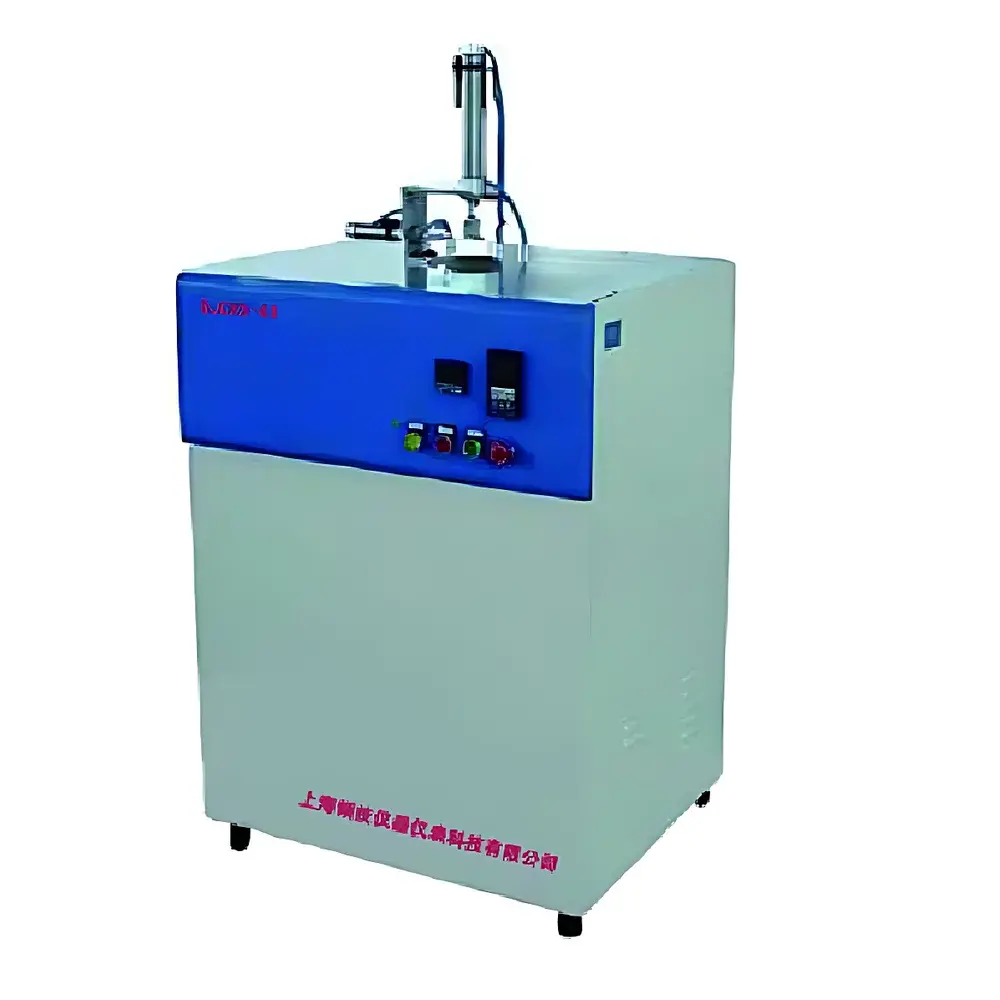
Qinji QJCXS-43 Single-Specimen Rubber Low-Temperature Brittleness Tester with Integrated Environmental Chamber
| Brand | Qinji |
|---|---|
| Origin | Shanghai, China |
| Model | QJCXS-43 |
| Test Temperature Range | −70 °C to 0 °C |
| Impact Velocity | 2 m/s ±0.2 m/s |
| Temperature Stability During Test (3 min) | ±0.5 °C |
| Impact Head to Clamp Distance | 11 mm ±0.5 mm |
| Dimensions (W×D×H) | 700 mm × 700 mm × 1300 mm |
| Power Consumption | 1100 W |
| Compliance | GB/T 1682–2014 (revised edition of GB 1682–1982) |
Overview
The Qinji QJCXS-43 Single-Specimen Rubber Low-Temperature Brittleness Tester is a precision-engineered environmental test system designed to determine the brittle transition temperature (also known as the脆性温度 or “brittleness point”) of vulcanized rubber and elastomeric materials under controlled cryogenic conditions. Based on the principle of dynamic impact testing in a stabilized low-temperature environment, the instrument subjects a vertically clamped specimen to a standardized pendulum-driven impact at a defined velocity (2 m/s ±0.2 m/s) while maintaining precise thermal equilibrium. The brittle temperature is defined as the highest temperature at which the specimen exhibits visible fracture or cracking upon impact — a critical parameter for assessing low-temperature service limits in automotive seals, aerospace gaskets, cable jackets, and industrial hoses. Unlike ambient or accelerated aging methods, this test delivers direct mechanical response data under thermomechanical stress, aligning with fundamental polymer physics models of glass transition behavior in crosslinked elastomers.
Key Features
- Integrated compressor-based refrigeration system capable of reaching and stabilizing temperatures from −70 °C to 0 °C with high thermal uniformity across the test chamber volume
- Electromechanically actuated impact mechanism ensuring repeatable impact velocity within ±0.2 m/s tolerance, traceable via internal calibration protocol
- High-stability temperature control architecture: achieves ≤±0.5 °C fluctuation over 3-minute dwell periods following thermal equilibration — essential for ISO/IEC 17025-compliant testing workflows
- Adjustable specimen clamp assembly with fixed vertical alignment; impact head center positioned precisely 11 mm ±0.5 mm above the lower edge of the clamp to ensure consistent strain localization
- Robust stainless-steel chamber construction with insulated double-wall design and transparent observation window for real-time visual assessment of fracture initiation
- Front-panel digital interface with independent setpoint control for temperature, dwell time, and impact cycle sequencing
Sample Compatibility & Compliance
The QJCXS-43 accommodates standard dumbbell-shaped or rectangular specimens (per GB/T 1682–2014, equivalent to ASTM D2137–16 for low-temperature brittleness of elastomers). It supports materials including natural rubber (NR), styrene-butadiene rubber (SBR), nitrile rubber (NBR), ethylene propylene diene monomer (EPDM), silicone rubber (VMQ), thermoplastic elastomers (TPEs), and flexible PVC compounds. While not intended for rigid thermoplastics or fiber-reinforced composites, it provides comparative ranking of formulation-dependent cold resistance. The system conforms to GB/T 1682–2014 (the current national standard superseding GB 1682–1982), and its operational parameters are compatible with the test methodology referenced in ISO 2285, ASTM D746, and JIS K 6261. For regulated environments, the instrument’s deterministic mechanical actuation and documented thermal stability support GLP-aligned test record generation when paired with external data logging.
Software & Data Management
The QJCXS-43 operates as a standalone hardware platform without embedded PC-based software. However, its analog/digital I/O interfaces (RS-232 and optional 0–10 V analog output) enable integration with third-party data acquisition systems for automated temperature logging, impact event timestamping, and pass/fail classification per ASTM D2137 criteria. Users may implement audit-trail-capable laboratory information management systems (LIMS) to associate test runs with sample IDs, operator credentials, calibration certificates, and environmental chamber validation reports. All temperature setpoints, dwell durations, and impact cycles are manually configured and recorded in hard-copy test logs — a practice consistent with minimal-GxP requirements where full 21 CFR Part 11 compliance is not mandated but traceability remains essential.
Applications
- Quality assurance of incoming elastomer batches in Tier-1 automotive suppliers verifying cold-weather sealing performance
- R&D screening of novel plasticizer systems or nanofiller modifications aimed at lowering Tb in EPDM roofing membranes
- Comparative evaluation of vulcanization accelerator packages on low-temperature resilience of CR (chloroprene) compounds
- Production line process validation for extruded silicone tubing used in pharmaceutical fluid transfer applications
- Failure analysis of field-return components exhibiting cracking after winter deployment in northern climates
- Supporting technical documentation for ISO/TS 16949 or IATF 16949-certified manufacturing sites requiring documented material qualification protocols
FAQ
What standards does the QJCXS-43 comply with?
It meets the requirements of GB/T 1682–2014, and its test methodology is technically aligned with ASTM D2137–16, ISO 2285, and JIS K 6261.
Is the system suitable for testing non-rubber elastomers such as TPU or TPE?
Yes — provided specimens meet dimensional and mounting specifications in GB/T 1682–2014 and exhibit sufficient elasticity to be clamped without deformation prior to impact.
Does the instrument include automatic temperature ramping or programmable multi-step profiles?
No — temperature is set manually and stabilized prior to each test; ramping must be performed externally or via operator-controlled adjustments.
Can test results be exported digitally?
Direct export is not supported onboard, but RS-232 and analog outputs allow connection to external DAQ systems for time-synchronized data capture.
What maintenance is required to sustain measurement accuracy?
Annual verification of refrigeration performance, impact velocity calibration using certified tachometry, and mechanical inspection of clamp alignment and impact head wear are recommended per manufacturer guidelines.



