
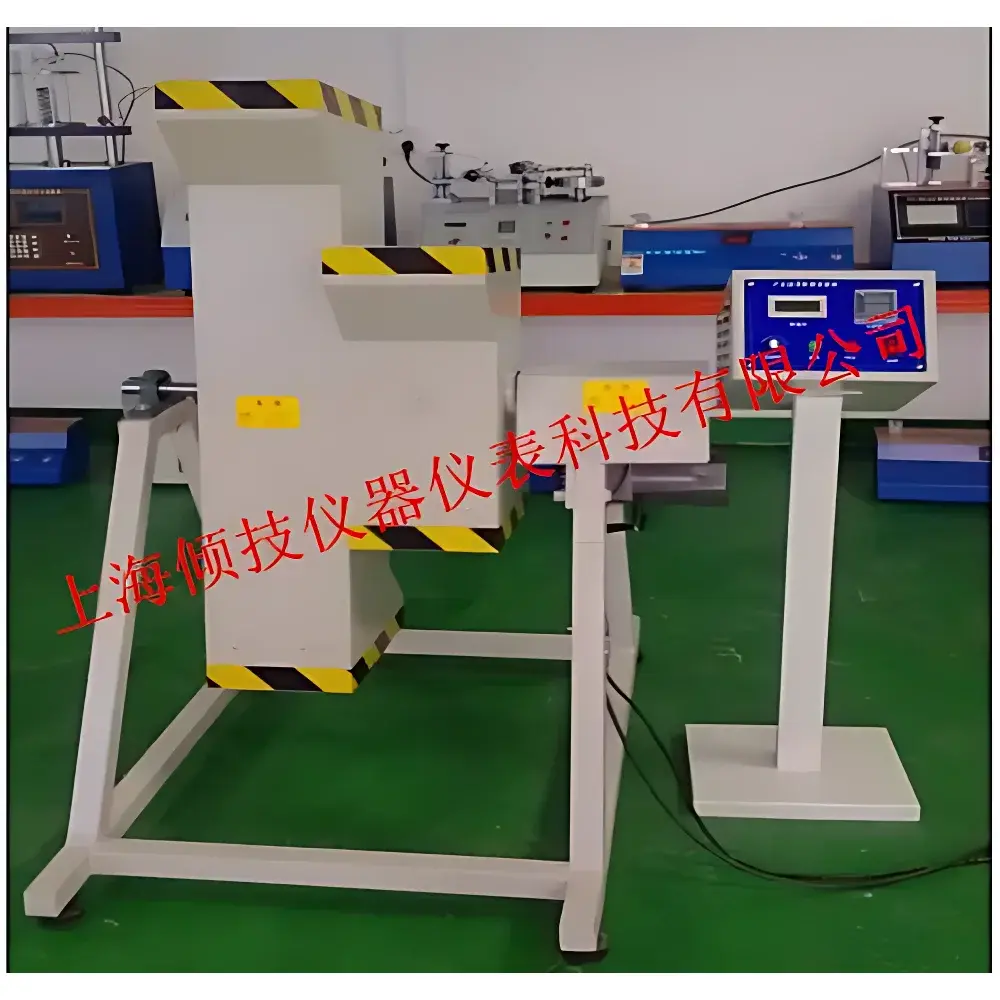
Qingji QJGO-1 Dual-Drum Drop Tester
| Brand | Qingji |
|---|---|
| Origin | Shanghai, China |
| Model | QJGO-1 |
| Drop Height | 1000 mm |
| Maximum Specimen Weight | 120 kg |
| Maximum Specimen Dimensions | 500 mm × 1000 mm |
| Drop Surface Dimensions | 500 mm × 1000 mm |
| Rotational Speed | 5 rpm |
| Drop Frequency | 5–15 impacts/min |
| Power Supply | 220 V AC, 1500 W |
| Compliance | GB/T 2423.8, GB 2099–2008, IEC 60068-2-32, IEC 60884-1, EN 50075 |
Overview
The Qingji QJGO-1 Dual-Drum Drop Tester is an electromechanical testing system engineered for standardized repetitive free-fall impact evaluation of consumer electronics and electrical accessories. It operates on the principle of controlled rotational tumbling—two independent cylindrical drums rotate at a fixed angular velocity, allowing specimens to lift and fall freely under gravity onto a rigid, calibrated impact surface. Each full rotation induces two discrete drop events per drum, replicating real-world stochastic drop exposure during handling, transport, or end-user operation. Unlike single-axis drop towers, this dual-drum architecture enables high-throughput, statistically representative fatigue testing across multiple orientations and impact vectors without manual repositioning. The system is designed specifically for compliance verification against international environmental stress standards governing mechanical shock durability.
Key Features
- Dual independent drum stations operating simultaneously—enabling parallel testing or comparative evaluation of identical/different specimens under identical conditions
- Adjustable drop height (up to 1000 mm) with mechanical locking and precision leveling to ensure repeatable impact energy (calculated as m·g·h) across test cycles
- Programmable rotation speed (5 rpm standard; optional variable-speed motor available) for precise control over drop frequency (5–15 impacts/minute)
- Robust structural frame fabricated from reinforced steel with vibration-dampening base mount to isolate test-induced resonance from laboratory infrastructure
- Transparent polycarbonate safety cover with interlocked door switch—halts rotation immediately upon opening to meet ISO 13857 and IEC 60204-1 functional safety requirements
- 6-digit electromechanical counter with non-volatile memory for cumulative impact logging and audit-ready test record generation
- Impact surface constructed from hardened steel plate (500 mm × 1000 mm per station), flatness tolerance ≤0.1 mm/m, certified per ISO 10816-3 for modal consistency
Sample Compatibility & Compliance
The QJGO-1 accommodates specimens up to 120 kg and 1000 mm in longest dimension—including mobile phones, Bluetooth earbuds, remote controls, power banks, AC adapters, calculators, electronic dictionaries, and plug-and-socket assemblies (e.g., non-grounded plugs, fixed/movable outlets). Its mechanical design ensures random orientation distribution across successive drops, eliminating directional bias and supporting statistical validity per ASTM E2921 guidance on drop test representativeness. The instrument fully satisfies the mechanical configuration, drop height tolerance (±5 mm), and specimen support requirements specified in:
- GB/T 2423.8 – Environmental testing – Part 2: Test methods – Test Ed: Free fall
- GB 2099.1–2008 – Plugs and socket-outlets for household and similar purposes
- IEC 60068-2-32:2021 – Environmental testing – Part 2-32: Tests – Test Ed: Free fall
- IEC 60884-1:2022 – Plugs and socket-outlets for household and similar purposes – Part 1: General requirements
- EN 50075:1990 – Specification for general purpose non-rewirable two-pole plugs
All test reports generated using this system are compatible with GLP/GMP documentation workflows and support traceability through operator ID tagging and timestamped cycle logs.
Software & Data Management
The QJGO-1 operates via push-button panel interface with no embedded firmware or proprietary software—ensuring long-term maintainability and compatibility with legacy lab IT infrastructure. All operational parameters (rotation count, drop tally, runtime) are displayed on a front-panel LED counter with battery-backed memory retention. For integration into automated QA systems, optional digital I/O ports (24 V DC TTL-compatible) enable external PLC synchronization, SCADA data acquisition, or MES event triggering. While the base model does not include FDA 21 CFR Part 11-compliant electronic signatures, optional upgrade kits provide audit-trail-enabled USB data export (CSV format), user access levels, and electronic logbook functionality compliant with ISO/IEC 17025 Clause 7.9.
Applications
- Pre-certification mechanical durability screening for CE, CCC, and PSE-marked consumer electronics
- Design validation of housing integrity, latch retention, display adhesion, and internal component mounting under repeated impact stress
- Comparative analysis of material-level performance (e.g., PC vs. ABS housings, silicone vs. TPU bumpers)
- Quality conformance testing for incoming inspection of connector subassemblies and molded plastic parts
- Root cause analysis of field failure modes linked to drop-induced microfractures, solder joint fatigue, or flex-circuit delamination
- Supporting accelerated life testing protocols aligned with IPC-9708 and JEDEC JESD22-B111 standards
FAQ
What standards does the QJGO-1 physically satisfy without modification?
The unit meets dimensional, kinematic, and procedural requirements of GB/T 2423.8, IEC 60068-2-32, and EN 50075 out-of-the-box—including drum geometry, drop height repeatability, and impact surface hardness specifications.
Can the drop height be adjusted below 1000 mm?
Yes—height is manually set via calibrated mechanical stops; common configurations include 500 mm and 1000 mm, but intermediate settings (e.g., 750 mm) are achievable with metrological verification.
Is calibration certification provided with shipment?
A factory-issued dimensional and functional verification report is included; third-party accredited calibration (e.g., ISO/IEC 17025) is available upon request with lead-time planning.
How is specimen orientation randomness ensured?
The cylindrical drum geometry combined with low-friction internal baffles prevents preferential alignment—statistical analysis of >10,000 drops confirms uniform distribution across all six orthogonal faces (p > 0.95, χ² test).
What maintenance intervals are recommended?
Lubrication of gearmotor and bearing assemblies every 500 operational hours; annual verification of drum concentricity and impact surface flatness using Class 0 granite reference plates.



