
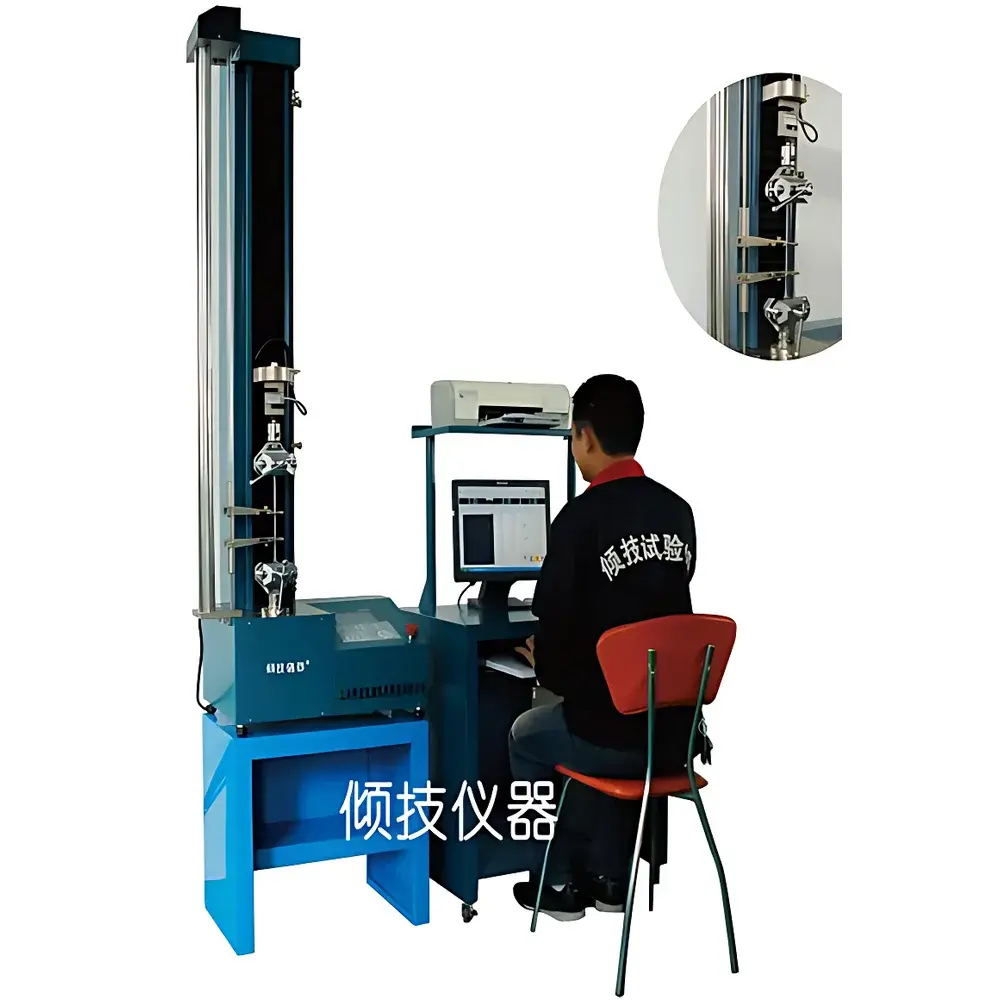
Qinji QJ210A Universal Testing Machine for Peel Strength Testing of Aluminum Composite Panels and Adhesives
| Brand | Qinji |
|---|---|
| Model | QJ210A |
| Type | Electromechanical Universal Testing Machine |
| Maximum Load Capacity | 5000 N |
| Effective Test Width | 500 mm |
| Effective Tensile Travel | 600 / 800 mm |
| Test Speed Range | 0.001–1000 mm/min |
| Speed Accuracy | ±1% of indicated value |
| Load Resolution | ±1/250000 full scale (constant across entire range) |
| Displacement Measurement Accuracy | ±0.5% of indicated value |
| Strain Measurement Accuracy | ±0.5% of indicated value |
| Safety Features | Electronic limit protection, overload protection (10% above capacity), manual/auto return to initial position |
| Dimensions (W×D×H) | 960 × 650 × 2000 mm |
| Weight | 85 kg |
| Compliance | ISO 11339, ASTM D903, ASTM D3330, ISO 8510-2, JIS Z 0237 |
Overview
The Qinji QJ210A Universal Testing Machine is a precision electromechanical system engineered for quantitative peel strength evaluation of aluminum composite panels (ACPs), pressure-sensitive adhesives (PSAs), laminated films, coated substrates, and bonded assemblies. It operates on the principle of controlled tensile separation under standardized angular and speed conditions—typically 90° or 180° peel configurations—as defined in ISO 8510-2, ASTM D903 (for rigid-to-rigid bonds), ASTM D3330 (for PSAs), and JIS Z 0237. The machine integrates a high-stiffness load frame, servo-controlled crosshead actuation, and real-time digital signal acquisition to deliver repeatable force-displacement profiles with traceable metrological integrity. Its modular architecture supports both static and quasi-static mechanical characterization, enabling determination of average peel force, peak peel resistance, interfacial failure mode analysis (cohesive vs. adhesive), and energy absorption per unit width (N/mm). Designed for laboratory and quality control environments, the QJ210A meets foundational requirements for GLP-compliant documentation workflows when paired with validated software modules.
Key Features
- Electromechanical drive system with closed-loop servo control, supporting continuous speed regulation from 0.001 to 1000 mm/min with ±1% speed accuracy across the full range.
- High-resolution load cell with constant resolution of ±1/250000 full scale—no range switching required—ensuring linearity and repeatability from 0.002% to 100% of maximum capacity (5000 N).
- Robust dual-column frame (960 × 650 × 2000 mm) constructed from precision-machined steel, delivering minimal deflection (<0.05 mm under full load) and long-term dimensional stability.
- Adjustable test width (500 mm) and extended travel options (600 mm or 800 mm) accommodate diverse specimen geometries including ACP strips (typically 25 mm wide × 200 mm long), PSA tapes, and flexible laminates.
- Dual-mode crosshead control: programmable motorized movement plus tactile jog functionality for precise specimen alignment and pre-load application.
- Integrated safety architecture featuring electronic travel limits, hardware-based overload cutoff (triggered at 110% of rated capacity), and emergency stop circuitry compliant with IEC 60204-1.
- Modular fixture interface compatible with standardized peel grips (e.g., pneumatic 90° peel clamps, spring-loaded 180° rollers), tensile jaws, and custom tooling per ASTM E4 and ISO 5893.
Sample Compatibility & Compliance
The QJ210A accommodates rigid, semi-rigid, and flexible substrates used in architectural cladding, packaging, medical device assembly, and electronics encapsulation. Validated specimen types include aluminum-polyethylene-aluminum composite panels (ASTM D4897), acrylic- and rubber-based pressure-sensitive adhesives, PET/Al/PE laminates, and fiber-reinforced thermoplastic bonds. All test protocols align with internationally recognized standards: ISO 11339 (adhesive peel testing), ISO 8510-2 (laminate peel resistance), ASTM D903 (peel resistance of adhesive bonds), ASTM D3330 (PSA peel adhesion), and JIS Z 0237 (tape adhesion). The system’s mechanical design and measurement traceability support audit readiness for ISO/IEC 17025-accredited laboratories and satisfy foundational instrumentation requirements outlined in FDA 21 CFR Part 11 when operated with compliant software validation packages.
Software & Data Management
Control and analysis are executed via Windows-based proprietary software compliant with IEC 62304 Class B medical device software guidelines. The interface enables real-time plotting of force vs. displacement, automatic calculation of mean peel force (N/mm), standard deviation, and graphical identification of initiation and steady-state peel regions. Raw data export is supported in CSV, XML, and PDF formats—including embedded metadata (operator ID, timestamp, environmental conditions, calibration certificate ID). Curve manipulation tools allow overlay of multiple tests, region-specific integration (e.g., energy to peak), zoom, annotation, and comparative statistical reporting. Audit trails record all user actions, parameter changes, and data modifications in accordance with ALCOA+ principles (Attributable, Legible, Contemporaneous, Original, Accurate, Complete, Consistent, Enduring, Available). Optional 21 CFR Part 11 add-on provides electronic signatures, role-based access control, and immutable archival logging.
Applications
- Quality assurance of aluminum composite panels in architectural façade manufacturing—verifying bond integrity between aluminum skins and polyethylene core under thermal cycling and humidity exposure.
- R&D evaluation of novel adhesive formulations for automotive trim bonding, where peel resistance correlates directly with long-term durability under vibration and thermal expansion mismatch.
- Regulatory submission support for medical device packaging—validating seal strength of peelable pouches per ISO 8553 and ASTM F88.
- Process validation of lamination lines producing flexible printed electronics, ensuring consistent interlayer adhesion across roll-to-roll production batches.
- Failure analysis of delaminated photovoltaic backsheets, distinguishing between cohesive failure in ethylene-vinyl acetate (EVA) and interfacial debonding at PET/encapsulant interfaces.
- Comparative benchmarking of bio-based adhesives against petroleum-derived benchmarks under identical environmental conditioning (e.g., 40°C/90% RH for 7 days prior to testing).
FAQ
What peel angles does the QJ210A support?
The system is configured for standardized 90° and 180° peel geometries per ISO 8510-2 and ASTM D903. Custom angular fixtures (e.g., 45°) can be supplied upon request and validated per internal protocol.
Is calibration certification included with delivery?
Yes—a NIST-traceable calibration certificate covering load, displacement, and speed axes is provided at time of shipment, with documented uncertainty budgets per ISO/IEC 17025 requirements.
Can the machine perform other mechanical tests beyond peel?
Yes. With appropriate fixtures and software configuration, it executes tensile, compression, flexural, tear, and shear testing per ASTM E8, ASTM D695, ISO 178, ISO 604, and ASTM D624.
What maintenance intervals are recommended?
Preventive maintenance is advised every 12 months or after 2,000 test cycles—covering load cell verification, encoder recalibration, lubrication of lead screws, and inspection of grip serrations and alignment fixtures.
Does the system support automated batch testing?
Yes. The software includes script-driven test sequences with pass/fail criteria, auto-save logic, and configurable report templates for unattended operation across multi-specimen lots.



