
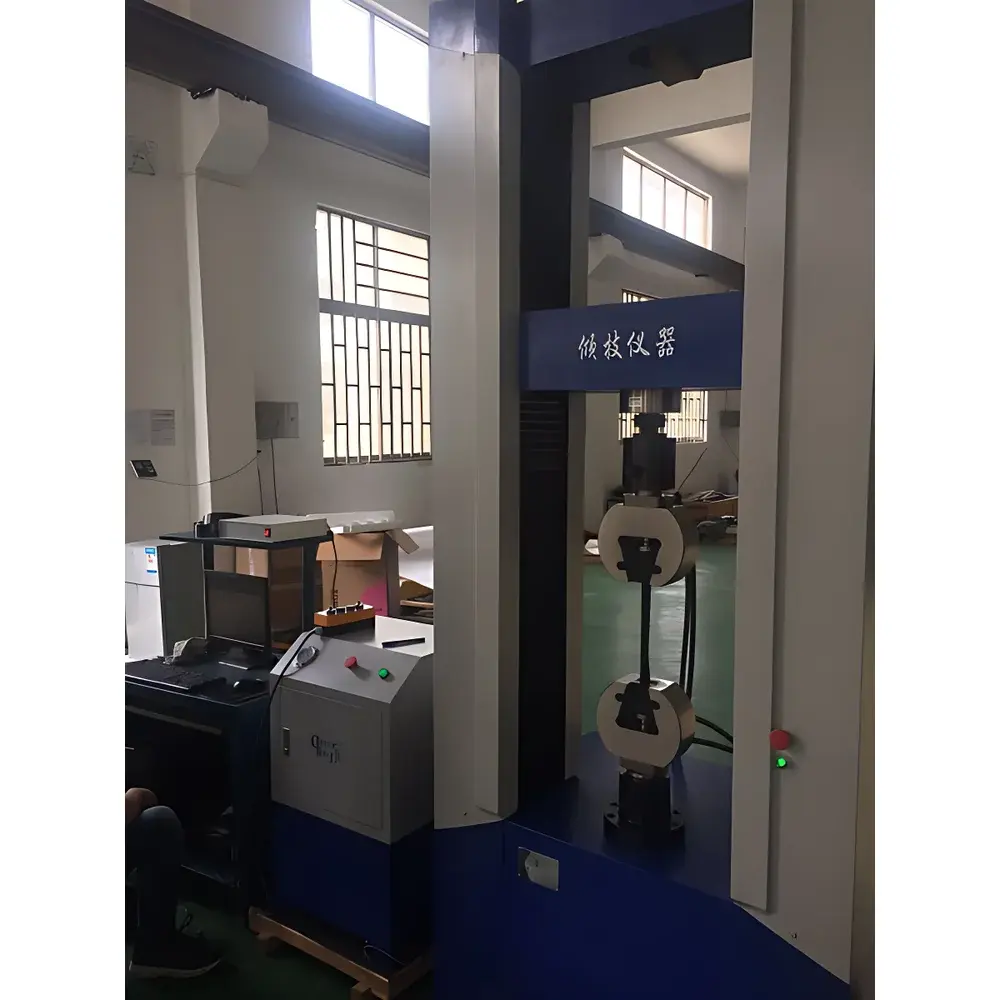
QJ212 50 kN Universal Testing Machine (UTM)
| Origin | Shanghai, China |
|---|---|
| Manufacturer Type | Authorized Distributor |
| Origin Category | Domestic (China-made) |
| Model | QJ212 |
| Price | USD 7,700 (FOB Shanghai) |
| Load Capacity | 50 kN (extendable to 500 kN with optional load cells) |
| Force Resolution | ±1/250,000 full scale, dual-range-free, constant resolution across entire range |
| Effective Test Width | 500 mm |
| Maximum Tensile Travel | 600 mm or 800 mm (configurable) |
| Test Speed Range | 5–300 mm/min (continuously adjustable) |
| Force Measurement Accuracy | ±1% of reading |
| Displacement Accuracy | ±1% of reading |
| Strain/Deformation Accuracy | ±1% of reading |
| Motor Power | 4 kW |
| Dimensions (W×D×H) | 960 × 650 × 2000 mm |
| Net Weight | ~85 kg |
Overview
The QJ212 50 kN Universal Testing Machine (UTM) is a microprocessor-controlled electromechanical system engineered for precision mechanical characterization of metallic, polymeric, composite, and elastomeric materials under uniaxial loading conditions. Based on the principle of servo-controlled hydraulic or electromechanical force application—depending on configuration—it delivers high reproducibility in tensile, compression, flexural, peel, tear, shear, puncture, and low-cycle fatigue testing. Designed to meet fundamental requirements of ISO 6892-1 (tensile testing of metals), ASTM E8/E8M, ASTM D638 (plastics), ASTM D790 (flexural properties), ISO 178, and DIN 53455, the system supports both routine quality control and R&D-grade mechanical property quantification. Its Windows-based control interface enables real-time acquisition and visualization of load–displacement, stress–strain, and time-dependent curves—with dynamic scaling, overlay, traversal, and export capabilities compliant with internal lab documentation standards.
Key Features
- Electromechanical actuation architecture with closed-loop PID control for stable speed and load regulation across the full 5–300 mm/min range
- High-resolution force transduction (±1/250,000 FS) with no internal range switching—ensuring consistent resolution from 0.02% to 100% of 50 kN capacity
- Dual-speed crosshead movement: rapid positioning (fast mode) and fine-adjustment (slow mode), including jog functionality for precise specimen alignment
- Integrated electronic limit switches and overload protection (triggered at 110% of selected load cell capacity) to prevent mechanical damage during abnormal loading
- Automated return-to-start function post-test; manual override available via intuitive front-panel controls
- Rigid, two-column frame with 500 mm clear test width and 600/800 mm vertical travel—optimized for standard ASTM/ISO specimen geometries and夹具 compatibility
- 4 kW AC servo drive system delivering high torque at low speeds and smooth transitions across the operational envelope
Sample Compatibility & Compliance
The QJ212 accommodates flat, round, and custom-shaped specimens per ISO 527, ASTM D638 Type I–V, ASTM E8 dog-bone geometries, and ISO 6892-1 gauge lengths up to 250 mm. Standard wedge-action grips, pneumatic clamps, and bend fixtures are available for metals, plastics, textiles, adhesives, and thin films. All hardware complies with CE machinery directive (2006/42/EC) and meets electromagnetic compatibility (EMC) requirements per EN 61326-1. The system supports audit-ready operation under GLP and GMP environments when paired with validated software modules—including electronic signature support, user access levels, and 21 CFR Part 11–compliant audit trails (optional configuration).
Software & Data Management
Control and analysis are executed via proprietary Windows-native software featuring real-time plotting, multi-curve overlay, automatic yield point detection (0.2% offset method), modulus calculation (tangent/secant), and fracture energy integration. Raw data exports to CSV, Excel, and XML formats; graphical outputs support PNG, PDF, and EMF vector export. Calibration certificates traceable to NIM (National Institute of Metrology, China) or ISO/IEC 17025-accredited labs can be generated per test session. Software permits post-hoc curve editing—addition/deletion of data points, baseline correction, and interpolation—without altering original acquisition logs, preserving raw data integrity per ALCOA+ principles.
Applications
This UTM serves laboratories conducting mechanical validation across sectors including automotive component suppliers (e.g., seat belt webbing, gasket compression set), medical device manufacturers (suture tensile strength, catheter kink resistance), packaging R&D (peel adhesion of laminates, seal integrity), construction materials (rebar yield strength, mortar compressive behavior), and academic polymer research (viscoelastic recovery, creep compliance). It is routinely deployed for supplier qualification per IATF 16949 clause 8.4.2.2 and supports material certification reports required by ASME BPVC Section II and EN 10002-1.
FAQ
Is the QJ212 compatible with third-party extensometers?
Yes—standard analog (±10 V) and digital (RS-422, LVDT-compatible) inputs support OEM and aftermarket axial and lateral extensometers for strain-controlled testing.
Can the system perform cyclic loading tests?
Yes—programmable waveforms (sine, triangle, trapezoidal) enable low-cycle fatigue protocols up to 5 Hz with load/displacement feedback loop closure.
What calibration documentation is provided upon delivery?
A factory calibration report referencing national metrological standards, plus a blank calibration log template aligned with ISO/IEC 17025 requirements.
Is remote diagnostics supported?
Standard Ethernet connectivity allows secure remote assistance via TeamViewer (IT-admin approved); firmware updates and parameter backups are performed offline to ensure data sovereignty.
Does the warranty cover load cell recalibration?
The 12-month comprehensive warranty covers parts and labor for mechanical and electronic subsystems; load cell recalibration services are offered annually under separate service agreement.



