
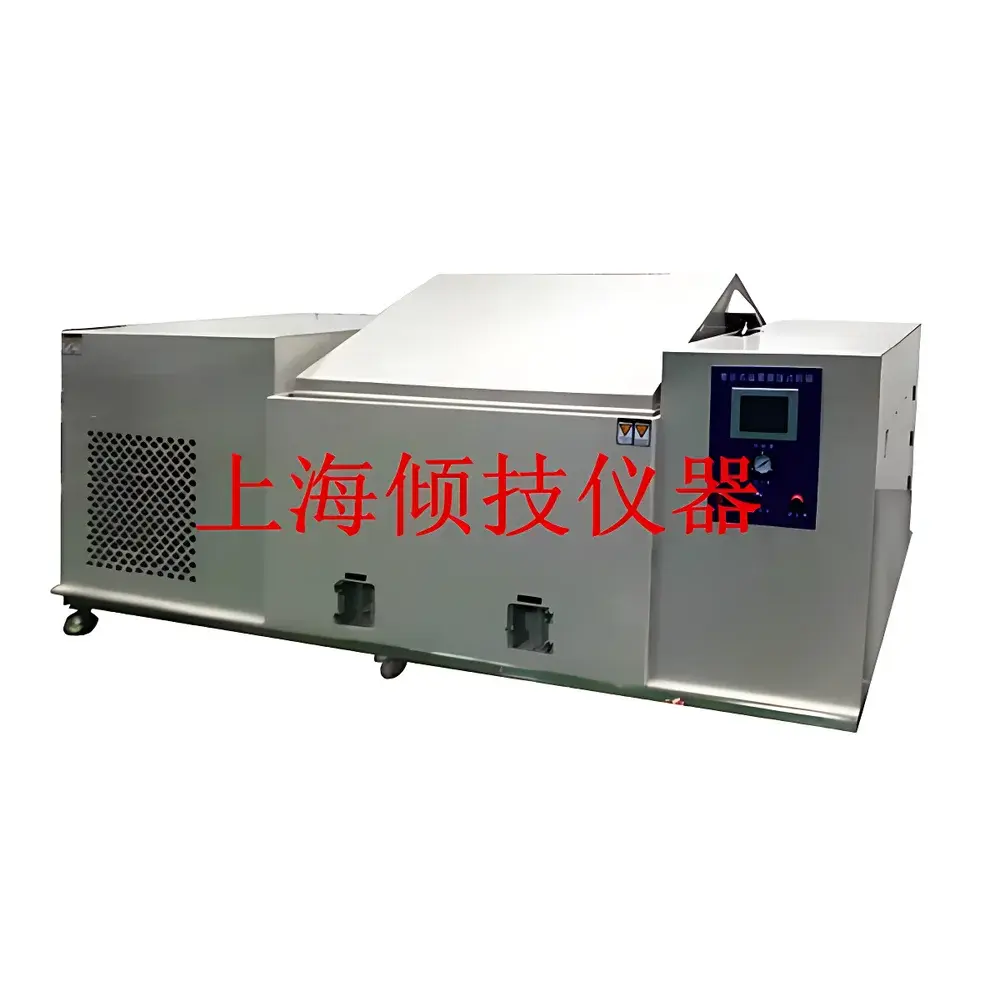
QJYS Acetic Acid Salt Spray Test Chamber
| Brand | Qingji |
|---|---|
| Origin | Shanghai, China |
| Model | QJYS |
| Salt Fog Deposition Rate | 100 mL/80 cm²/h |
| Temperature Range | Ambient to 200°C |
| Chamber Volume Options | 108–800 L |
| Salt Solution Tank Capacity | 15–40 L |
| Compliance | GB/T 2423.17 (Neutral & Acetic Acid Salt Spray) |
Overview
The QJYS Acetic Acid Salt Spray Test Chamber is an engineered environmental test system designed for accelerated corrosion evaluation of metallic components, protective coatings, plating systems, and finished industrial products under controlled saline atmospheric conditions. Based on the principle of continuous or cyclic salt fog exposure—where atomized sodium chloride solution (with or without acetic acid addition) is introduced into a thermally regulated chamber—the instrument simulates aggressive coastal or industrial atmospheric environments. Unlike neutral salt spray (NSS), the acetic acid salt spray (AASS) test per ASTM B368 and ISO 9227 introduces pH-controlled acidity (pH 3.1–3.3) to intensify electrochemical corrosion kinetics, particularly for copper-accelerated testing of zinc and cadmium platings. The QJYS series operates within a temperature range of ambient to 200°C, enabling elevated-temperature salt fog testing where thermal stress synergizes with chloride ion attack—a critical requirement for automotive under-hood components, aerospace fasteners, and marine-grade hardware.
Key Features
- Stainless steel 316L inner chamber construction with seamless welded joints, ensuring long-term resistance to chloride-induced pitting and crevice corrosion.
- Precisely calibrated air-saturated salt fog nozzles with adjustable pressure regulation (0.8–1.2 bar), delivering uniform deposition rate of 100 mL/80 cm²/h ±10% across the test specimen zone.
- Dual-mode operation: programmable switching between Neutral Salt Spray (NSS), Acetic Acid Salt Spray (AASS), and optionally Copper-Accelerated Acetic Acid Salt Spray (CASS) protocols via manual or automated control interface.
- Independent heating system with PID-controlled chamber temperature regulation (±2°C accuracy), supporting stable operation up to 200°C for high-temperature corrosion validation per ISO 11997-2.
- Integrated salt solution reservoir (15–40 L capacity) with level sensor, corrosion-resistant pump, and auto-refill capability; compatible with deionized water (resistivity ≥5 MΩ·cm) and reagent-grade NaCl.
- Front-access viewing window with double-layer tempered glass and anti-fog heating element, enabling real-time visual monitoring without chamber opening or parameter disturbance.
Sample Compatibility & Compliance
The QJYS chamber accommodates specimens up to 1600 × 1000 × 500 mm (L×W×H), with configurable sample racks and non-conductive support fixtures to prevent galvanic coupling during exposure. It supports standardized test specimen orientation (15°–30° from vertical) per ISO 9227 and ASTM B117. The system complies with national and international standards including GB/T 2423.17, ISO 9227, ASTM B117, ASTM B368, and JIS Z 2371. All operational parameters—including chamber temperature, fog deposition rate, and solution pH—are traceable and recordable for GLP/GMP-aligned quality audits. Optional data logging modules provide time-stamped outputs suitable for FDA 21 CFR Part 11-compliant environments when paired with validated software.
Software & Data Management
The QJYS chamber features a microprocessor-based controller with intuitive touchscreen HMI (Human-Machine Interface), supporting multi-step test programs with up to 99 cycles, dwell times, and ramp profiles. Real-time display includes chamber temperature, elapsed test time, and cumulative salt consumption. Optional RS485/Modbus RTU or Ethernet (TCP/IP) connectivity enables integration with centralized laboratory information management systems (LIMS). Exported CSV log files contain timestamped chamber temperature, setpoint deviation, and alarm history—structured for post-test statistical analysis of corrosion onset, blistering progression, and red rust formation per ISO 4628-3.
Applications
- Automotive OEMs and Tier-1 suppliers validating corrosion resistance of brake calipers, exhaust hangers, and fastener assemblies.
- Electroplating facilities qualifying zinc-nickel, tin-zinc, and trivalent chromium coatings per ASTM B633 and ISO 2081.
- Electronic connector manufacturers assessing solderability retention and contact resistance degradation after salt fog exposure.
- Aerospace component vendors performing qualification testing of aluminum alloy housings and titanium fasteners per AMS 2700.
- Paint and coating R&D labs evaluating primer adhesion loss, scribe creep, and delamination behavior in organic coating systems.
FAQ
What standards does the QJYS chamber support for acetic acid salt spray testing?
It fully implements ISO 9227 AASS and ASTM B368 methods, including pH adjustment to 3.1–3.3 using glacial acetic acid and verification via calibrated pH meter before each test cycle.
Can the chamber operate continuously at 200°C with salt fog present?
Yes—the heating system and chamber insulation are rated for sustained operation at 200°C; however, prolonged high-temperature salt fog exposure requires careful selection of specimen materials and periodic nozzle inspection to prevent crystallization-induced clogging.
Is the salt solution tank resistant to acetic acid corrosion?
Yes—the tank is fabricated from PP (polypropylene) with UV-stabilized additives, certified for compatibility with 5% acetic acid in saline solution per ASTM D543.
Does the system include calibration documentation for traceability?
Each unit ships with a factory calibration certificate for temperature sensor and fog deposition rate, aligned to ISO/IEC 17025-accredited reference standards.
What maintenance intervals are recommended for optimal reproducibility?
Nozzle cleaning every 40 hours of operation, chamber interior wipe-down after each test cycle, and annual verification of temperature uniformity per IEC 60068-3-5 are advised.



