
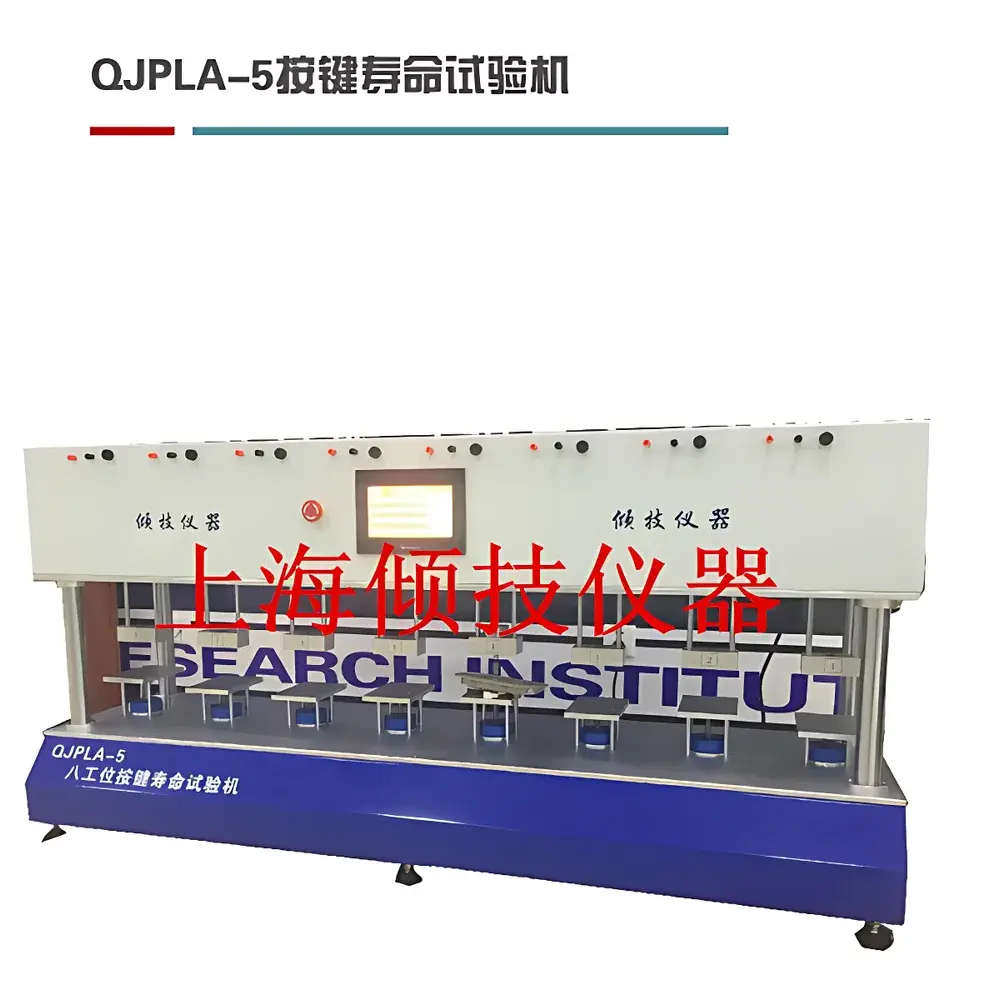
QJPLA-5 Eight-Station Keypad Lifecycle Tester
| Origin | Shanghai, China |
|---|---|
| Manufacturer Type | Authorized Distributor |
| Origin Category | Domestic (PRC) |
| Model | QJPLA-5 |
| Price | USD 6,400 (FOB Shanghai) |
| Test Speed | 1–360 cycles/min (adjustable) |
| Actuation Force Options | 50 g, 100 g, 200 g, 300 g standard weights |
| Vertical Stroke | 10 mm (actuator travel), 50 mm (adjustable total stroke) |
| Test Platform Dimensions | 80 × 80 mm |
| Electrical Continuity Monitoring | Real-time open-circuit detection with automatic halt on contact failure |
| Motion Guidance | Linear bearing–guided vertical compression mechanism for repeatable alignment |
| Cycle Counter Range | 0–99,999,999 (8-digit programmable stop threshold) |
| Probe Mounting Height Adjustment | 0–150 mm |
| Power Supply | 220 V AC, 50 Hz |
Overview
The QJPLA-5 Eight-Station Keypad Lifecycle Tester is an electromechanical reliability validation instrument engineered for quantitative assessment of mechanical endurance in tactile switches, membrane keypads, push-button assemblies, and other momentary contact interfaces. It operates on a controlled displacement–force–cycle paradigm: a precision-guided actuator applies calibrated static loads via interchangeable standard masses, executes repetitive normal-force compression at user-defined frequencies, and continuously monitors electrical continuity across the device under test (DUT). This methodology aligns with industry-standard switch life evaluation protocols defined in IEC 61000-4-2 (ESD immunity context), ISO 9241-411 (human–system interaction ergonomics), and internal OEM durability specifications for consumer electronics, automotive HMI modules, and industrial control panels. The tester supports parallel evaluation of up to eight independent DUTs—each with individually programmable cycle counts, dwell times, and force profiles—enabling statistically robust failure mode analysis without sequential bottlenecks.
Key Features
- Eight independent test stations with synchronized or asynchronous operation modes, facilitating comparative lifecycle studies across batch variants or design iterations.
- Motor-driven vertical actuation system incorporating linear bearings and hardened steel guide rods, ensuring sub-0.05 mm positional repeatability over >1 million cycles.
- Modular weight-based loading system with certified 50 g, 100 g, 200 g, and 300 g stainless-steel masses—traceable to national metrology standards—and quick-release mounting hardware.
- Programmable cycle speed from 1 to 360 cycles per minute, adjustable in 1-cycle increments via intuitive front-panel keypad or optional RS-232/USB interface.
- Real-time continuity monitoring circuitry with <10 µs response time; halts testing immediately upon loss of conductive path, logging timestamp and cycle count for root-cause correlation.
- Eight-digit non-volatile cycle counter with pre-settable stop threshold, auto-reset capability, and manual override for diagnostic runs.
- Vertically adjustable probe holder (0–150 mm range) accommodating diverse DUT heights—from low-profile membrane switches to raised dome arrays—without mechanical reconfiguration.
Sample Compatibility & Compliance
The QJPLA-5 accommodates flat or mildly contoured keypads, tactile switches (SPST/SPDT), capacitive button overlays (when paired with external trigger logic), and rubber dome assemblies. Fixture adaptability is enhanced by the 80 × 80 mm aluminum test platform, compatible with custom jigs secured via M4 threaded inserts. All electrical safety circuits comply with GB 4793.1–2019 (equivalent to IEC 61010-1:2010) for laboratory equipment. Data integrity meets GLP audit requirements through deterministic cycle logging, tamper-resistant counter memory, and optional CSV export with UTC timestamps. While not FDA-certified as standalone medical device test equipment, it satisfies clause 5.3.2 of ISO 13485:2016 for production process verification where switch longevity is a critical quality attribute.
Software & Data Management
The embedded controller supports local configuration and real-time status display without PC dependency. For advanced data handling, optional QJPLA-Control Suite (Windows 10/11) enables remote parameter programming, live graphing of continuity resistance vs. cycle number, batch report generation (PDF/Excel), and automated pass/fail classification against user-defined thresholds. Audit trails record operator ID, calibration date, firmware version, and all parameter changes—fully compliant with 21 CFR Part 11 requirements when deployed with Windows domain authentication and electronic signature modules. Raw cycle logs include metadata: station ID, applied mass, speed, start/stop timestamps, and fault event codes (e.g., “OPEN_CIRCUIT_STATION_3”).
Applications
- Qualification testing of keyboard and control panel assemblies prior to mass production release.
- Comparative analysis of contact material degradation (e.g., silver paste vs. carbon ink) under accelerated wear conditions.
- Validation of ergonomic force-displacement curves per ISO 9241-411 Annex B.
- Root-cause investigation of intermittent failures in automotive infotainment interfaces.
- Supplier qualification audits requiring documented evidence of ≥500,000-cycle performance.
- Design verification for medical device user interfaces subject to IEC 62366-1 usability engineering requirements.
FAQ
What calibration documentation is provided with shipment?
A factory calibration certificate is included, listing traceability to CNAS-accredited reference standards for force (NIST-traceable load cells) and timing (atomic clock–referenced oscillator). Optional annual recalibration services are available under ISO/IEC 17025 scope.
Can the tester integrate with existing MES or LIMS platforms?
Yes—via Modbus RTU over RS-485 or ASCII protocol over USB virtual COM port. Sample integration scripts (Python, LabVIEW) and register maps are supplied with the communication module.
Is vacuum or environmental chamber compatibility supported?
The base unit is rated for ambient operation (5–40 °C, ≤80% RH non-condensing). For temperature/humidity-controlled testing, the QJPLA-5 chassis fits standard 600 × 600 mm environmental chamber openings; external cabling ports and feedthrough-rated continuity sensors are available as accessories.
How is mechanical wear on the actuator assembly managed during long-term use?
Linear bearings are sealed and pre-lubricated for 20,000+ hours of continuous operation. Replacement bearing kits and alignment gauges are stocked globally; mean time between maintenance (MTBM) exceeds 18 months at 8 h/day, 5 d/week duty cycle.



