
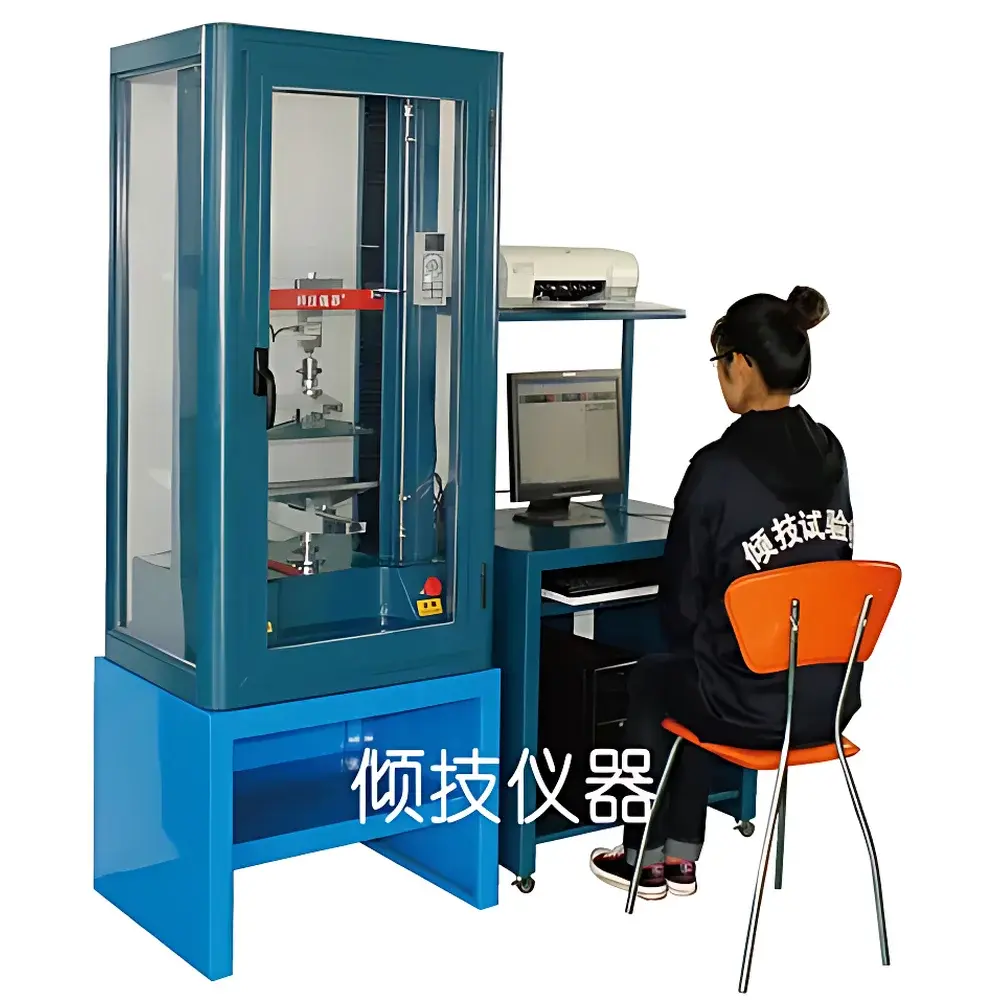
QJ211S2 Cover Plate Four-Point Bending Tester
| Origin | Shanghai, China |
|---|---|
| Manufacturer Type | Authorized Distributor |
| Country of Origin | China |
| Model | QJ211S2 |
| Price Range | USD 7,000 – 14,000 |
| Max Load Capacity | 10 kN |
| Force Accuracy | ±0.5% of reading |
| Effective Test Width | 320 mm |
| Stroke (Tensile) | 500 mm (extendable to 800 mm) |
| Speed Range | 0.01–300 mm/min |
| Speed Accuracy | ±0.5% of set value |
| Displacement & Strain Measurement Accuracy | ±0.5% of reading |
| Force Resolution | 500,000 counts (full-scale, no range switching) |
| Control System | Panasonic full-digital AC servo controller |
| Sensor | High-precision load cell (USA-sourced) |
| Software | Windows-based closed-loop test platform supporting constant-load, constant-strain, and constant-displacement control modes |
| Safety Protection | Electronic limit switches, software-based overload detection (>110% FS), automatic return post-test |
| Mass | ~145 kg |
Overview
The QJ211S2 Cover Plate Four-Point Bending Tester is an electromechanical universal testing system engineered for high-reproducibility mechanical characterization of thin, brittle, and laminated planar substrates—particularly cover glass used in consumer electronics. It implements the standardized four-point bending configuration defined in ASTM C1499, ISO 178, and GB/T 6569, where two outer support rollers and two inner loading rollers apply pure bending moment with zero shear force across the central span. This geometry eliminates shear-induced fracture artifacts and enables accurate determination of flexural strength, modulus of rupture (MOR), and elastic modulus in transparent, low-toughness materials such as aluminosilicate glass, chemically strengthened glass, and sapphire-coated displays. The system’s rigid frame, precision-ground load train, and real-time closed-loop servo control ensure minimal compliance error (<0.02 mm under 10 kN), critical for sub-micron displacement resolution in brittle fracture initiation studies.
Key Features
- Four-point bending configuration compliant with ASTM C1499, ISO 178, and GB/T 6569 for standardized flexural property evaluation
- 10 kN maximum load capacity with 0.5-class force accuracy and 500,000-count resolution across full scale—no range switching required
- Panasonic full-digital AC servo drive system delivering precise speed control from 0.01 to 300 mm/min (±0.5% accuracy)
- Integrated high-precision USA-manufactured load cell and linear variable differential transformer (LVDT)-based displacement feedback
- Full-featured Windows-based test software supporting constant-force, constant-strain, and constant-displacement control modes
- Dual-speed crosshead actuation (fast positioning + fine testing mode) with electronic limit protection and auto-return functionality
- Modular fixture interface accommodating interchangeable tooling for three-point bending, tensile, compression, shear, puncture, and peel tests
- Real-time dynamic display of load, displacement, strain, and stress–strain curves on 7-inch LCD; synchronized data export to CSV/PDF/Excel formats
Sample Compatibility & Compliance
The QJ211S2 is optimized for flat, rigid specimens ≤320 mm wide and ≤800 mm long—including smartphone front panels (Gorilla Glass, Dragon Trail), tablet and monitor cover lenses, automotive HUD substrates, and ophthalmic lens blanks. Its adjustable roller spacing (standard 20–100 mm inner span; customizable) supports both small-format mobile components and larger display modules. All test protocols align with internationally recognized standards including ASTM C1499 (advanced ceramics), ISO 178 (plastics), JIS R3205 (glass), GB/T 6569 (fine ceramics), and YY/T 0341 (medical device packaging). The system meets mechanical safety requirements per ISO 12100 and incorporates hardware/software interlocks satisfying IEC 61508 SIL1 functional safety principles for laboratory equipment.
Software & Data Management
The embedded Windows OS test platform provides audit-trail-capable data acquisition with timestamped metadata (operator ID, sample ID, environmental conditions, calibration status). Raw data streams are logged at ≥100 Hz with lossless compression. Curve manipulation tools include point-wise annotation, multi-curve overlay, derivative calculation (dF/dx for stiffness mapping), and automatic yield point detection via ASTM E111 tangent offset method. Exported reports comply with GLP documentation requirements—each PDF includes digital signature fields, revision history, and instrument identification (serial number, firmware version). Optional FDA 21 CFR Part 11 compliance package available upon request, featuring role-based access control, electronic signatures, and immutable audit logs.
Applications
- Flexural strength and fracture toughness assessment of chemically tempered cover glass under controlled humidity/temperature environments
- Comparative evaluation of edge-strengthening treatments (e.g., laser etching, ion exchange depth profiling) via localized four-point bend testing
- Quality assurance screening of display module lamination integrity (OCA, PSA bonding strength under bending fatigue)
- Mechanical validation of emerging transparent ceramics (e.g., YAG, spinel) for AR/VR waveguide substrates
- Regulatory submission support for medical device glass components (ISO 10993-1 biocompatibility matrix integration)
- R&D-stage optimization of glass composition and annealing profiles using Weibull modulus analysis of failure probability distributions
FAQ
What standards does the QJ211S2 support for cover glass testing?
ASTM C1499, ISO 178, GB/T 6569, JIS R3205, and EN 1288-3 are natively implemented; custom protocol scripting is supported via API access.
Can the system perform cyclic bending fatigue tests?
Yes—the closed-loop software supports programmable load/displacement waveforms (sine, triangle, trapezoidal) with cycle counting, dwell timing, and failure-triggered termination.
Is third-party calibration certification included?
A NIST-traceable calibration certificate (force, displacement, speed) is provided at shipment; annual recalibration services are available under extended maintenance contracts.
How is specimen alignment verified prior to test initiation?
The system includes a built-in optical alignment aid (crosshair reticle projected onto specimen surface) and preload verification step ensuring uniform contact before ramping to target load.
What is the typical lead time for custom fixture design?
Standard fixtures ship with unit; application-specific tooling (e.g., curved-surface supports, vacuum chucks) requires 10–15 business days after dimensional specifications approval.



