
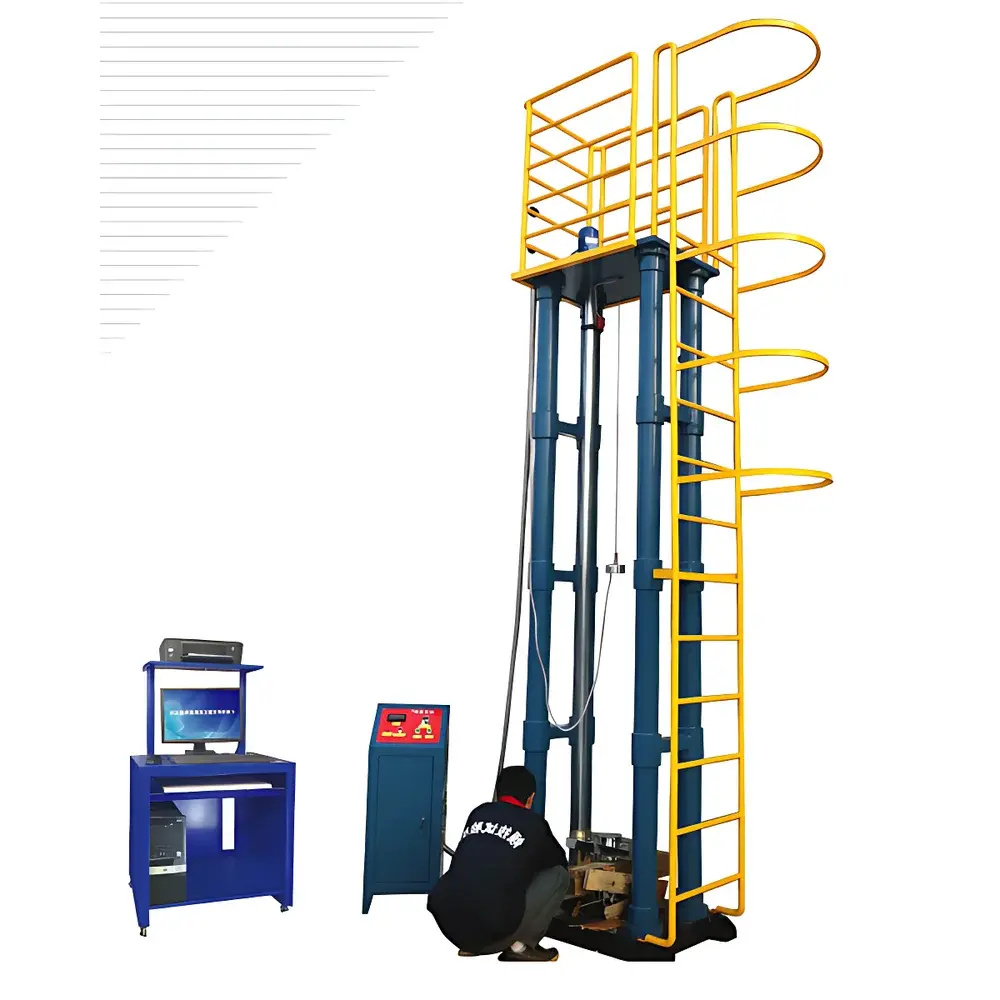
QJLC Impact Tester for Climbing Ropes – Microcomputer-Controlled Drop-Weight (Spherical Hammer) System
| Origin | Shanghai, China |
|---|---|
| Manufacturer Type | Authorized Distributor |
| Origin Category | Domestic (PRC) |
| Model | QJLC Impact |
| Price | USD 11,200 (FOB Shanghai) |
Overview
The QJLC Impact Tester for Climbing Ropes is a microcomputer-controlled drop-weight impact testing system engineered for quantitative evaluation of dynamic energy absorption and failure resistance in high-strength synthetic fiber ropes—specifically designed for mountaineering, industrial fall protection, and rescue applications. Based on the classical free-fall pendulum principle with calibrated spherical impactor mass and precisely controlled drop height, the system delivers repeatable kinetic energy input (in joules) to simulate real-world shock loading scenarios such as sudden arrest during a fall. Unlike generic plastic or pipe impact testers, this configuration integrates rope-specific fixtures—including adjustable clamping jaws with low-slip serrated surfaces, vertical alignment guides to eliminate torsional bias, and a non-contact optical trigger system that records impact velocity immediately prior to contact—ensuring compliance with mechanical test requirements defined for dynamic rope certification under EN 892 and UIAA 101. The instrument operates within a rigid steel frame with vibration-damped base, minimizing energy loss to the support structure and enhancing measurement fidelity.
Key Features
- Microprocessor-based control unit with touch-screen HMI interface for real-time parameter setting (drop height: 0.5–2.0 m in 10-mm increments; impactor mass: 5.0–10.0 kg in 0.5-kg steps)
- High-resolution optical encoder for pre-impact velocity verification (±0.02 m/s accuracy), enabling precise kinetic energy calculation (E = ½mv²)
- Dedicated rope test fixture with dual-axis tension monitoring (0–50 kN range) to capture peak load and elongation at break during impact event
- Automatic data logging of force-time, displacement-time, and energy-absorption curves at 10 kHz sampling rate
- Compliance-ready architecture: Built-in audit trail, user-level access control (admin/operator/guest), and timestamped test records meeting GLP and ISO/IEC 17025 documentation requirements
- Modular design supports rapid reconfiguration for alternate standards: ASTM F568 (safety harness webbing), ISO 10542-2 (fall arrest systems), and EN 354 (personal protective equipment against falls)
Sample Compatibility & Compliance
The QJLC system accommodates static and semi-static climbing ropes (8–13 mm diameter), kernmantle construction ropes, and dynamic single/double/twin ropes per EN 892. It also supports flat webbing, sling materials, and textile-based anchor components. Test configurations adhere strictly to the geometric and procedural constraints specified in EN 892 Annex B (impact force test), including mandatory use of UIAA-certified 80-kg test mass, standardized drop factor (DF = 2), and 2.0-m free-fall distance. All firmware and calibration protocols are traceable to NIM (National Institute of Metrology, China) standards. Full documentation packages—including calibration certificates, uncertainty budgets, and verification reports—are supplied with each unit to support laboratory accreditation audits under ISO/IEC 17025.
Software & Data Management
The embedded QJLC TestSuite v3.2 software provides ISO 17025-compliant data handling: automatic generation of PDF test reports with digital signatures, encrypted database storage with role-based retrieval permissions, and export options for CSV, XML, and ASTM E1434-compliant binary formats. Audit logs record all user actions—including parameter modifications, calibration events, and report generation—with immutable timestamps and operator ID tagging. Optional integration with LIMS platforms via OPC UA or RESTful API enables seamless data flow into enterprise quality management systems. Software validation documentation (IQ/OQ/PQ protocols) is available upon request for regulated environments requiring FDA 21 CFR Part 11 or EU Annex 11 compliance.
Applications
- Dynamic impact force measurement of climbing ropes per EN 892 and UIAA 101
- Evaluation of energy absorption efficiency and elongation behavior under shock loading
- Comparative testing of rope aging effects (UV exposure, abrasion cycles, freeze-thaw conditioning)
- Verification of splice and knot integrity under dynamic load conditions
- Quality assurance testing for PPE manufacturers supplying CE-marked fall protection systems
- Research-grade characterization of novel high-modulus fibers (e.g., Dyneema®, Vectran®, Technora®) in rope architectures
FAQ
Does the QJLC system meet UIAA certification requirements for rope testing?
Yes—the mechanical configuration, drop height control, impactor geometry, and data acquisition parameters fully satisfy UIAA Standard 101 and EN 892 Annex B test protocols.
Can the system be used for static rope testing under EN 1891?
Yes, by adjusting drop height to 0.5 m and using the 5.0-kg impactor, the system complies with EN 1891 Type A static rope impact test methodology.
Is third-party calibration certificate included with delivery?
Yes—a full NIM-traceable calibration certificate covering impactor mass, drop height encoder, and load cell is provided, along with uncertainty analysis per ISO/IEC 17025 Clause 6.5.
What maintenance intervals are recommended for long-term reliability?
Biannual verification of impactor mass and guide rail alignment is advised; annual recalibration of load cell and velocity sensor is required for ISO/IEC 17025 compliance.
Is remote technical support available for international customers?
Yes—dedicated engineering support is provided via secure screen-sharing sessions, with English-speaking application specialists available during CET business hours.



