
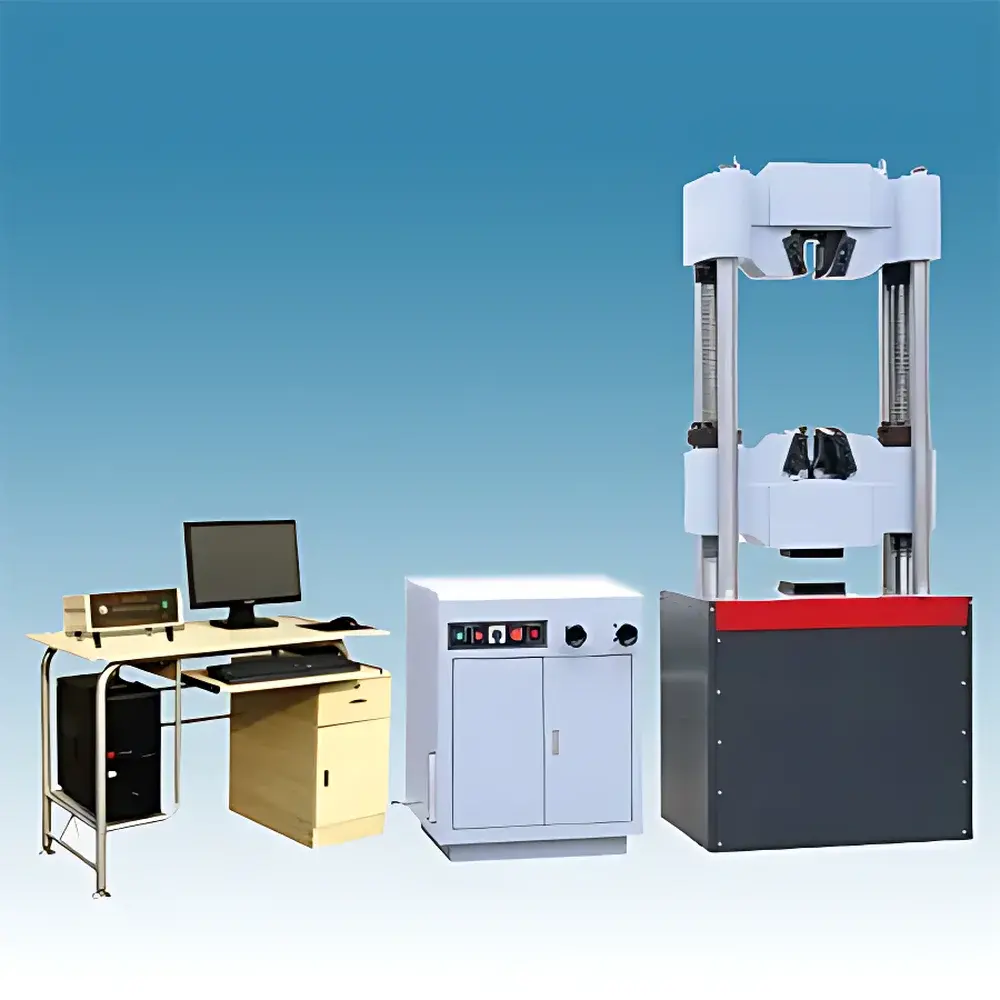
Hengyi HY(WE)100060 Electro-Hydraulic Servo Universal Testing Machine
| Brand | Hengyi |
|---|---|
| Origin | Shanghai, China |
| Manufacturer Type | Direct Manufacturer |
| Regional Classification | Domestic (China) |
| Model | HY(WE)100060RTYH |
| Instrument Type | Electro-Hydraulic Servo Testing Machine |
| Max Load Capacity | 0–1000 kN |
| Force Accuracy | ±0.5% of reading |
| Resolution | ≤0.5% of full scale |
| Compression Space | 600 mm |
| Tensile Space | 600 mm |
| Round Specimen Grip Range | Φ20–Φ60 mm |
| Flat Specimen Thickness Capacity | 0–40 mm |
| Piston Stroke | 150 mm |
| Bend Support Span Adjustment | 100–600 mm |
| Shear Specimen Diameter | Φ10 mm |
| Deformation Measurement Accuracy | ±0.5% of reading |
| Displacement Measurement Error | ±0.5% of reading |
| Stress Rate Control Range | 1–60 N/mm²/s |
| Strain Rate Control Range | 0.00025–0.0025 s⁻¹ |
| Closed-Loop Control Accuracy (Constant Load/Deformation/Displacement) | ±1% of setpoint |
| Dimensions (W×D×H) | 880×580×2260 mm |
| Motor Power | 1.5 kW, 3-phase |
| Weight | 3500 kg |
Overview
The Hengyi HY(WE)100060 Electro-Hydraulic Servo Universal Testing Machine is a high-capacity, dual-actuation system engineered for precision mechanical property evaluation of metallic and non-metallic structural materials under static loading conditions. Based on the principle of hydraulic force generation coupled with electro-hydraulic servo control, the machine delivers stable, programmable load application across tension, compression, bending, and shear configurations. Its oil-cylinder-underneath architecture provides an open-front test zone with vertically adjustable crosshead positioning—enabling flexible specimen handling and extended travel for large-scale components such as structural steel beams, concrete cylinders, and pipeline sections. The system integrates a high-stiffness load frame, precision-machined grip assemblies, and a robust 1000 kN capacity actuator, making it suitable for routine quality assurance in manufacturing environments as well as standardized mechanical testing per ASTM E4, ASTM E8/E8M, ISO 6892-1, ISO 7500-1, and GB/T 228.1.
Key Features
- Electro-hydraulic servo control architecture enabling closed-loop regulation of load, displacement, and strain at user-defined rates—compliant with ISO 16840 and ASTM E1012 requirements for system verification.
- High-accuracy multi-range load cell (imported origin) calibrated to ±0.5% FS accuracy; real-time digital signal conditioning ensures minimal drift and thermal stability over extended test durations.
- Adjustable test space: 600 mm tensile clearance and 600 mm compression height accommodate standard and custom-sized specimens—including reinforced concrete prisms, welded joints, and cast iron blocks.
- Dual-mode gripping system: Self-aligning wedge grips for round specimens (Φ20–Φ60 mm) and parallel-faced platens for flat specimens up to 40 mm thick—designed to minimize stress concentration and slippage.
- Programmable bending fixture with 100–600 mm support span adjustment, compatible with three-point and four-point bending per ASTM C78 and ISO 10543.
- Integrated shear test capability using standardized Φ10 mm punch-and-die tooling aligned to ASTM D732 and ISO 3785 methodologies.
- 1.5 kW three-phase servo motor driving a high-efficiency axial piston pump—optimized for low-noise operation and consistent pressure delivery during long-duration creep or relaxation tests.
Sample Compatibility & Compliance
The HY(WE)100060 supports a broad spectrum of standardized and application-specific specimens used across industrial and academic laboratories. Typical test samples include structural steel plates and bars, cold-formed fasteners (bolts, nuts, rivets), wire ropes and cables, seamless pipes, castings and forgings, geotechnical rock cores, cured cementitious composites, ceramic tiles, polymer-reinforced laminates, and composite rebar. All mechanical testing workflows align with internationally recognized standards including but not limited to ASTM A370, ASTM D695, ISO 6892-1, ISO 15630-1, EN 10002-1, and GB/T 228.1–2021. The system’s force and displacement measurement traceability meets ISO/IEC 17025 requirements when operated within certified calibration intervals. Optional load cell and extensometer calibration certificates are available per ISO 376 and ISO 9513.
Software & Data Management
Built upon a Windows-based real-time control platform, the machine employs a full-digital, proportional-integral-derivative (PID)-tuned closed-loop controller capable of simultaneous acquisition of load, displacement, and strain data at up to 1 kHz sampling rate. The software interface supports creation and storage of reusable test templates—including ramp-hold, cyclic loading, and multi-step stress-relaxation protocols. Raw data export is available in CSV, Excel, and universal ASCII formats; graphical visualization includes real-time stress–strain, load–displacement, and time-history plots with customizable axes and annotations. Audit trail functionality records operator ID, timestamp, parameter changes, and calibration events—supporting GLP/GMP documentation needs. Exported reports comply with ISO 5893 formatting conventions and may be configured to include laboratory accreditation logos, test standard references, and uncertainty statements.
Applications
- Quality control laboratories performing incoming material verification per supplier specifications and internal engineering standards.
- Mechanical testing departments in automotive OEMs and Tier-1 suppliers evaluating weld integrity, suspension component fatigue resistance, and chassis material compliance.
- Civil engineering labs conducting compressive strength assessment of concrete, mortar, and asphalt mixtures in accordance with ASTM C39, ASTM C109, and EN 12390 series.
- Aerospace maintenance facilities validating bolt pretension, bearing strength, and shear performance of fastener systems under simulated service loads.
- Academic research groups investigating constitutive behavior of novel alloys, fiber-reinforced polymers, and additive-manufactured metal parts under monotonic and quasi-static loading.
- Third-party certification bodies executing accredited mechanical testing for CE marking, ASME BPVC Section II, and PED 2014/68/EU conformity assessments.
FAQ
What standards does this machine support for tensile testing of metallic materials?
ASTM E8/E8M, ISO 6892-1, EN ISO 6892-1, GB/T 228.1, and JIS Z 2241.
Is the system compliant with FDA 21 CFR Part 11 for electronic records and signatures?
Yes—when deployed with optional audit trail and electronic signature modules, the software satisfies predicate rule requirements for regulated pharmaceutical and medical device testing environments.
Can the machine perform constant strain rate testing for ductility evaluation?
Yes—strain rate control is implemented via closed-loop feedback from a clip-on or video extensometer, supporting rates from 0.00025 s⁻¹ to 0.0025 s⁻¹ per ISO 6892-1 Annex A.
What is the recommended calibration interval for force measurement?
Per ISO 7500-1, annual calibration is required; however, laboratories operating under ISO/IEC 17025 must establish calibration frequency based on usage intensity, historical performance, and risk assessment.
Does the system support automated test sequence execution for batch processing?
Yes—the software allows definition of sequential test programs with auto-reset, specimen identification prompts, and pass/fail logic based on preconfigured acceptance criteria.



