
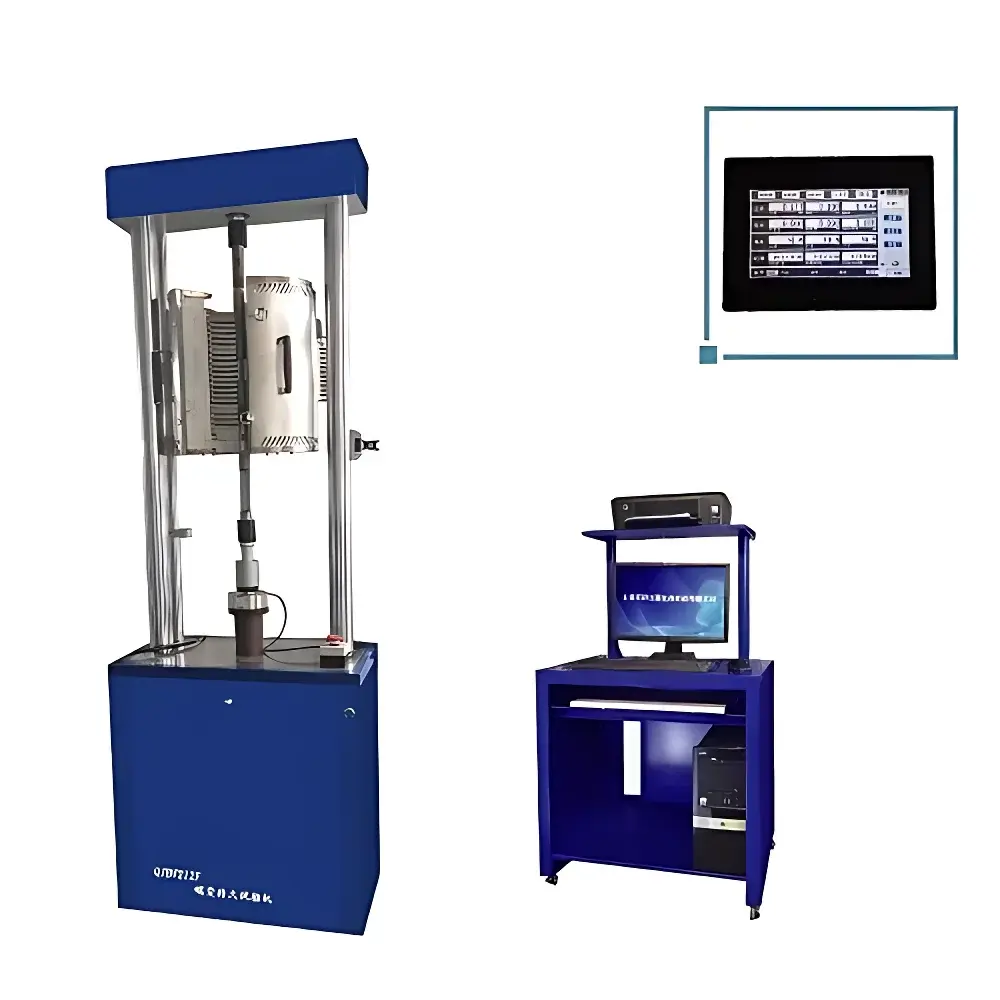
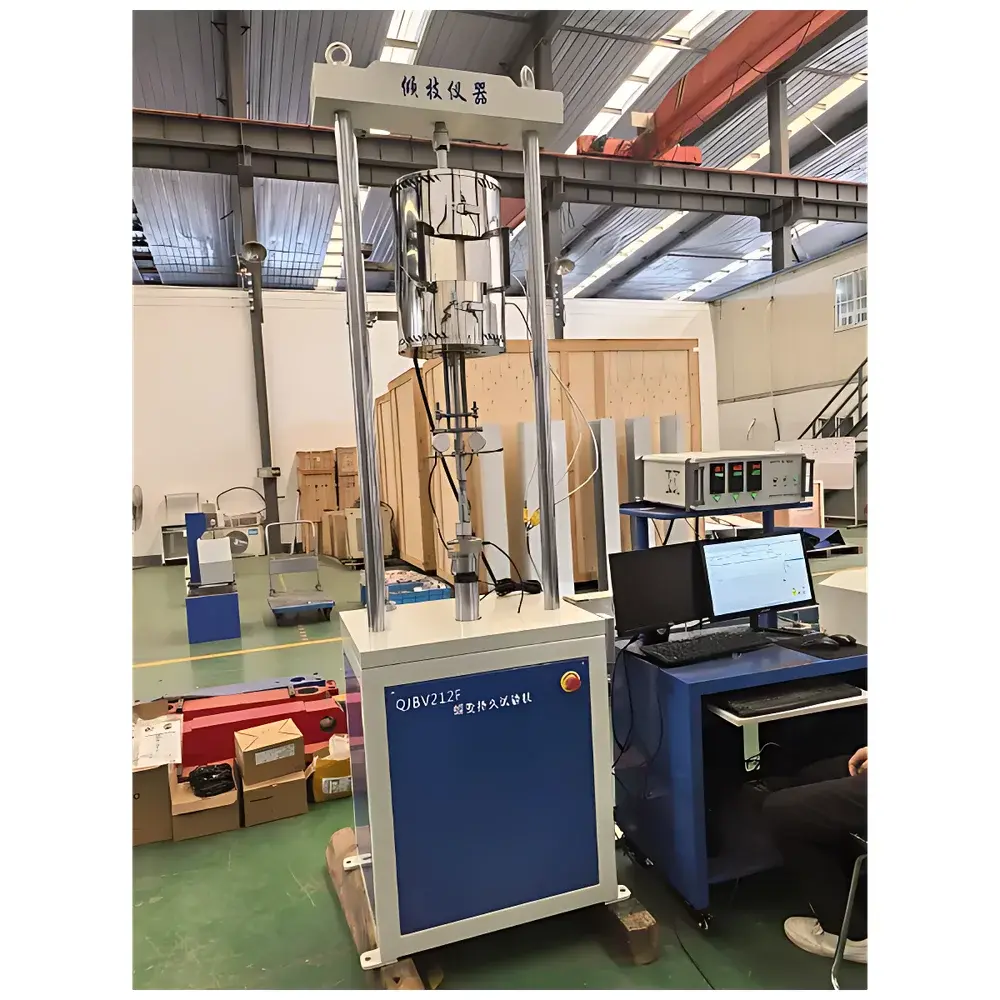
Qinsun QJ212-10KN Creep and Stress Rupture Testing Machine
| Brand | Qinsun |
|---|---|
| Origin | Shanghai, China |
| Model | QJ212-10KN |
| Max Test Load | 50 kN |
| Crosshead Stroke | 200 mm |
| Furnace Chamber Diameter | φ50 mm |
| Furnace Length | 450 mm |
| Host Weight | 850 kg |
| Temperature Range | RT to 1200 °C |
| Temperature Control Accuracy | ±0.5 °C |
| Temperature Resolution | 0.1 °C |
| Constant-Temperature Zone Length | >150 mm |
| Load Control Accuracy | ±1% FS |
| Load Resolution | 0.1 N |
| Deformation Measurement | Imported Linear Encoder |
| Deformation Range | Up to 25 mm |
| Deformation Accuracy | ±0.5% FS |
| Load Measurement Accuracy | ±0.5% FS (from 1% FS) |
| Crosshead Speed | 0.01–180 mm/min |
| Power Supply | 3 kW |
Overview
The Qinsun QJ212-10KN Creep and Stress Rupture Testing Machine is a precision-engineered mechanical testing system designed for long-term, high-temperature deformation characterization of polymeric, metallic, and composite materials under sustained uniaxial load. Operating on the fundamental principles of time-dependent viscoelastic and viscoplastic deformation, the system enables standardized creep strain measurement, creep rate analysis, and stress rupture life determination in accordance with ASTM E139, ISO 204, GB/T 2039, and HB 5150–5151. Its robust dual-column frame architecture supports stable thermal-mechanical coupling during extended-duration tests—routinely spanning hundreds to thousands of hours—while maintaining mechanical integrity and dimensional stability across temperature gradients up to 1200 °C.
Key Features
- High-stability mechanical loading train incorporating imported servo-controlled actuation with continuous load range adjustment (0–10 kN, 0–20 kN, 0–30 kN, 0–50 kN, or 0–100 kN options), ensuring precise force application and repeatability over multi-day test cycles.
- Integrated high-temperature furnace with uniform axial temperature distribution; constant-temperature zone exceeds 150 mm in length and maintains ±0.5 °C control accuracy within a programmable range from ambient to 1200 °C.
- Optimized furnace geometry (φ50 mm chamber diameter × 450 mm total length) accommodates standard ASTM E139 and ISO 204 specimen configurations while minimizing radial thermal gradients and axial heat loss.
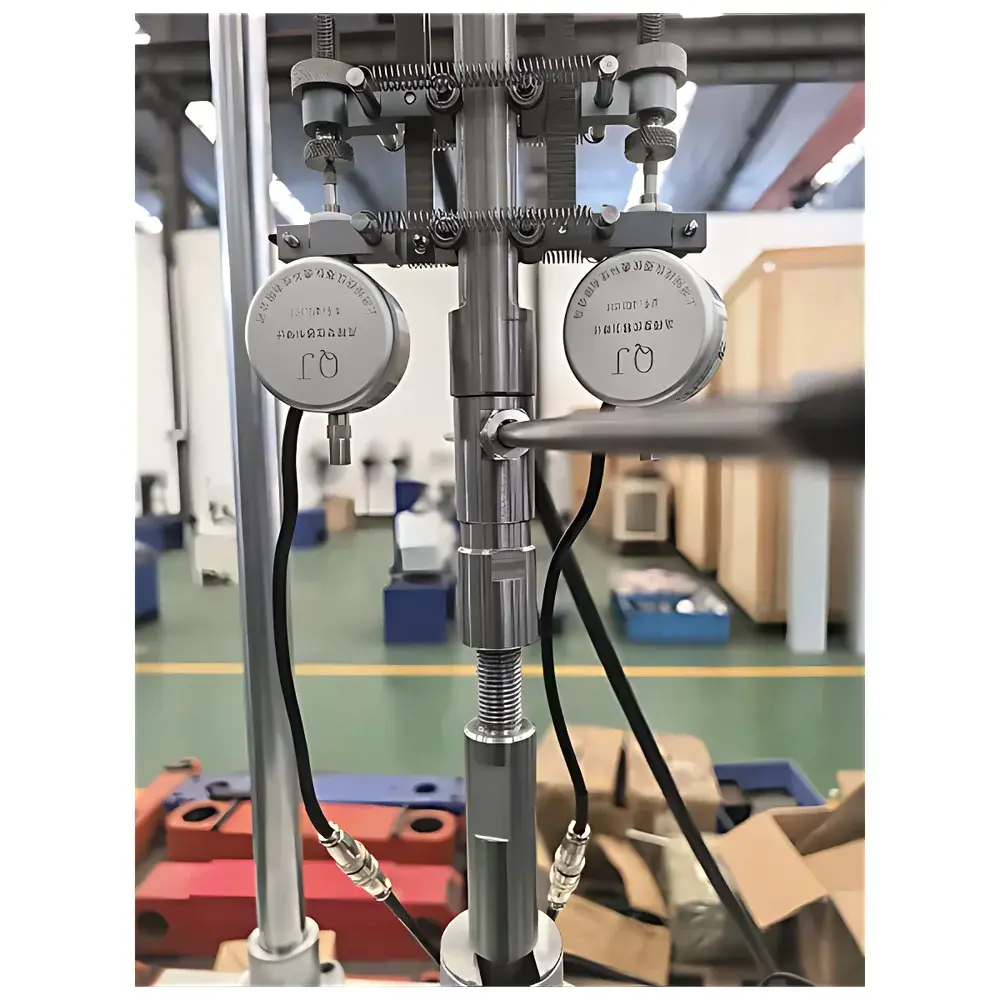
- High-resolution displacement measurement via industrial-grade linear encoder (±0.5% FS accuracy, 25 mm full-scale range), synchronized with real-time load acquisition at 100 Hz sampling rate for reliable strain-rate derivation.
- Modular crosshead drive system offering programmable speed control from 0.01 to 180 mm/min—enabling both rapid preloading and ultra-slow creep-stage positioning with sub-micron positional fidelity.
- Structural mass of 850 kg ensures vibration damping and mechanical rigidity essential for low-noise, high-fidelity data collection in shared laboratory environments.
Sample Compatibility & Compliance
The QJ212-10KN accommodates standard creep specimens per ASTM E139 (cylindrical or flat-bar geometries), including those fabricated from thermoplastics (e.g., PEEK, PEI), engineering thermosets, aluminum alloys, stainless steels, titanium alloys, and nickel-based superalloys. Specimen gripping utilizes hardened steel wedge-type fixtures with adjustable clamping pressure to prevent slippage and minimize stress concentration. All thermal and mechanical subsystems comply with JJG 276–88 (Chinese national verification regulation for high-temperature creep testing machines), GB/T 2039–1997, and HB 5150–5151. The system’s load and temperature calibration protocols support traceability to national metrological standards, facilitating audit readiness for GLP and GMP-regulated laboratories.
Software & Data Management
Control and data acquisition are managed through Qinsun’s proprietary CreepTest v4.x software suite, compliant with FDA 21 CFR Part 11 requirements for electronic records and signatures. The platform provides real-time visualization of load–time–strain–temperature profiles, automated event logging (e.g., yield onset, tertiary creep initiation, rupture), and customizable report generation in PDF/CSV formats. Audit trails record all parameter changes, user logins, calibration events, and test interruptions with timestamped metadata. Raw data files are stored in vendor-neutral binary format with embedded metadata headers, enabling post-acquisition reprocessing using third-party tools such as MATLAB or Python-based material modeling frameworks.
Applications
- Determination of primary, secondary, and tertiary creep stages in polymer matrix composites under elevated service temperatures.
- Long-term stress rupture evaluation of turbine blade alloys for aerospace engine qualification per AMS 2301 and GE B50TF15.
- Time-to-failure modeling for automotive under-hood components exposed to cyclic thermal-mechanical loading.
- Validation of constitutive models (e.g., Norton-Bailey power law, Garofalo hyperbolic sine law) used in finite element simulations of high-temperature structural behavior.
- Comparative assessment of creep resistance across candidate materials during early-stage R&D screening in academic and industrial research labs.
- Support for ISO 178 and ASTM D638-based modified creep protocols for semi-crystalline thermoplastics used in medical device housings.
FAQ
What standards does this machine support for creep testing?
It complies with ASTM E139, ISO 204, GB/T 2039–1997, HB 5150–5151, and JJG 276–88 for mechanical and thermal performance verification.
Can the system operate unattended for 1000+ hour tests?
Yes—the hardware architecture, redundant thermal protection circuits, and software watchdog timers enable fully autonomous operation with periodic status reporting via Ethernet.
Is furnace calibration traceable to national standards?
Yes—each unit ships with a factory-issued calibration certificate referencing CNAS-accredited reference standards; optional on-site recalibration services are available.
What specimen geometries are supported?
Standard cylindrical (6–10 mm diameter) and flat-bar (2–4 mm thickness) specimens per ASTM E139; custom grips can be supplied upon request.
Does the system meet regulatory requirements for pharmaceutical or medical device testing?
The software supports 21 CFR Part 11 compliance (audit trail, electronic signature, role-based access); hardware meets IEC 61000-6-3 EMC emission limits for laboratory use.



