
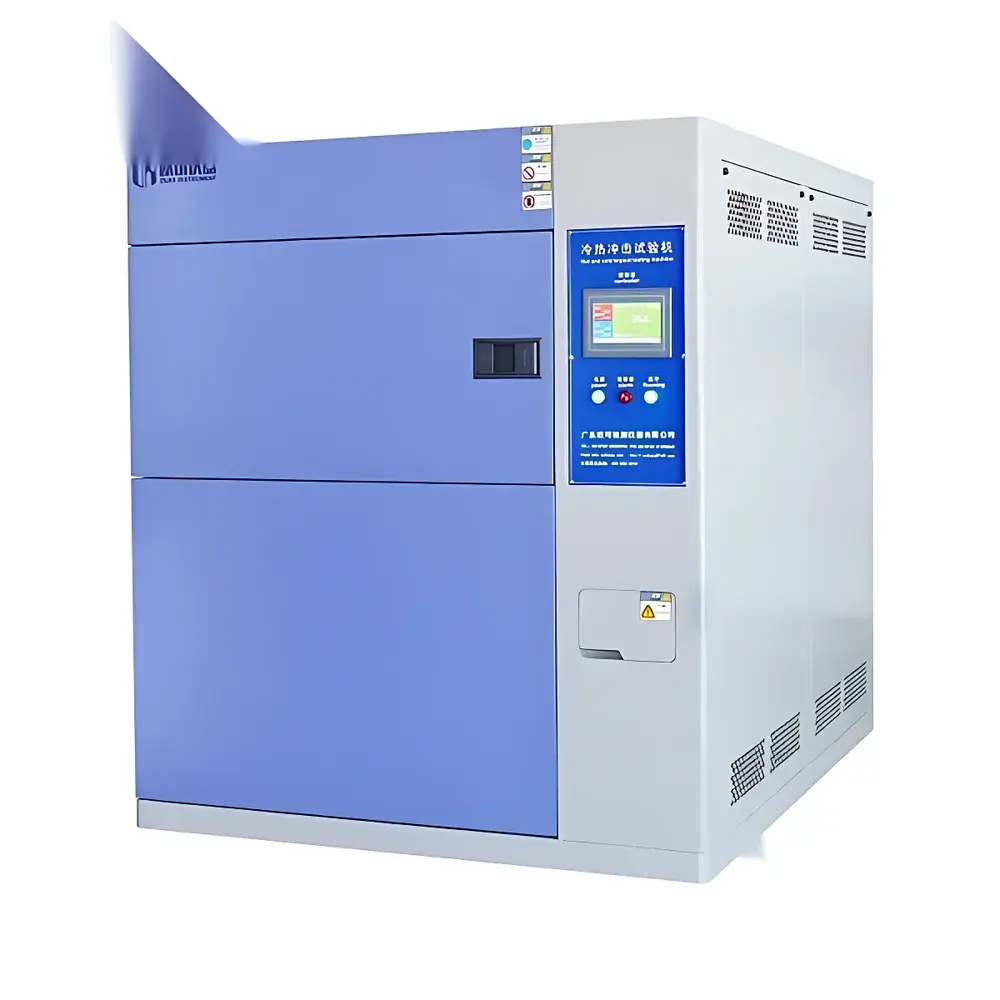
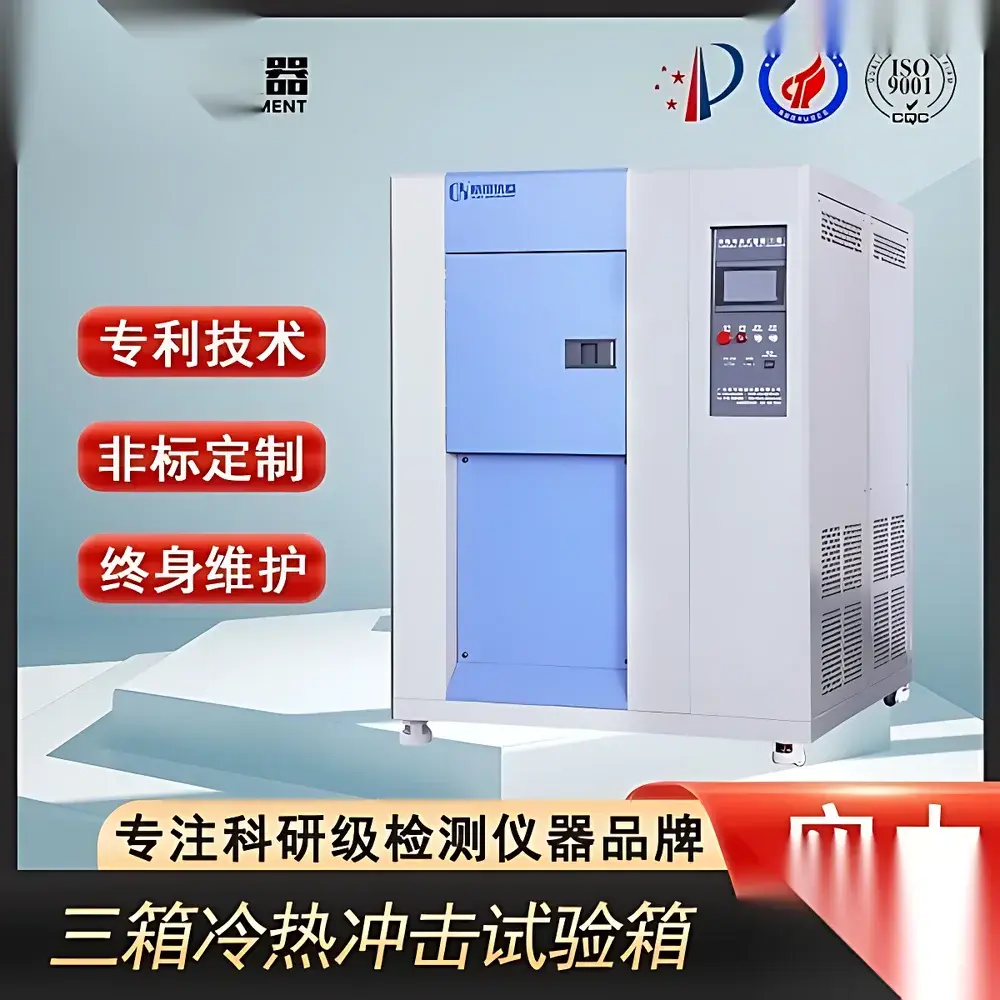
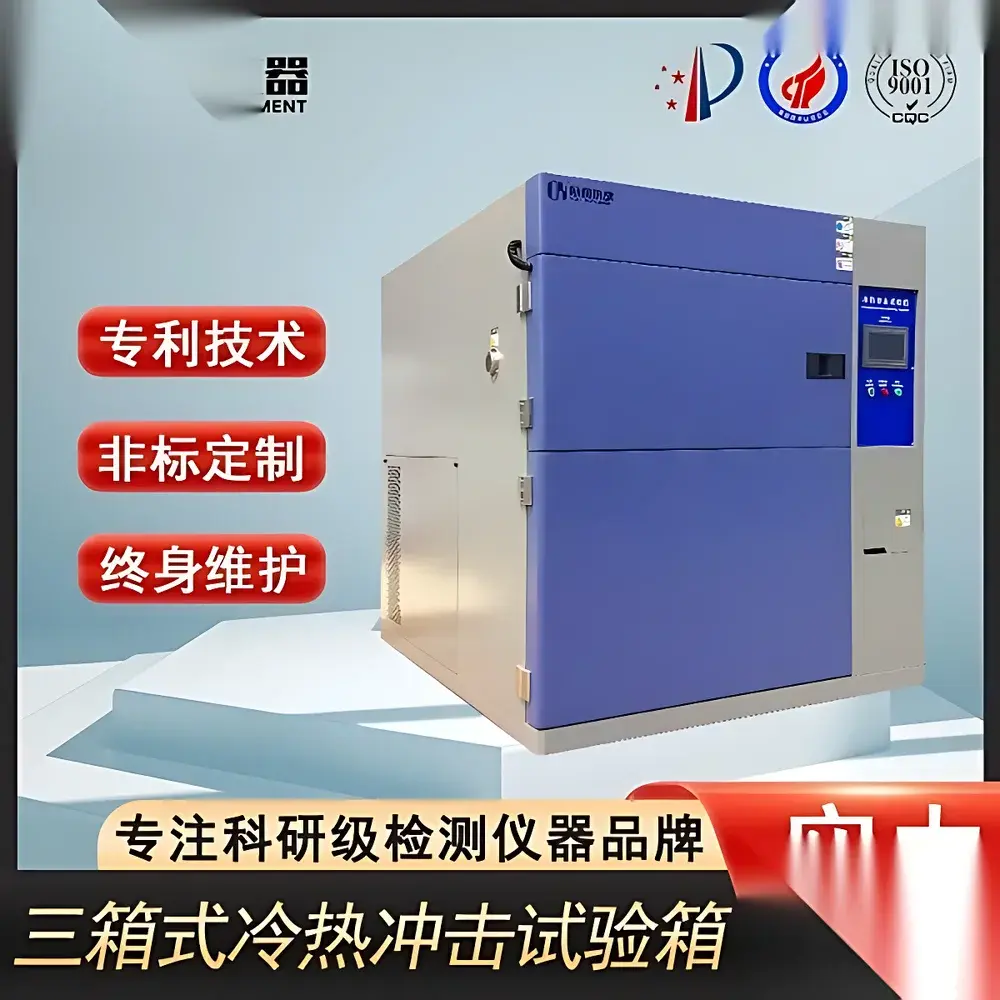
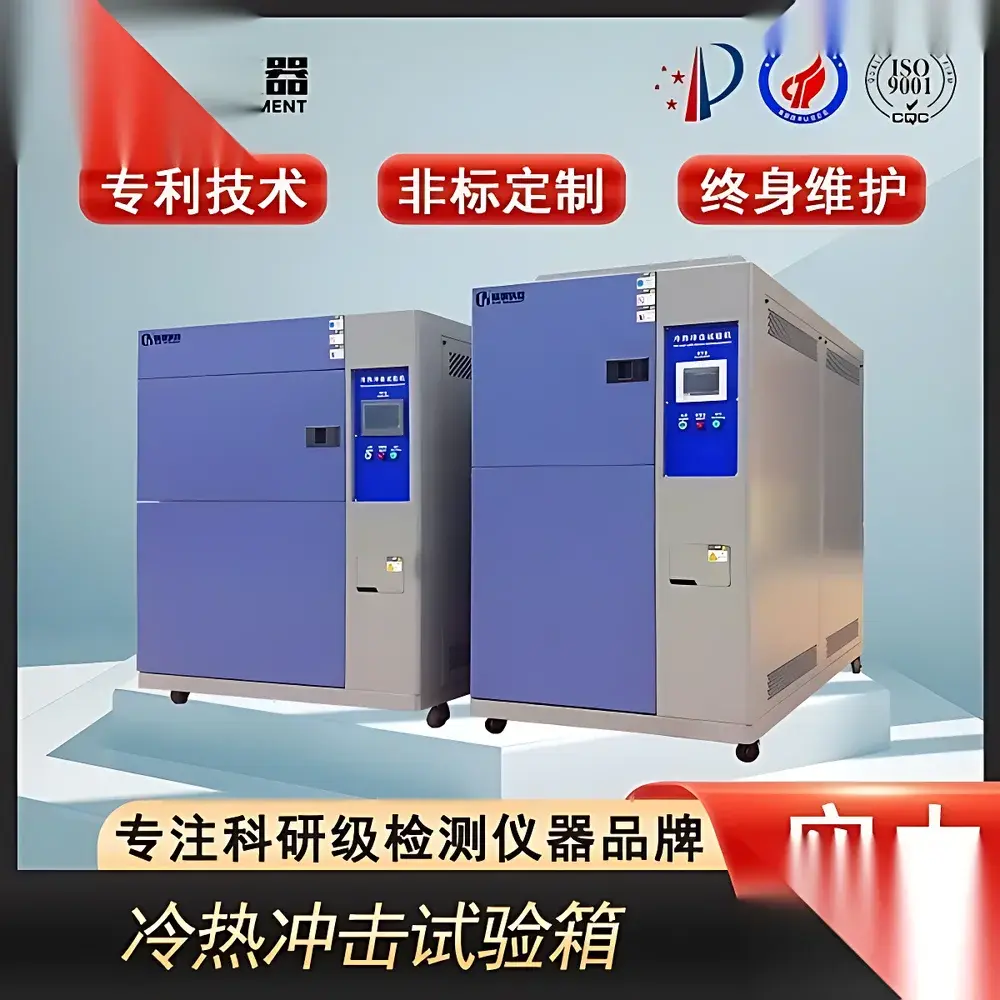
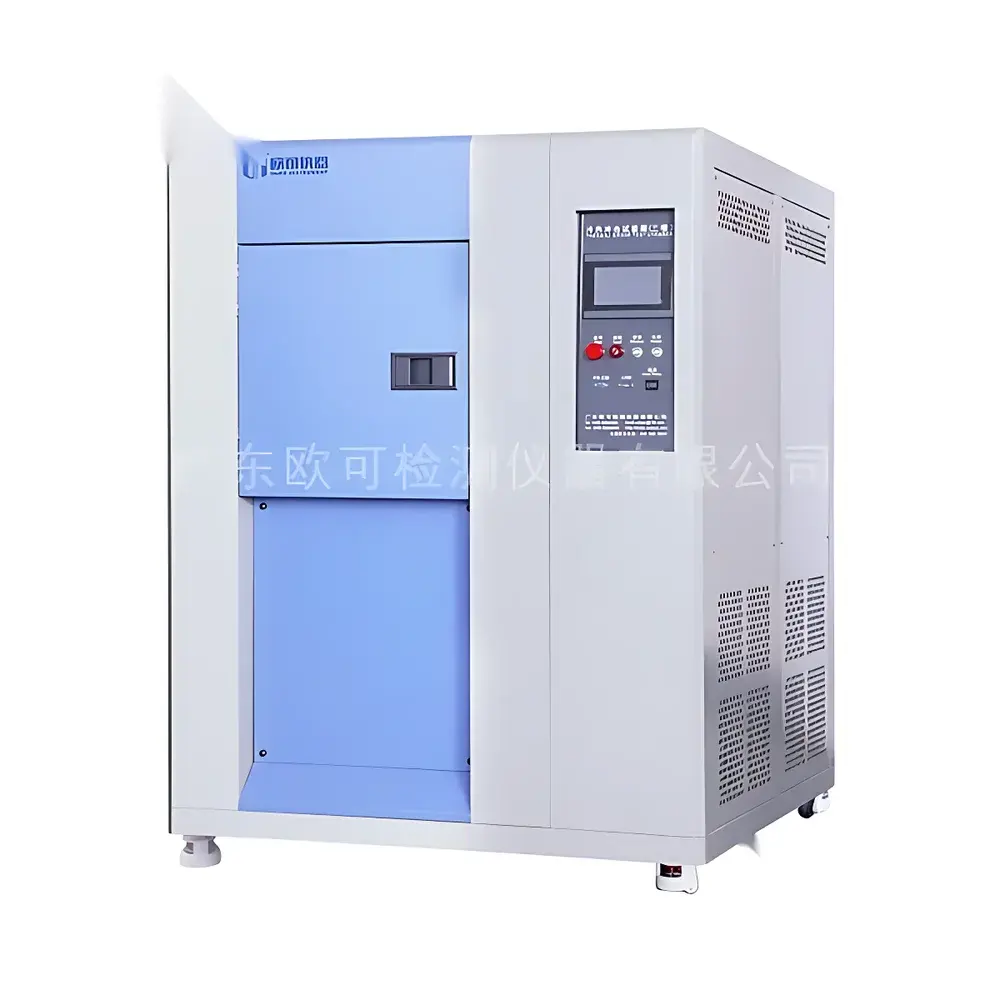
OK-TS-42 Triple-Zone Thermal Shock Test Chamber with Rapid Transition and Dual-Compartment Temperature Storage
| Brand | OK Instruments |
|---|---|
| Origin | Imported |
| Manufacturer Type | Authorized Distributor |
| Temperature Range (High Zone) | +60 °C to +200 °C |
| Temperature Range (Low Zone) | –10 °C to –70 °C (Configurable: A/–40 °C, B/–60 °C, C/–70 °C) |
| Test Chamber Range | 0 °C to –65 °C (Configurable) |
| Temperature Uniformity | ±3 °C |
| Temperature Stability | ±0.5 °C |
| High-to-Low Transition Time | ≤15 s |
| Temperature Recovery Time | ≤5 min |
| Heating Rate (Avg.) | 5 °C/min |
| Cooling Rate (Avg.) | 1.5 °C/min |
| Internal Dimensions (W×H×D) | 360 × 350 × 400 mm |
| External Dimensions (W×H×D) | 1650 × 1790 × 1440 mm |
| Test Port | Ø50 mm (Left Side) |
| Control System | Korean TIME880 or Japanese OYO8226 LCD Touch HMI |
| Compliance | GB/T 2423.1–2 |
Overview
The OK-TS-42 Triple-Zone Thermal Shock Test Chamber is engineered for accelerated reliability validation of electronic components, aerospace assemblies, automotive ECUs, PCBs, and hermetically sealed packages under extreme thermal cycling stress. It operates on the principle of rapid thermal transition between independently controlled high-temperature and low-temperature storage zones—eliminating mechanical movement of test specimens and ensuring zero vibration-induced artifacts during shock events. Unlike single-chamber cyclic chambers, this three-compartment architecture (hot zone / cold zone / test zone) employs pneumatic damper-driven air-path switching to deliver repeatable, high-fidelity thermal transients. The system meets the fundamental physical requirements of thermal shock testing defined in IEC 60068-2-14, MIL-STD-810H Method 503.6, and JESD22-A104D, with full traceability to national metrological standards via NIST-traceable calibration protocols.
Key Features
- Triple-zone architecture with independent hot and cold reservoirs—enabling true static-sample thermal shock without specimen repositioning or mechanical actuation.
- Pneumatically actuated DAPER valves (from Parker Hannifin) ensure sub-15-second zone transition with <±0.3 s timing repeatability and zero leakage at thermal extremes.
- High-efficiency dual-refrigeration cascade system using R507/R23 (zero ozone depletion potential) with dual French Tecumseh compressors and water-cooled shell-and-tube condensers.
- Advanced BTC (Balance Temperature Control) algorithm with PID+SSR modulation maintains thermal equilibrium between heating energy input and chamber heat loss—achieving stable setpoint hold within ±0.5 °C over extended cycles.
- Large-format color LCD touch HMI (TIME880 or OYO8226) supporting bilingual (EN/CN) interface, 96 programmable test profiles, up to 999 cycles, and 999 h 59 min dwell time per segment.
- Integrated RS-232/RS-485 communication port with PC-based software for remote program editing, real-time data logging (temperature, valve status, compressor load), and GLP-compliant audit trail export.
- Structural integrity validated per ISO 14644-1 Class 8 cleanroom-compatible construction: SUS304 mirror-finish interior (1.0 mm), stainless steel exterior, and hybrid insulation (glass wool + rigid polyurethane foam).
Sample Compatibility & Compliance
The OK-TS-42 accommodates standard JEDEC trays, 19″ rack-mount enclosures, and custom fixtures up to 30 kg mass. Its Ø50 mm left-side test port supports live electrical feedthroughs (up to 300 V AC/DC) and thermocouple routing under full thermal isolation. All operational parameters—including ramp rates, dwell times, cycle counts, and alarm thresholds—are configurable to align with qualification protocols per IPC-9701A (Performance Classes), AEC-Q200 (Automotive Passive Components), and NASA-EEE-INST-002 (Space Electronics). The controller firmware implements 21 CFR Part 11–compliant electronic signatures, user-level access control (admin/operator/guest), and immutable event logs for FDA-regulated environments.
Software & Data Management
The embedded controller stores full-cycle temperature profiles, valve actuation timestamps, compressor runtime, and fault history in non-volatile memory. Optional PC software enables CSV export of time-stamped thermocouple readings (T1–T6 configurable), graphical overlay of actual vs. target curves, and automated pass/fail evaluation against user-defined tolerance bands (e.g., ±2 °C deviation threshold). Audit trails include operator ID, timestamp, parameter change history, and calibration certificate metadata—fully compliant with ISO/IEC 17025 documentation requirements for accredited test labs.
Applications
This chamber is routinely deployed in failure analysis labs for solder joint fatigue assessment (IPC-TM-650 2.6.27), plastic package delamination screening (JEDEC JESD22-A106B), MEMS device hysteresis characterization, and battery cell thermal runaway propagation studies. Its rapid transition capability makes it suitable for evaluating thermal interface material (TIM) performance degradation, conformal coating adhesion loss, and optoelectronic module wavelength drift under repeated thermal excursions. Industrial users apply it for HALT (Highly Accelerated Life Testing) pre-screening prior to formal qualification per MIL-HDBK-344A.
FAQ
What standards does the OK-TS-42 comply with?
It satisfies GB/T 2423.1–2022 (cold/dry heat), GB 10592–1989 (temperature gradient specifications), GJB 150A–2009 (military environmental testing), and technical equivalency to IEC 60068-2-14 and MIL-STD-810H Method 503.6.
Can the chamber operate unattended for extended durations?
Yes—equipped with auto-restart after power interruption, scheduled start/stop functionality, and email/SMS alert integration (via optional Ethernet gateway) for remote monitoring.
Is calibration support available with NIST-traceable documentation?
Factory calibration includes 9-point sensor verification across the full operating range; certified calibration reports with uncertainty budgets are provided upon request.
What maintenance intervals are recommended for the refrigeration system?
Compressor oil and filter replacement every 12 months or 4,000 operating hours; annual leak check with helium mass spectrometry and refrigerant purity analysis per AHRI Standard 700.
Does the system support custom test profile scripting beyond the built-in GUI?
Yes—via ASCII command protocol over RS-232, enabling integration into LabVIEW, Python, or MATLAB-based automated test suites with full state-machine control.



