
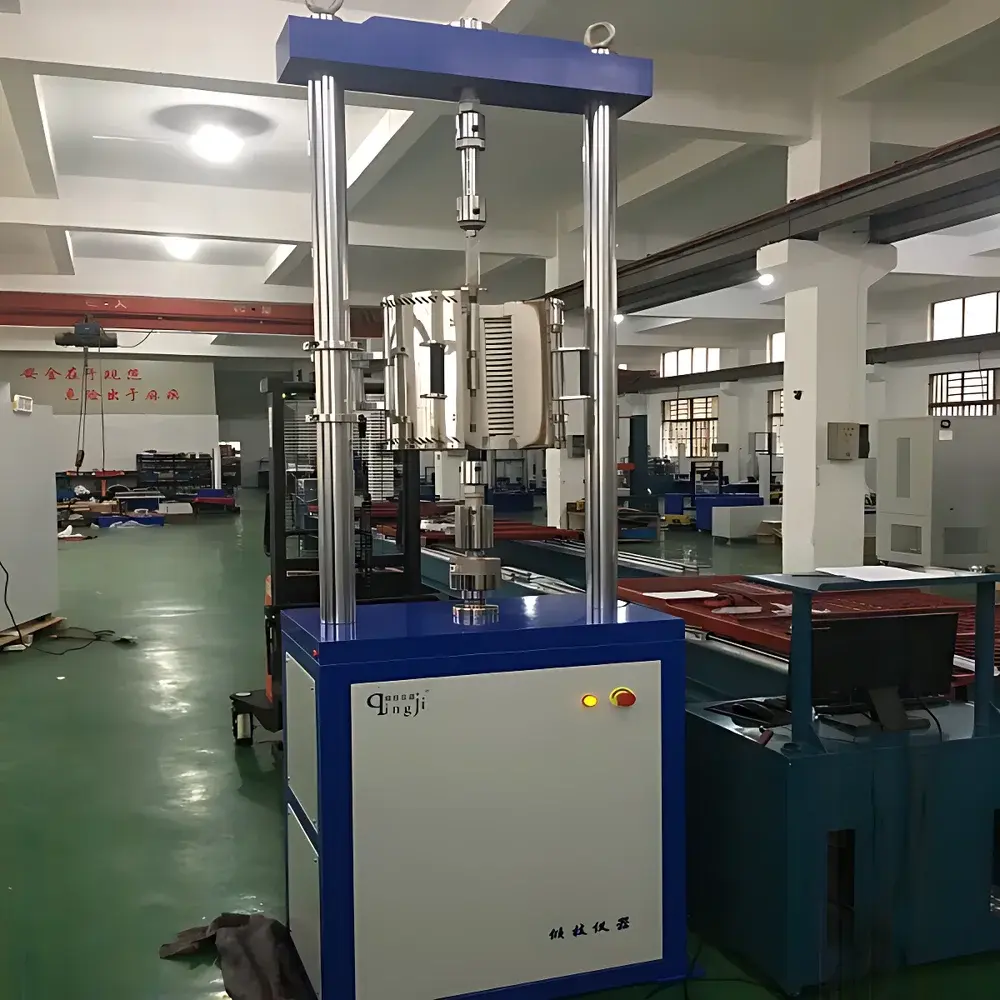
Qinji QJBV212F High-Temperature Tensile Testing Machine
| Brand | Qinji |
|---|---|
| Origin | Shanghai, China |
| Model | QJBV212F |
| Max Test Load | 200 kN |
| Load Range | 1–200 kN (Full Scale) |
| Load Accuracy | ±0.5% of reading (from 1% FS) |
| Crosshead Travel | 800 mm |
| Displacement Resolution | 0.001 mm |
| Temperature Range | Ambient to 1200 °C |
| Furnace Bore Diameter | φ50 mm |
| Furnace Length | 450 mm |
| Uniform Temperature Zone Length | >150 mm |
| Temperature Stability | ±0.5 °C |
| Temperature Resolution | 0.1 °C |
| Creep Load Control | Servo-driven, continuous adjustment (0–100 kN) |
| Load Control Accuracy | ±1% |
| Load Resolution | 0.1 N |
| Power Supply | 3 kW |
| Weight | 850 kg |
Overview
The Qinji QJBV212F High-Temperature Tensile Testing Machine is an engineered solution for static and time-dependent mechanical characterization of metallic and alloy materials under elevated temperature conditions. Designed in accordance with established metrological and testing standards—including JJG 276-1988 (Verification Regulation for High-Temperature Creep and Stress-Rupture Testing Machines), GB/T 2039–1997 (Metallic Materials—Tensile Creep and Stress-Rupture Testing Methods), and HB 5150–1996 / HB 5151–1996 (Aerospace Industry Standards for High-Temperature Tensile Creep and Stress-Rupture Testing)—this system integrates a high-stiffness load frame, precision servo-controlled loading actuation, and a vertically oriented split-type high-temperature furnace. The instrument operates on the principle of uniaxial tensile loading while maintaining specimen temperature uniformity across a defined gauge section, enabling quantification of stress–strain behavior, creep strain rate, time-to-rupture, and minimum creep rate under constant load or constant stress conditions.
Key Features
- Robust dual-column load frame with 200 kN maximum capacity and <0.5% load measurement uncertainty (from 1% of full scale), certified per ISO 7500-1 Class 0.5 requirements.
- High-resolution displacement sensing (0.001 mm) via linear variable differential transformer (LVDT) or encoder-coupled crosshead tracking, supporting both total extension and extensometer-based strain measurement.
- Integrated vertical split-tube furnace with φ50 mm bore and 450 mm overall length, delivering a stable, radially symmetric thermal field with >150 mm uniform zone (±0.5 °C) from ambient to 1200 °C.
- Servo-controlled creep loading system with continuous, programmable force application (0–100 kN range), offering ±1% control accuracy and 0.1 N resolution for precise stress hold and ramp profiles.
- Modular test configuration support: accommodates standard ASTM E139, ISO 204, and GB/T 2039-compliant specimen geometries (e.g., cylindrical, flat, notched) with optional vacuum or inert-gas purge interfaces.
- Thermal shielding and water-cooled load train components ensure long-term operational integrity and minimize thermal drift in load cell and displacement transducers.
Sample Compatibility & Compliance
The QJBV212F is validated for use with ferrous and non-ferrous alloys—including nickel-based superalloys (e.g., Inconel 718, Hastelloy X), titanium alloys (Ti-6Al-4V), austenitic stainless steels (316, 304H), and aluminum alloys—under controlled atmospheric conditions. Specimen mounting utilizes standardized grips compatible with threaded, shoulder, or tabbed configurations. All calibration and verification procedures align with national and international metrological frameworks: JJG 276, GB/T 2039, ASTM E209, ISO 204, and EN 10002-5. The system supports traceable calibration using NIST-traceable deadweight standards and certified reference thermocouples (Type S or K).
Software & Data Management
Control and data acquisition are managed via a dedicated Windows-based platform compliant with GLP/GMP documentation requirements. The software provides real-time plotting of load–time, strain–time, and creep rate–time curves; automated calculation of key parameters including ε̇min, tr, and rupture elongation; and export of raw ASCII or CSV datasets for third-party analysis (e.g., MATLAB, Python, Origin). Audit trail functionality meets FDA 21 CFR Part 11 requirements, recording user actions, method changes, calibration events, and data modifications with timestamps and electronic signatures. Data files are timestamped, version-controlled, and stored in a hierarchical directory structure aligned with ISO/IEC 17025 laboratory information management system (LIMS) integration protocols.
Applications
- Creep property evaluation of turbine blade and disk materials in aerospace propulsion systems.
- Stress-rupture life prediction for pressure vessel components operating at elevated temperatures in petrochemical and nuclear applications.
- Development and qualification of advanced heat-resistant alloys for next-generation gas turbines and fusion reactor structural components.
- Validation of constitutive models (e.g., Norton-Bailey, Garofalo) used in finite element simulation of high-temperature component deformation.
- Quality assurance testing of weldments and additively manufactured parts subjected to thermal-mechanical service loads.
- Research into microstructural evolution (e.g., grain boundary sliding, cavity nucleation) during sustained high-temperature loading.
FAQ
What temperature uniformity can be achieved in the furnace’s hot zone?
The furnace maintains ±0.5 °C deviation over a minimum 150 mm axial length within the specified operating range (ambient to 1200 °C), verified using multi-point calibrated thermocouples per ASTM E220.
Is the system suitable for constant-load creep testing per ISO 204?
Yes—the servo-controlled loading system supports fully automated constant-load mode with closed-loop feedback, meeting ISO 204 Annex A requirements for load stability and data sampling frequency.
Can the machine be integrated into an existing LIMS or MES environment?
The software provides ODBC-compliant database connectivity and supports HL7/ASTM E1384 message formatting for seamless integration with enterprise laboratory and manufacturing execution systems.
What maintenance intervals are recommended for long-term reliability?
Routine inspection of furnace insulation, thermocouple calibration, load cell zero-check, and grip surface wear assessment is advised every 500 operational hours or annually—whichever occurs first—per the manufacturer’s preventive maintenance schedule.



