
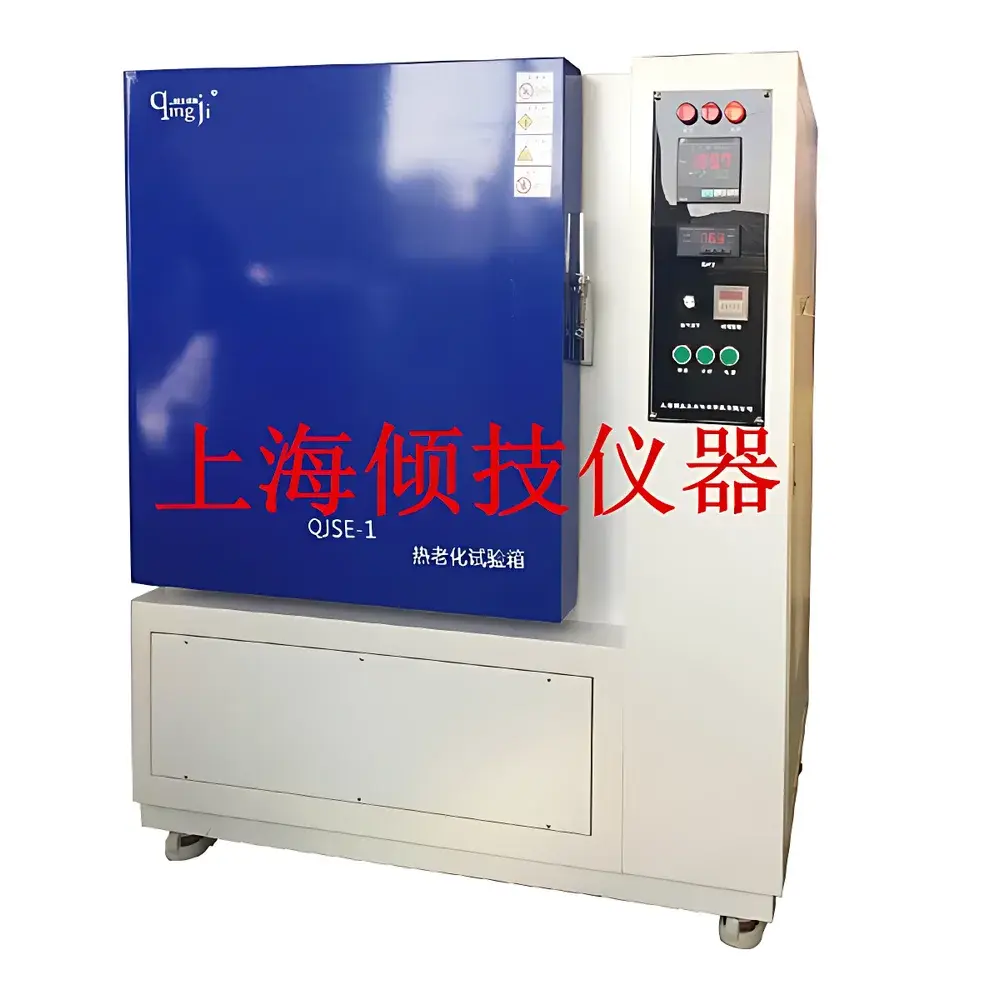
Qinji QJ-AGE Series Electrical Insulating Materials Aging Test Chamber
| Brand | Qinji |
|---|---|
| Origin | Shanghai, China |
| Model | QJ-AGE Series |
| Temperature Range | RT+20°C to 300°C |
| Temperature Uniformity | ≤ ±2°C |
| Temperature Fluctuation | ≤ ±0.5°C |
| Heating Rate | ≤60 min (from RT+20°C to 200°C) |
| Total Power Consumption | 6.7 kW (Heating: 6 kW |
| Auxiliary Systems | 0.7 kW) |
| Noise Level | ≤65 dB(A) |
| Compliance | IEC 60540 (Ed. 2.0, 2019), ASTM D573, ISO 188, GB/T 2951.12–2008 |
| Control System | Imported Digital PID Controller with Dual-Air-Channel Circulation Architecture |
| Safety Features | Dual Independent Overtemperature Cut-off (Electrical & Optical), Redundant Thermal Fuse Protection |
Overview
The Qinji QJ-AGE Series Electrical Insulating Materials Aging Test Chamber is an engineered environmental simulation system designed specifically for accelerated thermal aging evaluation of polymeric insulating materials used in electrical and electronic applications. It operates on the principle of controlled isothermal exposure under standardized atmospheric conditions—enabling precise replication of long-term service degradation mechanisms such as oxidative chain scission, crosslinking, and volatilization of plasticizers. The chamber conforms to the thermally driven aging protocols defined in IEC 60540 (Cables and insulated wires — Test methods for elastomeric and thermoplastic insulations and sheaths), ASTM D573 (Rubber—Deterioration by Heat Aging), ISO 188 (Rubber, vulcanized or thermoplastic—Accelerated ageing and heat resistance tests), and GB/T 2951.12–2008 (Electric cables—Test methods for non-metallic materials—Part 12: Aging methods). Its dual-air-channel forced convection architecture ensures uniform thermal distribution across the working volume, minimizing spatial gradients that could compromise test reproducibility—critical for comparative qualification of insulation formulations across R&D, QC, and regulatory submission workflows.
Key Features
- High-stability temperature control system utilizing imported digital PID controllers with real-time auto-tuning capability and 0.1°C resolution setpoint adjustment
- Dual independent air circulation paths with tangential blower configuration to achieve ≤ ±2°C temperature uniformity across the entire test chamber volume (per IEC 60068-3-5)
- Redundant overtemperature protection: primary electronic cut-off at 310°C + secondary optical thermal fuse (non-resettable) activated at 330°C
- Robust stainless-steel inner chamber (SUS304) with seamless welded construction and high-density mineral fiber insulation (≥100 mm thickness) for low thermal leakage and energy efficiency
- Front-access observation window with double-layer tempered glass and anti-fog heating element for uninterrupted visual monitoring without thermal disturbance
- Modular heater bank design with individual circuit breakers and thermal overload relays—ensuring operational safety and simplified maintenance
Sample Compatibility & Compliance
The QJ-AGE chamber accommodates standard test specimens per IEC 60540—including flat strips (25 mm × 6 mm × 2 mm), dumbbell-shaped tensile samples (Type 1B), and full-diameter cable sections up to Ø35 mm. Specimen racks are configurable for vertical suspension or horizontal placement, supporting simultaneous multi-condition testing (e.g., staggered aging durations at fixed temperature or parallel exposures at different setpoints). All operational parameters—including temperature setpoint, dwell time, ramp rate, and alarm thresholds—are programmable and traceable in accordance with GLP and GMP-aligned documentation practices. The system supports audit-ready data logging compliant with FDA 21 CFR Part 11 requirements when paired with optional validated software modules.
Software & Data Management
While the base unit features a standalone digital controller with local data storage (up to 100 cycles, timestamped), optional PC-integrated software enables remote supervision, automated report generation (PDF/CSV), and long-term trend analysis. The software provides full event logging—including power interruptions, door openings, and alarm triggers—with user-level access control and electronic signature functionality. Calibration records, maintenance logs, and sensor verification reports are stored in a structured database supporting ISO/IEC 17025 laboratory accreditation requirements. All temperature sensors (PT100 Class A) are factory-calibrated and supplied with NIST-traceable certificates.
Applications
- Qualification of ethylene-propylene rubber (EPR), silicone rubber, cross-linked polyethylene (XLPE), and PVC-based insulation compounds for medium- and high-voltage cable systems
- Comparative lifetime estimation of polymer blends under Arrhenius-based accelerated aging models (e.g., extrapolation from 110°C, 135°C, and 150°C isothermal holds)
- Pre-compliance screening for UL 1581 Section 1060 (Heat Aging), CSA C22.2 No. 0.3, and EN 50306-2
- Material stability assessment during formulation development for aerospace wire harnesses and automotive EV battery interconnects
- Supporting failure analysis investigations where thermal history reconstruction is required for root-cause determination
FAQ
What standards does this chamber directly support for test execution?
It is configured and validated for IEC 60540, ASTM D573, ISO 188, and GB/T 2951.12–2008. Optional calibration packages extend coverage to UL 1581 and EN 50306 series.
Can the chamber operate continuously at 300°C for extended periods?
Yes—the thermal insulation, heater design, and airflow management allow stable 300°C operation for ≥1,000 hours, subject to periodic verification of sensor drift and chamber uniformity.
Is third-party IQ/OQ validation support available?
Qinji provides documented IQ/OQ templates aligned with ISO 13485 and GMP Annex 15 frameworks; on-site protocol execution and witness testing can be arranged through authorized regional partners.
How is temperature uniformity verified during routine use?
Users perform quarterly mapping using nine calibrated PT100 probes placed per IEC 60068-3-5; deviation limits are enforced automatically via the controller’s built-in uniformity diagnostic mode.
Does the system include provisions for exhaust gas management during volatile decomposition?
An optional activated carbon filtration module and external vent duct interface (DN80 flange) are available for applications involving halogenated polymers or flame-retardant additives.



