
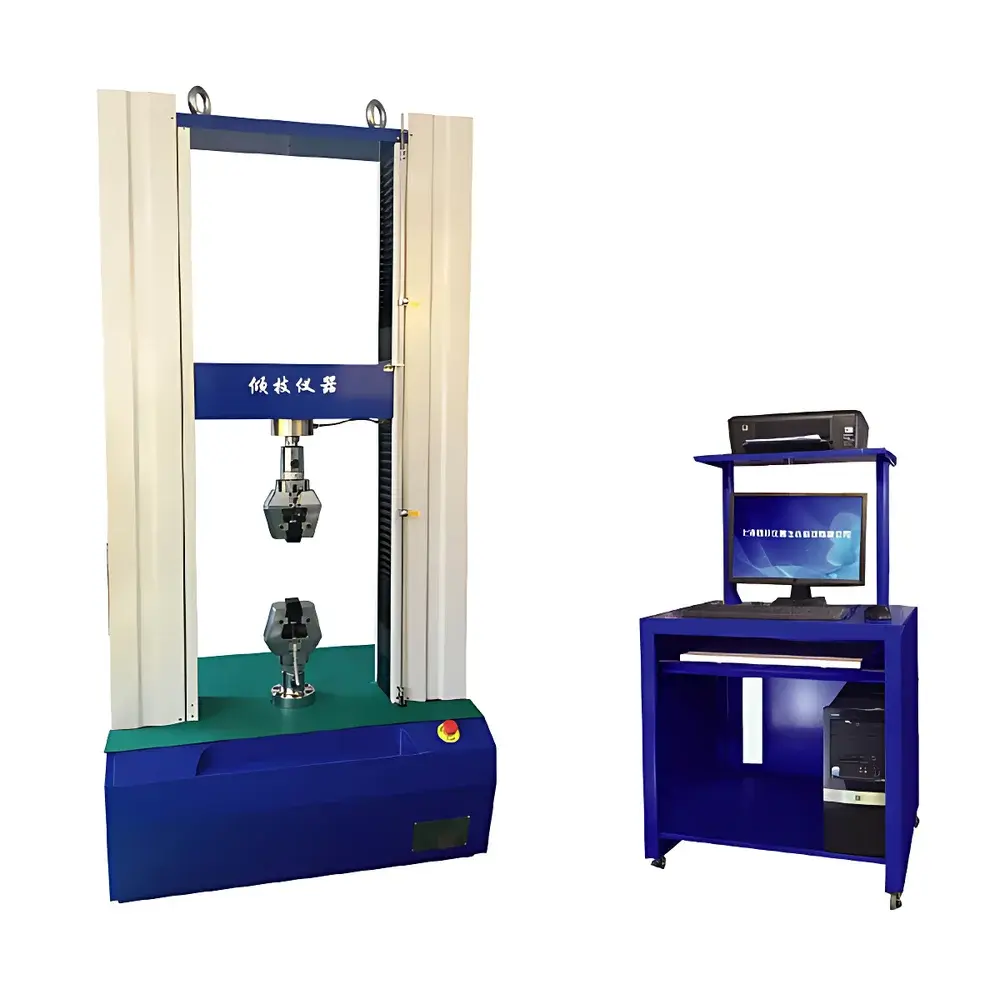
QJ212 Universal Testing Machine
| Origin | Shanghai, China |
|---|---|
| Manufacturer Type | Authorized Distributor |
| Origin Category | Domestic (China-made) |
| Model | QJ212 |
| Instrument Type | Electromechanical Universal Testing Machine |
| Load Capacity | Up to 500 kN (configurable in 50/100/200/300/500 kN ranges) |
| Force Accuracy | Class 0.5 per ISO 7500-1 |
| Effective Test Width | 520 mm |
| Max Tensile Stroke | 800 mm |
| Speed Range | 0.01–1000 mm/min (standard max: 300 mm/min) |
| Speed Accuracy | ±0.5% of indicated value |
| Displacement & Strain Measurement Accuracy | ±0.5% of indicated value |
| Force Resolution | 500,000 counts,不分档 (single-range, full-scale resolution maintained) |
| Sensor | High-precision load cell (USA-sourced) |
| Controller | Panasonic全数字交流伺服控制系统 |
| Control Mode | Full-digital closed-loop control supporting constant load, constant strain, constant displacement, and cyclic testing |
| Safety Protection | Software-based overload diagnosis (10% over capacity), electronic travel limits, mechanical emergency stop |
| Power Requirement | 2–5 kW |
| Dimensions (W×D×H) | 1000 × 680 × 2450 mm |
| Weight | ~1450 kg |
Overview
The QJ212 Universal Testing Machine is an electromechanical static materials tester engineered for high-precision mechanical property evaluation across tensile, compression, flexure, peel, shear, tear, puncture, and low-cycle fatigue regimes. Built on a rigid dual-column frame architecture with reinforced crosshead guidance and precision-ground lead screws, it delivers stable force transmission and minimal deflection under load—critical for achieving ISO 7500-1 Class 0.5 force accuracy and repeatable displacement linearity. Its measurement principle relies on real-time feedback from a high-stability, temperature-compensated load cell (sourced from a U.S.-based OEM), coupled with closed-loop servo control that dynamically adjusts motor torque to maintain target stress/strain/displacement profiles. Designed for integration into QC labs, R&D centers, and certification facilities, the QJ212 supports standardized mechanical characterization compliant with global regulatory frameworks governing material qualification.
Key Features
- Full-range force resolution of 500,000 counts without internal range switching—ensures consistent resolution across the entire 50 kN to 500 kN configurable capacity.
- Dual-speed crosshead actuation (fast/slow modes) with programmable acceleration/deceleration profiles for optimized test cycle time and specimen integrity during loading/unloading.
- Integrated safety architecture: software-driven overload cutoff (10% above set limit), hardware-based electronic end-limit switches, and manual emergency stop—all independently validated per IEC 61800-5-2 functional safety guidelines.
- Modular fixture interface compatible with ISO 26203-compliant wedge, pin, and hydraulic clamping systems; custom fixtures available per ASTM E8/E21 specifications for metallics or ISO 527/ASTM D638 for polymers.
- Real-time data acquisition at ≥1 kHz sampling rate, synchronized with position and strain channel inputs—enabling accurate modulus calculation and yield point detection per ASTM E111 and ISO 527-2.
- Self-diagnostic firmware with event logging (including overload events, sensor drift alerts, and actuator thermal warnings) traceable via timestamped audit trail—supporting GLP/GMP documentation requirements.
Sample Compatibility & Compliance
The QJ212 accommodates specimens ranging from thin films (≥0.05 mm thickness) to structural steel coupons (up to 60 mm width × 25 mm thickness), provided within its 520 mm effective test width and 800 mm vertical stroke envelope. It meets mechanical testing requirements defined in over 20 international and industry-specific standards—including ASTM E8 (tension), E9 (compression), D638 (plastics), D790 (flexure), D1876 (peel), D3574 (foam compression), ISO 6892-1 (metal tensile), ISO 178 (flexural), GB/T 228.1 (Chinese national standard), JIS Z 2241, and DIN 50125. All test protocols are pre-configured in software with parameter validation logic to prevent out-of-spec execution—ensuring result validity for third-party accreditation (e.g., CNAS, A2LA, UKAS).
Software & Data Management
The embedded Windows-based test control software provides real-time graphical visualization of stress–strain, load–displacement, and time-history curves. Users may perform post-test operations including curve overlay, segment extraction, derivative calculation (e.g., tangent modulus), automatic yield strength determination (0.2% offset method), and fracture energy integration—all compliant with ASTM E1823 definitions. Raw data exports are generated in CSV and XML formats with embedded metadata (operator ID, calibration certificate ID, environmental conditions). Audit-trail functionality records all user actions, parameter modifications, and system events with tamper-proof timestamps—meeting FDA 21 CFR Part 11 requirements for electronic records and signatures when deployed with validated user access controls and electronic signature workflows.
Applications
- Metallic materials: Yield strength, ultimate tensile strength, elongation at break, reduction in area, Young’s modulus, and proof stress evaluation per ASTM E8 and ISO 6892-1.
- Polymers & composites: Tensile modulus, breaking elongation, flexural strength, and creep compliance under ISO 527 and ASTM D790.
- Adhesives & laminates: Peel resistance (90°/180°), shear strength, and interfacial fracture toughness using ASTM D1876 and D1002 protocols.
- Elastomers & foams: Compression set, resilience, and hysteresis loop analysis per ASTM D3574 and ISO 1856.
- Bio-materials: Suture tensile strength, hydrogel compressive modulus, and scaffold mechanical stability per ISO 10993-12 and ASTM F2125.
FAQ
What load capacities are supported by the QJ212, and how is capacity selection implemented?
The QJ212 is factory-configured for one of five nominal capacities: 50 kN, 100 kN, 200 kN, 300 kN, or 500 kN. Capacity is selected during initial commissioning via software calibration and verified with NIST-traceable deadweight standards. No hardware modification is required for re-ranging within the 500 kN maximum envelope.
Does the system support automated test sequence execution for batch testing?
Yes—the software includes a scriptable test scheduler allowing sequential execution of up to 99 test methods with auto-save, pass/fail criteria evaluation, and report generation. Each test step can define unique control modes, speed ramps, dwell periods, and termination conditions.
Is the QJ212 suitable for dynamic fatigue testing?
It supports low-cycle fatigue (LCF) testing up to 5 Hz with sinusoidal or trapezoidal waveforms when equipped with optional high-response servo drive tuning and dedicated fatigue software module—compliant with ASTM E606 and ISO 1099.
How is calibration traceability maintained?
Each unit ships with a factory calibration certificate referencing NIST-traceable standards. Annual recalibration is recommended; certified service engineers perform verification against ISO/IEC 17025-accredited reference machines, issuing updated certificates with uncertainty budgets.
Can the system be integrated into a laboratory information management system (LIMS)?
Yes—via OPC UA or TCP/IP API interfaces, enabling bidirectional data exchange with LIMS platforms such as LabWare, STARLIMS, or Thermo Fisher SampleManager for sample ID synchronization, result auto-import, and electronic batch record linkage.



