
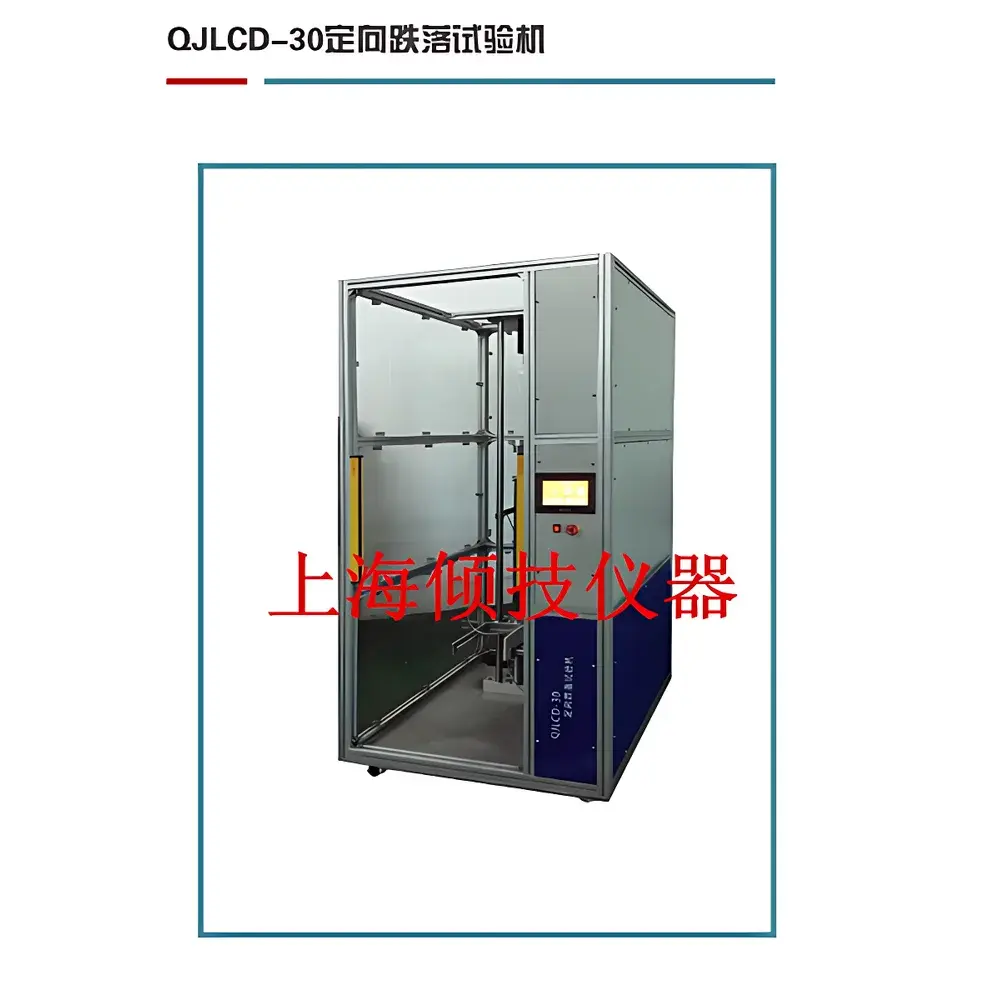
Qinji QJBLC-73 Single-Arm Packaging Drop Tester
| Brand | Qinji |
|---|---|
| Origin | Shanghai, China |
| Model | QJBLC-73 |
| Instrument Type | Electronic Universal Testing Machine |
| Drop Height Range | 300–2000 mm |
| Accuracy Class | ≥ Grade 1 |
| Drop Orientation | Face, Edge, Corner |
| Height Indication | LED Digital Display |
| Height Display Accuracy | ≤ ±2% of Set Value |
| Maximum Load Capacity | 60 kg |
| Test Chamber Dimensions | 1000 × 800 × 800 mm |
| Angular Deviation in Drop Orientation | ≤ 5° |
| Motor Power | 0.5 HP |
| Overall Dimensions (L×W×H) | ≈ 1700 × 1200 × 3015 mm |
| Net Weight | 435 kg |
| Power Supply | AC 380 V, 50 Hz, 10 A |
| Compliant Standards | ISO 2248, JIS Z0202-87, GB/T 4857.5–1992 |
Overview
The Qinji QJBLC-73 Single-Arm Packaging Drop Tester is an electromechanically actuated, gravity-driven impact testing system engineered for quantitative evaluation of package integrity under simulated free-fall conditions. It operates on the principle of controlled vertical release—where a test specimen, secured to a lifting carriage, is elevated to a user-defined height and then released without mechanical interference to undergo unimpeded free fall onto a rigid, horizontal impact surface. This methodology replicates real-world distribution hazards including manual handling drops, palletized unit load instability, and conveyor-induced impacts. Designed in strict accordance with internationally recognized transport packaging test standards—including ISO 2248 (Packaging—Complete, filled transport packages—Vertical impact test by dropping), JIS Z0202-87 (Japanese Industrial Standard for Package Drop Testing), and GB/T 4857.5–1992 (Chinese National Standard for Packaging—Basic Tests for Transport Packages—Part 5: Vertical Impact Test by Dropping)—the QJBLC-73 provides traceable, repeatable, and auditable test data essential for quality assurance, regulatory submission, and supply chain validation.
Key Features
- Single-arm cantilever architecture with high-rigidity steel frame, ensuring structural stability during repeated drop cycles and minimizing lateral deflection during impact;
- Precision-height adjustment via servo-controlled lifting mechanism, supporting continuous height selection from 300 mm to 2000 mm in 1 mm increments;
- LED digital height display with real-time feedback and ≤ ±2% deviation relative to set value, enabling rapid verification prior to each test cycle;
- Three-axis orientation capability: programmable face-down, edge-down, and corner-down drop configurations, each aligned within ≤5° angular tolerance per IEC/ISO alignment tolerances;
- Test chamber volume of 1000 × 800 × 800 mm accommodates standard shipping containers, corrugated boxes, retail-ready packaging, and intermediate bulk containers (IBCs) up to 60 kg gross weight;
- Integrated safety interlock system including emergency stop button, infrared light curtain, and mechanical anti-rebound latch to prevent unintended carriage descent or post-impact rebound;
- AC 380 V, 50 Hz, 10 A power input compatible with industrial three-phase infrastructure; 0.5 HP motor ensures consistent lifting torque across full height range without thermal derating.
Sample Compatibility & Compliance
The QJBLC-73 supports a broad spectrum of packaged goods—from consumer electronics enclosures and pharmaceutical secondary packaging to food-grade flexible pouches and industrial component crates. Its open-test-chamber design permits rapid reconfiguration for irregularly shaped items, while the 60 kg load capacity covers >95% of commercial shipping units defined in ASTM D4169 and ISTA 3A protocols. All mechanical and control functions conform to ISO/IEC 17025 general requirements for competence of testing and calibration laboratories. The instrument’s operational parameters are fully documented for inclusion in GLP-compliant test reports and FDA 21 CFR Part 11–aligned audit trails when integrated with validated third-party data acquisition software.
Software & Data Management
While the QJBLC-73 operates as a standalone hardware platform with embedded microcontroller-based logic, it features RS-232 and optional Ethernet interfaces for integration into centralized laboratory information management systems (LIMS). Users may log test parameters—including drop height, orientation mode, sample ID, operator name, date/time stamp, and pass/fail status—into external databases via ASCII protocol. For regulated environments, optional firmware upgrades support timestamped event logging with digital signature capability, fulfilling minimum ALCOA+ (Attributable, Legible, Contemporaneous, Original, Accurate, Complete, Consistent, Enduring, Available) data integrity requirements. No proprietary cloud service or vendor-hosted platform is required or embedded.
Applications
- Validation of cushioning performance in foam-in-place, molded pulp, and honeycomb paperboard inserts;
- Comparative assessment of seal strength and seam integrity in flexible packaging after simulated transit shock;
- Design verification of child-resistant closures and tamper-evident bands under worst-case orientation impact;
- Correlation studies between drop test failure modes and vibration-induced damage observed in ASTM D999 or ISO 13355 simulations;
- Supplier qualification testing per ISO 11607 (Packaging for terminally sterilized medical devices) Annex C criteria;
- Root cause analysis of field return incidents through controlled reproduction of suspected drop scenarios.
FAQ
Is the QJBLC-73 compliant with FDA or EU MDR requirements for medical device packaging validation?
Yes—when operated within its certified height and load specifications and paired with documented test procedures aligned with ISO 11607-1:2019 and ISO 11607-2:2019, the system supports generation of data suitable for regulatory submissions. Full compliance requires site-specific IQ/OQ/PQ validation executed by the end user.
Can the drop height be calibrated and certified by an accredited metrology lab?
Yes—the height measurement subsystem uses traceable linear encoder feedback and is compatible with NIST-traceable calipers or laser distance meters. Calibration certificates may be issued per ISO/IEC 17025 upon request.
What maintenance intervals are recommended for long-term reliability?
Routine inspection of guide rails, lifting cable tension, and impact surface flatness is advised every 500 test cycles. Annual lubrication of gearmotor assemblies and verification of electrical grounding continuity are included in the manufacturer’s maintenance schedule.
Does the system include test report generation functionality?
No built-in report engine is provided; however, all test parameters are exportable via serial interface for automated report assembly using Excel, LabVIEW, or custom LIMS modules.
Is technical support available outside mainland China?
Yes—Qinji maintains authorized service partners in Southeast Asia, the Middle East, and Latin America. Remote diagnostics and English-language engineering documentation are standard with every unit shipment.



