
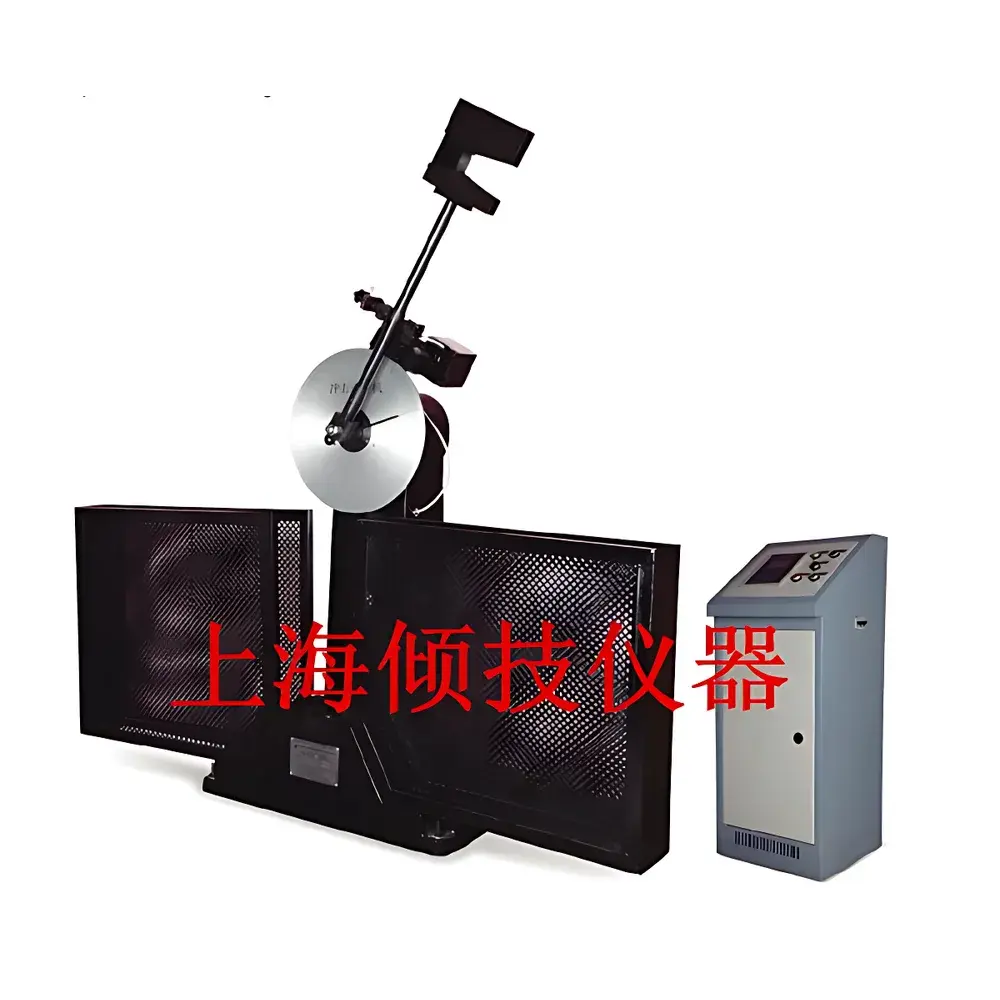
QJBCS Alloy Impact Testing Machine
| Origin | Shanghai |
|---|---|
| Manufacturer Type | Distributor |
| Origin Category | Domestic |
| Model | QJBCS |
| Quotation | ¥40,000 |
| Instrument Type | Other Impact Testing Machines |
| Impact Energy | 450 J |
| Impact Velocity | 5.2 m/s |
| Pendulum Torque (Impact Constant) | 100 N·m |
| Load Cell Range | 100 N |
| Maximum Lifting Height | 200 mm |
Overview
The QJBCS Alloy Impact Testing Machine is a manually operated pendulum-type impact tester engineered for precise Charpy V-notch and Izod impact testing of metallic materials in accordance with internationally recognized standards—including ISO 148-1:2016, ASTM E23-22, and GB/T 229–2020. It employs classical pendulum mechanics based on conservation of energy principles: potential energy stored during pendulum elevation is converted into kinetic energy at the point of impact, enabling quantitative determination of absorbed energy during fracture. Designed specifically for ferrous alloys—including carbon steels, stainless steels, tool steels, and high-strength aluminum or titanium alloys—the system delivers repeatable, traceable results essential for quality control laboratories, metallurgical R&D facilities, and third-party certification bodies operating under GLP or ISO/IEC 17025 frameworks.
Key Features
- Manually actuated pendulum lifting mechanism with friction-based braking system—ensures stable, low-drift energy retention prior to release.
- Dual-scale calibrated pendulum with nominal impact energies of 150 J, 300 J, and 450 J, selectable via interchangeable hammers and verified per GB/T 808–2002 calibration requirements.
- Pendulum torque (impact constant) precisely set at 100 N·m, supporting consistent angular momentum transfer across test cycles.
- Standardized impact blade geometry: radius 2.0–2.5 mm, thickness 16 mm, aligned to ISO 148-2 and ASTM E23 specifications for notch sensitivity reproducibility.
- Rigid cast-iron base and reinforced frame (1000 × 830 × 1520 mm; ~300 kg) minimize vibration-induced measurement uncertainty during high-energy impacts.
- Integrated load cell (100 N range) enables real-time force-time profiling for advanced fracture dynamics analysis when paired with optional high-speed data acquisition modules.
Sample Compatibility & Compliance
The QJBCS accommodates standard Charpy specimens (10 mm × 10 mm × 55 mm) with V-notch or U-notch configurations, as well as sub-sized variants (e.g., 5 mm × 5 mm cross-sections) using appropriate support anvils. It complies with mechanical alignment tolerances defined in ISO 148-1 for anvil span (40 mm ± 0.2 mm), specimen centering, and blade-to-anvil clearance. All calibration and verification procedures follow GB/T 808–2002, which aligns with ISO 17025 metrological traceability requirements. The instrument supports audit-ready documentation for regulatory submissions under FDA 21 CFR Part 11 when integrated with compliant laboratory information management systems (LIMS).
Software & Data Management
While the base QJBCS operates without embedded software, it is compatible with optional PC-based data acquisition systems supporting USB or RS-232 interfaces. These platforms provide digital readout of absorbed energy (J), peak load (N), time-to-fracture (ms), and graphical force-displacement curves. Calibration certificates include uncertainty budgets compliant with ISO/IEC 17025 Annex A. Audit trails, user access controls, and electronic signatures can be implemented via external LIMS integration—enabling full compliance with GMP/GLP environments requiring data integrity per ALCOA+ principles.
Applications
- Quality assurance of structural steels used in pressure vessels, pipelines, and offshore platforms.
- Evaluation of temper embrittlement susceptibility in quenched-and-tempered alloy steels.
- Low-temperature toughness screening for cryogenic applications (e.g., LNG components).
- Comparative impact resistance assessment of weld metal, heat-affected zones (HAZ), and base materials.
- Metallurgical process validation—including aging, annealing, and surface hardening treatments.
- Failure analysis labs conducting root cause investigations involving brittle vs. ductile fracture modes.
FAQ
What standards does the QJBCS comply with for calibration and operation?
It conforms to GB/T 808–2002 (equivalent to ISO 148-1:2016 for verification) and GB/T 229–2020 (aligned with ASTM E23 and ISO 148-1 for test execution).
Can the machine test non-standard specimen sizes?
Yes—sub-sized specimens (e.g., 5 mm or 7.5 mm square cross-sections) may be tested using certified auxiliary supports and energy correction factors per ASTM E23 Annex A.
Is the 450 J impact energy rating the maximum usable value?
Yes—the 450 J configuration represents the highest calibrated energy level; lower settings (150 J, 300 J) are achieved by adjusting pendulum mass or radius of gyration per standardized calibration protocols.
How is measurement uncertainty quantified for this instrument?
Relative error is specified at ±1% across the full energy range, validated using certified reference specimens traceable to national metrology institutes (e.g., NIM China or NIST SRM 2241).
Does the system support automated data export for regulatory reporting?
When connected to optional DAQ hardware and compliant software, it supports CSV, XML, and PDF report generation with embedded metadata—including operator ID, timestamp, calibration status, and environmental conditions—for 21 CFR Part 11–compliant archives.



