
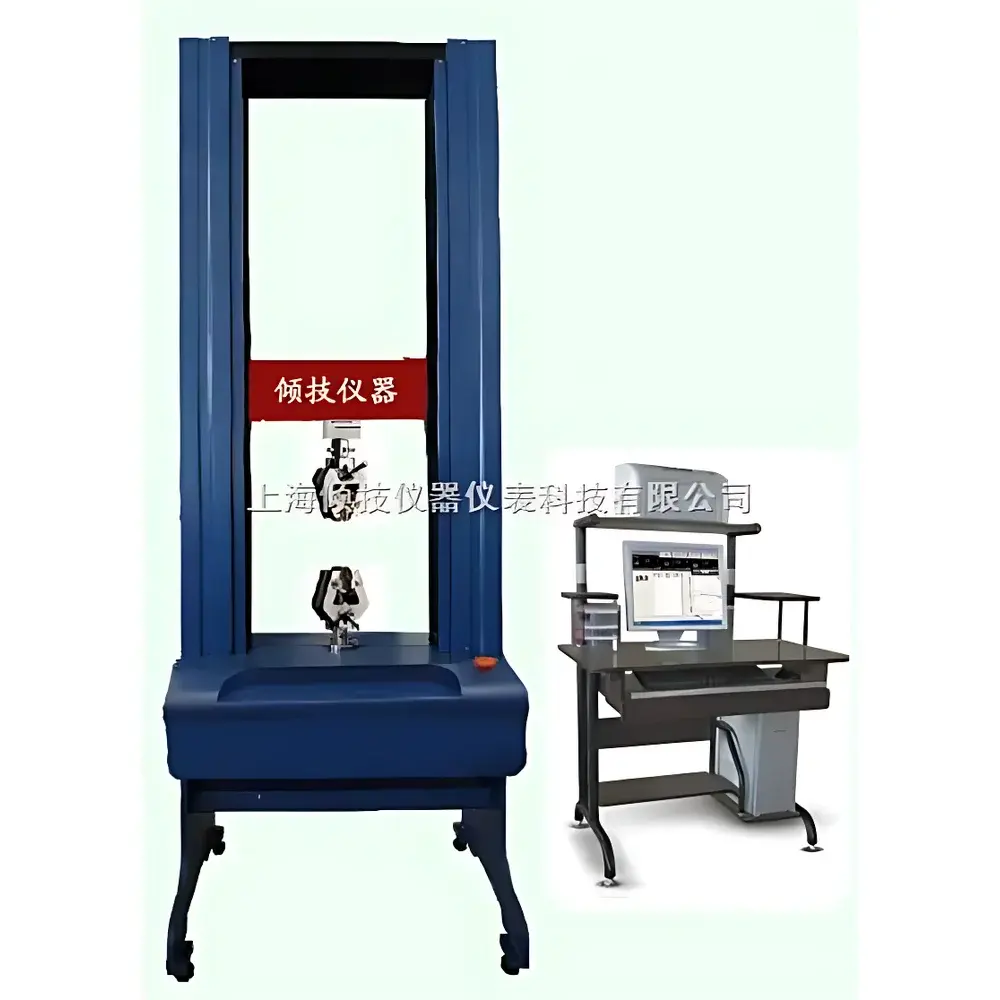
Qingji QJ211S Three-Point and Four-Point Bending Tester for LCD Glass Substrates
| Brand | Qingji |
|---|---|
| Origin | Shanghai, China |
| Model | QJ211S |
| Maximum Load Capacity | 10 kN |
| Accuracy Class | 0.5 |
| Effective Test Width | 320 mm |
| Stroke (Tensile Space) | 500 / 800 mm |
| Test Speed Range | 0.01–300 mm/min |
| Speed Accuracy | ±0.5% of reading |
| Force Resolution | 500,000 counts (full-scale, no range switching) |
| Force Measurement Range | 0.02–100% of full scale |
| Displacement & Strain Measurement Accuracy | ±0.5% of reading |
| Load Cell | High-precision U.S.-sourced sensor |
| Controller | Panasonic全-digital AC servo controller |
| Control System | Full-digital closed-loop system supporting constant stress, constant strain, and constant displacement modes |
| Safety Protection | Software diagnostics, electronic limit switches, overload protection at 110% of rated load |
| Weight | ~145 kg |
Overview
The Qingji QJ211S Three-Point and Four-Point Bending Tester is a precision electromechanical testing system engineered for the mechanical characterization of brittle, thin-film, and laminated substrates—particularly flat-panel display components such as TFT-LCD, OLED, and microLED glass substrates. It operates on standardized flexural loading principles defined in ASTM C1161, ISO 178, GB/T 9341, and JIS K7203, enabling controlled application of bending moments to evaluate fracture strength, elastic modulus, flexural yield point, and post-yield behavior under quasi-static conditions. Unlike general-purpose universal testers, the QJ211S integrates purpose-built fixtures, high-resolution displacement feedback, and low-noise force transduction specifically optimized for sub-millimeter-thick soda-lime or aluminosilicate glass specimens (typical thickness: 0.3–1.1 mm), where surface flaw sensitivity and edge effects dominate failure mechanics.
Key Features
- High-fidelity dual-mode bending configuration: Interchangeable three-point and four-point fixture sets with precision-ground support and loading rollers (diameter ≤ 3 mm) to minimize contact stress concentration per ISO 14125 requirements.
- 0.5-class accuracy certified force measurement chain, incorporating a U.S.-manufactured load cell with 500,000-count resolution and no internal range switching—ensuring consistent signal fidelity across the full 10 kN capacity.
- Dual-speed crosshead actuation (manual rapid return + programmable test speed from 0.01 to 300 mm/min) with ±0.5% speed accuracy, critical for capturing rate-dependent cracking thresholds in chemically strengthened glass.
- Full-digital closed-loop control architecture based on Panasonic AC servo drive and embedded motion controller, supporting real-time profile execution for multi-segment tests (e.g., preload → dwell → ramp → hold → unload).
- Integrated safety redundancy: hardware-based electronic limit switches, software-driven overload cutoff (triggered at 110% of 10 kN), and automatic return-to-home upon test completion or fault detection.
- Modular fixture interface compatible with custom-designed ceramic or hardened steel anvil sets for edge-supported, double-ring, or concentric loading geometries per IPC-TM-650 2.6.2.2 or SEMI D32 standards.
Sample Compatibility & Compliance
The QJ211S accommodates rectangular glass coupons up to 320 mm wide and 800 mm long, with standard test spans configurable from 20 mm to 100 mm (per ASTM C1161 Annex A1). It supports both uncoated and ITO-coated substrates, tempered or annealed glass, and laminated touch modules (e.g., cover lens + OCA + sensor glass). All mechanical calibrations are traceable to NIM (National Institute of Metrology, China) and align with ISO/IEC 17025 laboratory accreditation requirements. The system meets essential safety and electromagnetic compatibility criteria per GB/T 12802.1–2017 and EN 61326-1:2013, and its control firmware supports audit-ready operation logs required under GLP environments.
Software & Data Management
The Windows-based QTestSuite v4.x software provides native support for ASTM E4, ISO 178, and GB/T 228.1-compliant test method templates. Real-time plotting displays synchronized force–displacement, stress–strain, and deflection–time curves with user-adjustable axis scaling, overlay capability, and dynamic cursor interrogation. Raw data exports to CSV, XLSX, and XML formats include timestamped metadata (operator ID, environmental temperature/humidity if external sensors are connected), and all test sequences are stored with SHA-256 hash integrity verification. Optional 21 CFR Part 11 compliance package adds electronic signatures, role-based access control, and immutable audit trails for regulated R&D and QC laboratories.
Applications
- Flexural strength evaluation of cover glass (Gorilla Glass®, Dragontrail™) under three-point loading per MIL-STD-810H Method 516.8.
- Interlayer adhesion assessment in laminated display stacks using controlled four-point bending with acoustic emission monitoring ports.
- Chemical strengthening depth validation via controlled crack initiation and propagation analysis during incremental load steps.
- Thermal stress screening of glass substrates subjected to thermal cycling prior to bending—integrated with optional environmental chamber interfaces.
- Reliability qualification of flexible hybrid electronics (FHE) substrates incorporating ultra-thin glass (<0.1 mm) and polymer hybrids.
FAQ
Does the QJ211S comply with ISO 178 for plastics testing?
Yes—the system’s mechanical design, calibration protocol, and software test templates fully satisfy ISO 178:2019 requirements for determination of flexural properties, including specimen alignment tolerances, support roller geometry, and rate-of-crosshead-motion specifications.
Can it perform cyclic bending fatigue tests?
Yes—via QTestSuite’s programmable waveform engine, users can define sinusoidal, trapezoidal, or block-load profiles with up to 10,000 cycles per sequence; displacement-controlled mode ensures consistent strain amplitude across cycles.
Is third-party calibration certification available?
Yes—factory calibration reports with NIST-traceable reference standards are included; optional on-site recalibration by CNAS-accredited service engineers is available upon request.
What is the minimum glass thickness supported?
The system has successfully tested specimens as thin as 0.15 mm when used with low-profile support anvils and reduced span lengths; fixture customization is recommended for sub-0.3 mm applications.
How is data integrity ensured during long-duration tests?
All acquired data streams are buffered in non-volatile memory onboard the controller; lossless USB 3.0 streaming to host PC prevents data dropouts even during 72+ hour creep or relaxation experiments.



