
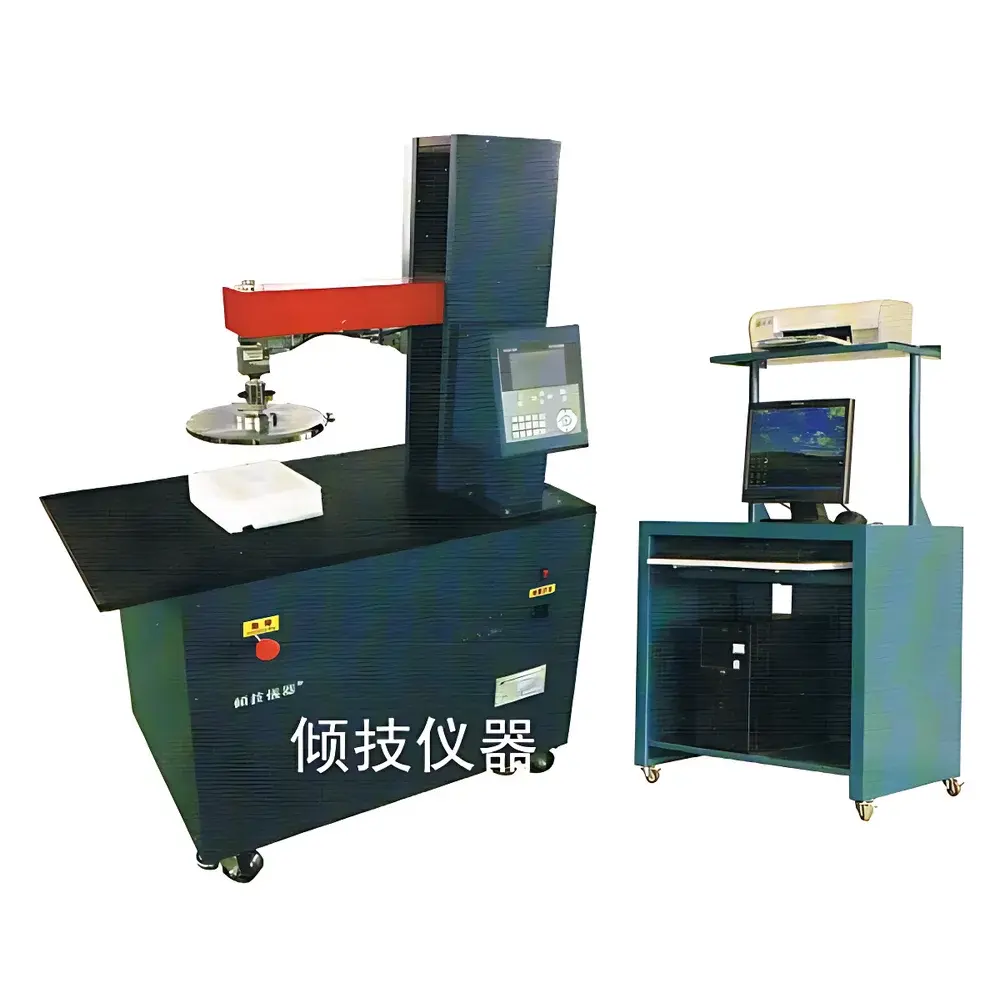
Qinji QJ-210K Hard Foam Compression Testing Machine
| Brand | Qinji |
|---|---|
| Origin | Shanghai, China |
| Model | QJ-210K Hard Foam Compression Testing Machine |
| Max Load Capacity | 2000 N |
| Force Sensor Accuracy | 0.01% FS |
| Measurement Accuracy | Class 0.5 |
| Repeatability | ≤0.5% |
| Displacement Accuracy | ≤0.2% |
| Strain Measurement Accuracy | ≤0.2% |
| Test Speed Range | 0.01–300 mm/min |
| Instrument Type | Electromechanical Universal Testing Machine |
| Compliant Standards | GB/T 6344–1996, GB/T 10807–2006, GB/T 20467–2006 |
Overview
The Qinji QJ-210K Hard Foam Compression Testing Machine is an electromechanical universal testing system engineered for high-reproducibility mechanical characterization of rigid and semi-rigid polymeric foam materials. Designed around a precision load frame with three-closed-loop control architecture (force, displacement, and strain), it delivers stable, traceable compression, indentation, and quasi-static mechanical response data under ISO/GB-compliant test protocols. Unlike general-purpose tensile testers, the QJ-210K integrates hardware and firmware optimizations specific to low-modulus, high-compliance foam substrates—minimizing preload artifacts, accommodating large axial deformations (>80% strain), and maintaining force linearity throughout progressive crush cycles. Its operational envelope supports standardized compression tests per GB/T 20467–2006 (compression set and recovery of molded/extruded sponge rubber), GB/T 10807–2006 (indentation hardness via constant-rate depth control), and GB/T 6344–1996 (tensile strength and elongation at break for flexible foams—when configured with appropriate grips). The system operates without hydraulic components, eliminating fluid maintenance and enabling clean-room-compatible deployment in QC laboratories and R&D facilities.
Key Features
- Electromechanical drive system with brushless servo motor and precision ball-screw transmission, ensuring smooth velocity control from 0.01 to 300 mm/min across full load range.
- High-resolution load cell calibrated to 0.01% full-scale accuracy, certified per ISO 7500-1 Class 0.5 requirements.
- Three-closed-loop digital controller supporting simultaneous real-time regulation of force, displacement, and strain—critical for capturing nonlinear viscoelastic transitions in foam collapse zones.
- Integrated LCD control panel with local operation capability; fully synchronized with PC-based software for remote monitoring and multi-user access.
- Modular fixture interface compatible with standard compression platens (φ100 mm, φ50 mm), indentation probes (spherical, flat-ended), and auxiliary fixtures for tensile, peel, and tear testing per ASTM D3574 and ISO 1798.
- Rugged steel frame with reinforced crosshead guidance, minimizing lateral deflection during high-aspect-ratio specimen compression (e.g., slab stock up to 300 mm height).
Sample Compatibility & Compliance
The QJ-210K accommodates specimens ranging from 10 × 10 × 10 mm cubes (for micro-indentation hardness) to 150 × 150 × 50 mm slabs (for compression set evaluation). It supports both conditioned (23°C/50% RH per ISO 291) and elevated-temperature testing when paired with environmental chamber options. All default test methods align with national and international standards including GB/T 20467–2006 (equivalent to ISO 1856 for compression behavior of flexible cellular plastics), GB/T 10807–2006 (aligned with ISO 2439 for indentation hardness), and GB/T 6344–1996 (harmonized with ISO 1798 for tensile properties). The system’s calibration documentation meets GLP audit requirements, and raw data files include embedded metadata (operator ID, timestamp, environmental conditions, calibration certificate ID) to support 21 CFR Part 11–compliant electronic records where validated software is deployed.
Software & Data Management
The included QinjiTest v4.x software provides ISO 17025-aligned test sequence definition, real-time curve overlay, and automated report generation in PDF/XLSX formats. Users can define multi-step protocols—e.g., pre-load → dwell → ramp compression → hold → unloading—with programmable triggers based on force threshold, displacement limit, or time duration. All test data are stored in encrypted binary format with SHA-256 checksums; export functions preserve original sampling resolution (≥100 Hz) and include full audit trails (user login, parameter changes, calibration events). Optional validation packages provide IQ/OQ documentation templates and electronic signature modules compliant with FDA 21 CFR Part 11 Annex 11 requirements. Software updates are delivered free-of-charge for the instrument’s service life, including backward-compatible firmware upgrades for enhanced noise rejection and thermal drift compensation.
Applications
- Determination of compressive stress–strain curves and yield point identification in rigid polyurethane (PUR) and phenolic foams used in insulation and structural cores.
- Indentation hardness profiling (ILD—Indentation Load Deflection) for automotive seat cushioning and mattress layer qualification per GB/T 10807–2006.
- Compression set measurement after 22-h exposure at elevated temperature (70°C), evaluating long-term resilience of elastomeric sponge gaskets per GB/T 20467–2006.
- Low-cycle fatigue testing of sandwich panel core materials under repeated compressive loading (1–100 cycles, 0.1–10 Hz).
- Quality conformance screening for incoming raw foam batches against internal specifications derived from ISO 844 or ASTM D1621.
- Research-grade characterization of novel bio-based foams, syntactic composites, and aerogel hybrids requiring precise force-displacement synchronization.
FAQ
What standards does the QJ-210K natively support?
It is factory-configured for GB/T 6344–1996, GB/T 10807–2006, and GB/T 20467–2006. ASTM D1621, ISO 844, and ISO 1856 test methods are available via optional software modules.
Is the system suitable for testing high-density structural foams above 200 kg/m³?
Yes—its 2000 N capacity and rigid frame design accommodate compressive testing of rigid polyisocyanurate (PIR), epoxy syntactic foams, and carbon-fiber-reinforced polymer foams within its displacement and speed limits.
Can test data be integrated into LIMS or ERP systems?
Yes—the software supports ODBC-compliant database export and includes REST API endpoints for direct integration with laboratory information management systems (LIMS) and enterprise resource planning (ERP) platforms.
Does the system include calibration certification?
Each unit ships with a factory-issued calibration certificate traceable to CNAS-accredited primary standards, valid for 12 months under normal use conditions.
What maintenance is required beyond annual recalibration?
No routine consumables or lubricants are required. Recommended preventive maintenance includes quarterly verification of crosshead alignment and annual inspection of encoder coupling integrity—documented in the included Maintenance Logbook.



