
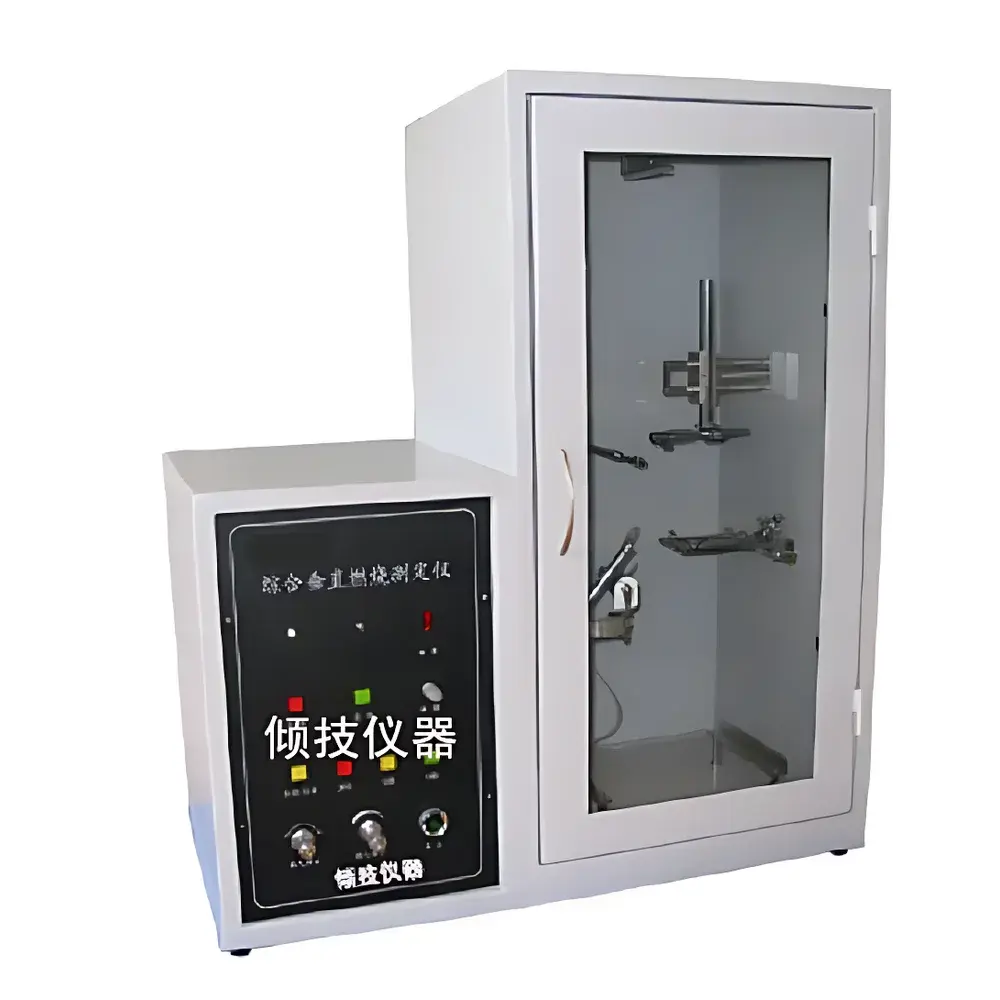
Qinji RSC-157 Horizontal & Vertical Combustion Test Chamber
| Brand | Qinji |
|---|---|
| Origin | Shanghai, China |
| Model | RSC-157 |
| Compliance Standards | GB/T 2408, ISO 1210, GB 4609, IEC 60950, UL 94, IEC 707, IEC 695-2-2 |
| Burner Positioning | Motorized vertical adjustment with programmable timing and positional repeatability |
| Gas Leak Detection | Integrated high-sensitivity combustible gas alarm system |
| Flame Application | Manual jog control for burner elevation/depression to precisely set flame-to-specimen distance |
| Exhaust System | Dedicated forced-air exhaust ducting with external venting capability |
| Sample Holders | Dual independent fixtures—horizontal (H) and vertical (V) configurations |
| Test Mode Switching | Toggle switch for rapid, tool-free transition between horizontal and vertical flame exposure protocols |
Overview
The Qinji RSC-157 Horizontal & Vertical Combustion Test Chamber is an engineered platform for standardized flammability assessment of polymeric materials—including thermoplastics, elastomers, thin films, and composite laminates—under controlled open-flame exposure. It operates on the principle of direct flame impingement in accordance with internationally harmonized small-flame ignition test methodologies. The apparatus implements a defined Bunsen-type burner delivering a calibrated propane or butane flame (typically 20 mm ± 1 mm height, 500 mm/min ± 50 mm/min upward flame propagation rate under standard conditions), enabling quantitative evaluation of ignition resistance, flame spread behavior, afterflame time, afterglow duration, and drip ignition propensity. Designed for regulatory conformance rather than qualitative observation, the RSC-157 delivers repeatable thermal insult profiles essential for classification under UL 94 V-0, V-1, V-2, HB, and 5V ratings, as well as compliance verification against GB/T 2408 (equivalent to ISO 1210) and IEC 695-2-2 (fire hazard testing — glowing/hot-wire ignition test).
Key Features
- Motor-driven burner carriage with programmable vertical positioning and dwell timing—ensures precise, operator-independent flame contact duration and height reproducibility across sequential tests.
- Dual-mode sample fixture assembly: separate horizontally mounted clamping frames (for HB-classification per UL 94/GB/T 2408) and vertically oriented holders (for V-rating determination), both fabricated from non-combustible, thermally stable stainless steel.
- Integrated combustible gas detection module compliant with EN 50194 and IEC 61000-6-3 EMC requirements; triggers audible/visual alarms and automatically shuts off gas supply upon threshold-level methane/propane concentration detection.
- Adjustable burner elevation via momentary-contact jog controls—permits fine-tuned alignment of flame tip relative to specimen surface (±0.5 mm resolution), critical for achieving nominal 10 mm ± 1 mm flame-to-edge distance per UL 94 Section 8.2.
- Dedicated axial exhaust system with variable-speed blower and external duct interface (Φ150 mm outlet)—maintains consistent draft conditions during combustion, prevents backdraft interference, and ensures complete removal of pyrolysis byproducts and CO-rich effluent.
- Front-access viewing window with multi-layer borosilicate glass (heat-resistant up to 800 °C) and integrated UV-filter coating—enables real-time visual monitoring without compromising operator safety or thermal integrity.
Sample Compatibility & Compliance
The RSC-157 accommodates specimens measuring up to 125 mm × 13 mm × ≤13 mm (L × W × D) in vertical configuration and 150 mm × 13 mm × ≤13 mm in horizontal orientation. It supports rigid and semi-rigid sheet, rod, and molded parts—provided they meet dimensional tolerances specified in UL 94 Clause 7.1 and GB/T 2408 Section 5.2. Specimen mounting conforms to ASTM D635 and ISO 1210 mechanical clamping requirements, ensuring zero slippage during flaming and afterflame phases. All operational parameters—including burner gas flow rate (regulated via precision needle valve), flame height verification protocol (using copper reference wire per UL 94 Annex A), and ambient conditioning (23 °C ± 2 °C, 50 % RH ± 5 % RH per ISO 291)—are documented in the instrument’s Standard Operating Procedure (SOP) package. The system meets structural and safety requirements outlined in IEC 61010-1 for electrical equipment used in measurement, control, and laboratory applications.
Software & Data Management
While the RSC-157 operates as a manually supervised benchtop instrument (no embedded microcontroller or touchscreen interface), it includes a comprehensive digital documentation toolkit. Users receive editable Excel-based test record templates aligned with GLP audit trails—featuring fields for operator ID, calibration date, gas type/lot number, ambient temperature/humidity logs, specimen identification, pre-test mass, observed afterflame times (t₁, t₂), afterglow duration, drip collection status, and pass/fail determination per UL 94 Table 2 or GB/T 2408 Table 1. Optional USB-connected stopwatch synchronization and optional thermal imaging add-on (FLIR ONE Pro-compatible) support traceable timing validation. All records comply with FDA 21 CFR Part 11 principles when deployed within validated laboratory information management systems (LIMS).
Applications
This chamber serves quality assurance laboratories in electrical equipment manufacturing (e.g., housing components for power supplies, circuit breakers, and EV battery enclosures), construction material certification bodies evaluating fire-stopping sealants and intumescent coatings, and polymer R&D facilities developing halogen-free flame-retardant formulations. It is routinely employed for type approval testing under CCC (China Compulsory Certification), CE marking (per EN 60695-11-10), and UL Component Recognition. End-use sectors include automotive interior trim validation, aerospace cabin material screening (per FAR 25.853(a)), and telecommunications infrastructure hardware qualification.
FAQ
What flame fuel gases are compatible with the RSC-157?
Propane and butane are the primary fuels specified in UL 94, ISO 1210, and GB/T 2408. Methane may be used only if explicitly permitted by the applicable test standard and accompanied by full recalibration of flame geometry.
Is third-party calibration certification included with purchase?
Calibration certificates traceable to NIM (National Institute of Metrology, China) or equivalent national metrology institutes are available upon request at additional cost; factory verification reports covering burner alignment, timer accuracy, and gas flow linearity are supplied standard.
Can the RSC-157 perform glow-wire testing?
No—glow-wire ignition temperature (GWIT) and glow-wire flammability index (GWFI) assessments require a dedicated glow-wire apparatus (e.g., IEC 60695-2-10 compliant unit); the RSC-157 is strictly configured for small-flame ignition testing.
What maintenance intervals are recommended for long-term reliability?
Burner nozzle cleaning every 50 test cycles, gas line filter replacement quarterly, and annual verification of exhaust airflow velocity (target: 0.5–0.8 m/s at duct inlet) using a calibrated hot-wire anemometer.
Does the system support automated data export to LIMS?
Native API integration is not provided; however, structured CSV output from the included Excel templates can be ingested via standard LIMS import modules supporting ODBC or flat-file ingestion protocols.



