
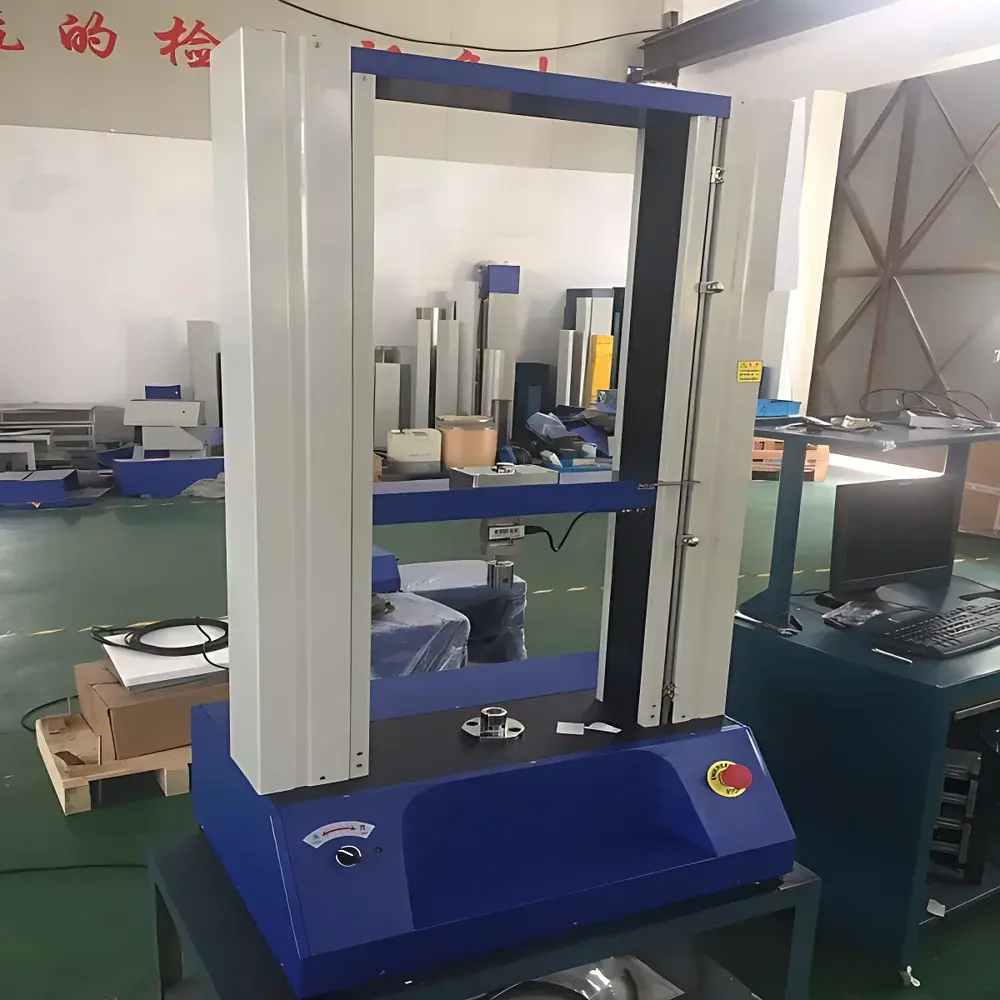
QJ211S Battery Material Tensile Testing Machine
| Origin | Beijing, China |
|---|---|
| Manufacturer Type | Authorized Distributor |
| Origin Category | Domestic (PRC) |
| Model | QJ211S |
| Price | USD 6,300 (FOB) |
| Instrument Type | Electromechanical Universal Testing Machine |
| Max Test Load | 30 kN |
| Load Range | 0–30 kN (fully adjustable) |
| Load Accuracy Class | ISO 7500-1 Class 1 |
| Stroke | 800 mm |
| Displacement Resolution | ±0.5% of reading |
| Load Cell Accuracy | 0.01% FS |
| Speed Range | 0.001–500 mm/min |
| Speed Accuracy | ±0.5% |
| Effective Test Width | 420 mm |
| Weight | ~140 kg |
| Safety Features | Dual electronic stroke limit, emergency stop button, overload auto-shutdown |
| Control Interface | Windows-based PC control with real-time data acquisition and closed-loop feedback |
Overview
The QJ211S Battery Material Tensile Testing Machine is a precision-engineered electromechanical universal testing system designed specifically for mechanical characterization of electrode coatings, separator films, current collectors, and composite battery components under controlled uniaxial loading conditions. Built upon a rigid dual-column frame architecture with high-stiffness crosshead guidance and servo-controlled ball-screw actuation, it operates on the fundamental principle of force-displacement transduction via calibrated load cells and high-resolution linear encoders. Its modular design enables seamless integration with specialized fixtures—including pneumatic film clamps, peel jigs, and low-force micro-grips—making it suitable not only for ASTM D882 (thin plastic films), ISO 527-3 (polymer sheets), and GB/T 2792 (adhesive peel strength), but also for emerging battery-specific test protocols such as IEEE 1625 Annex D (electrode tensile integrity) and UL 1642 Section 9 (cell mechanical abuse simulation). The system delivers repeatable, traceable mechanical data essential for R&D validation, QC release testing, and failure mode analysis in lithium-ion, solid-state, and sodium-ion battery manufacturing environments.
Key Features
- High-fidelity dual-closed-loop control: Simultaneous regulation of load, displacement, and strain via PID-tuned digital servo amplifier
- Class 1 load accuracy per ISO 7500-1, verified with NIST-traceable deadweight standards; 0.01% full-scale resolution on 30 kN load cell
- Adjustable speed range from 0.001 to 500 mm/min, with ±0.5% speed fidelity across entire range—critical for creep, stress-relaxation, and rate-dependent polymer behavior studies
- 800 mm effective stroke with ±0.5% displacement linearity—sufficient for full-thickness pouch cell stack compression or extended foil elongation tests
- Dual safety architecture: Programmable electronic stroke limits + mechanical hard-stop redundancy + emergency stop circuit compliant with IEC 60204-1
- Modular fixture interface: Standard M6 and T-slot mounting patterns support custom tooling for anode/cathode strip tension, separator puncture, and tab weld peel configurations
- Real-time dynamic visualization: Synchronized force–displacement–time plots rendered at ≥1 kHz sampling rate, with user-definable axis scaling and overlay capability
Sample Compatibility & Compliance
The QJ211S accommodates specimens ranging from 1 mm wide electrode strips to 50 mm wide separator membranes and 200 mm × 200 mm laminated pouch assemblies. It supports standardized test geometries per ASTM D3039 (composite tensile), ISO 1133 (melt flow index correlation), and GB/T 1040.3 (plastics—film and sheet). For battery-specific applications, it meets the mechanical test requirements outlined in DOE Vehicle Technologies Office (VTO) Battery Testing Manual Rev. 4 (Section 3.2.1: Electrode Tensile Strength), as well as internal OEM specifications for cathode binder fracture energy and anode calendering resilience. All calibration records, system verification reports, and operator logs are stored in audit-ready format compatible with GLP and GMP documentation workflows.
Software & Data Management
Control and analysis are executed via proprietary Windows-based software compliant with FDA 21 CFR Part 11 requirements—including electronic signatures, role-based access control, audit trail logging, and immutable data archiving. The software automatically calculates and exports standardized metrics: ultimate tensile strength (UTS), yield point (0.2% offset), Young’s modulus, elongation at break, Poisson’s ratio (with optional extensometer), and hysteresis area. Raw data exports to CSV, XML, and ASTM E1434-compliant .tdms formats ensure interoperability with MATLAB, Python (via pandas), and LIMS platforms. Batch processing templates allow automated execution of multi-step protocols—e.g., preconditioning → ramp-to-load → hold → unload—for evaluating viscoelastic recovery in PVDF-based binders.
Applications
- Tensile strength and elongation of copper/aluminum current collector foils (thickness: 6–20 µm)
- Adhesion strength of slurry-coated electrodes via 90° peel testing per ASTM D903
- Mechanical stability of ceramic-coated separators under biaxial strain simulation
- Compression modulus and yield behavior of stacked jelly-roll assemblies
- Creep compliance of solid polymer electrolytes at elevated temperatures (when integrated with environmental chamber)
- Interfacial shear strength between silicon anode layers and copper substrate using micro-shear fixtures
FAQ
Does the QJ211S support ASTM D882 testing for thin battery separator films?
Yes—the system meets all dimensional, speed, and grip separation requirements of ASTM D882-22, including recommended gauge length (50 mm), crosshead speed (100–500 mm/min), and clamping pressure control to prevent slippage.
Can test data be exported directly into LIMS or ERP systems?
Yes—CSV and XML outputs include metadata headers (operator ID, timestamp, sample ID, test standard), enabling direct ingestion into LabWare LIMS, SAP QM, or custom MES platforms.
Is the system validated for ISO/IEC 17025 accredited laboratories?
Yes—full validation package available, including IQ/OQ/PQ protocols, uncertainty budgets per GUM (JCGM 100), and traceable calibration certificates from CNAS-accredited metrology labs.
What is the maximum specimen thickness supported by standard wedge grips?
Standard pneumatic wedge grips accommodate specimens up to 5 mm thick; optional high-capacity hydraulic grips extend this to 20 mm for laminated cell stacks.
How is thermal drift compensated during long-duration creep tests?
The load cell features active temperature compensation circuitry (±0.01% FS/°C), and software applies real-time thermal zero correction using embedded thermistor readings logged at 1 Hz intervals.



