
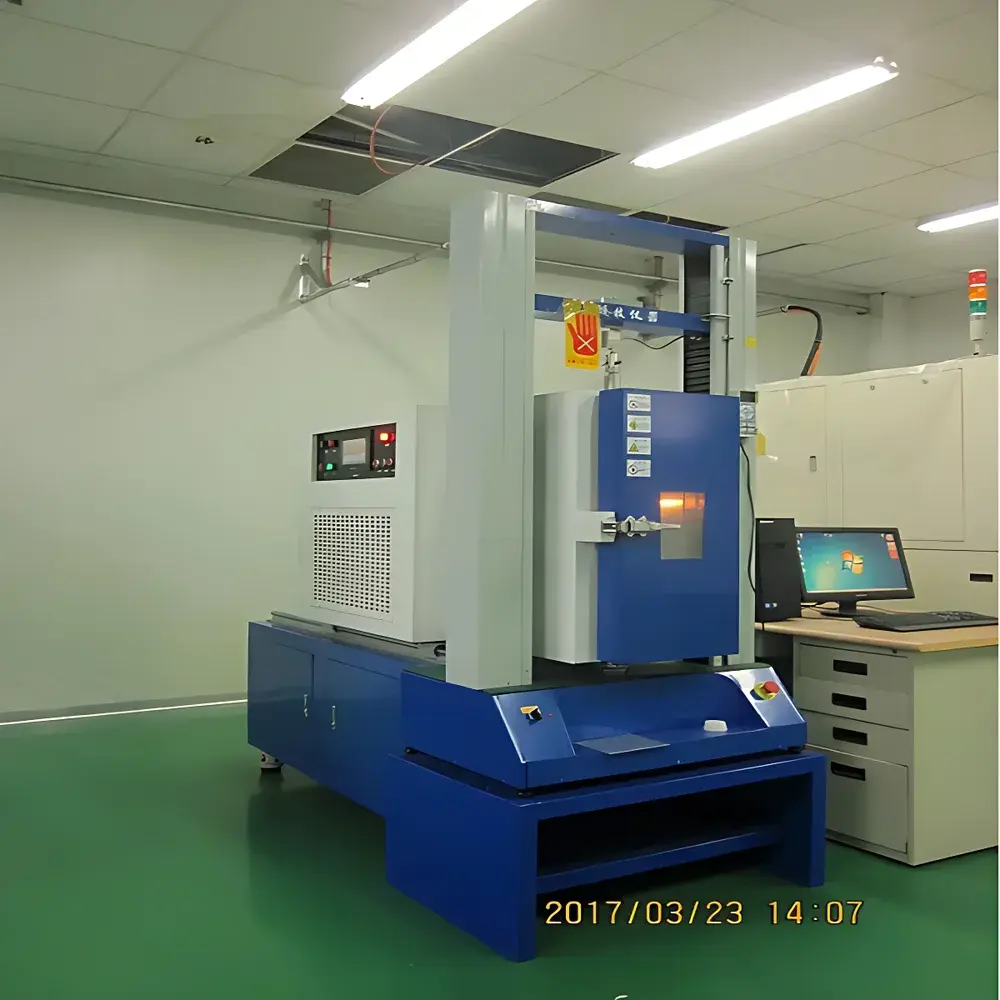
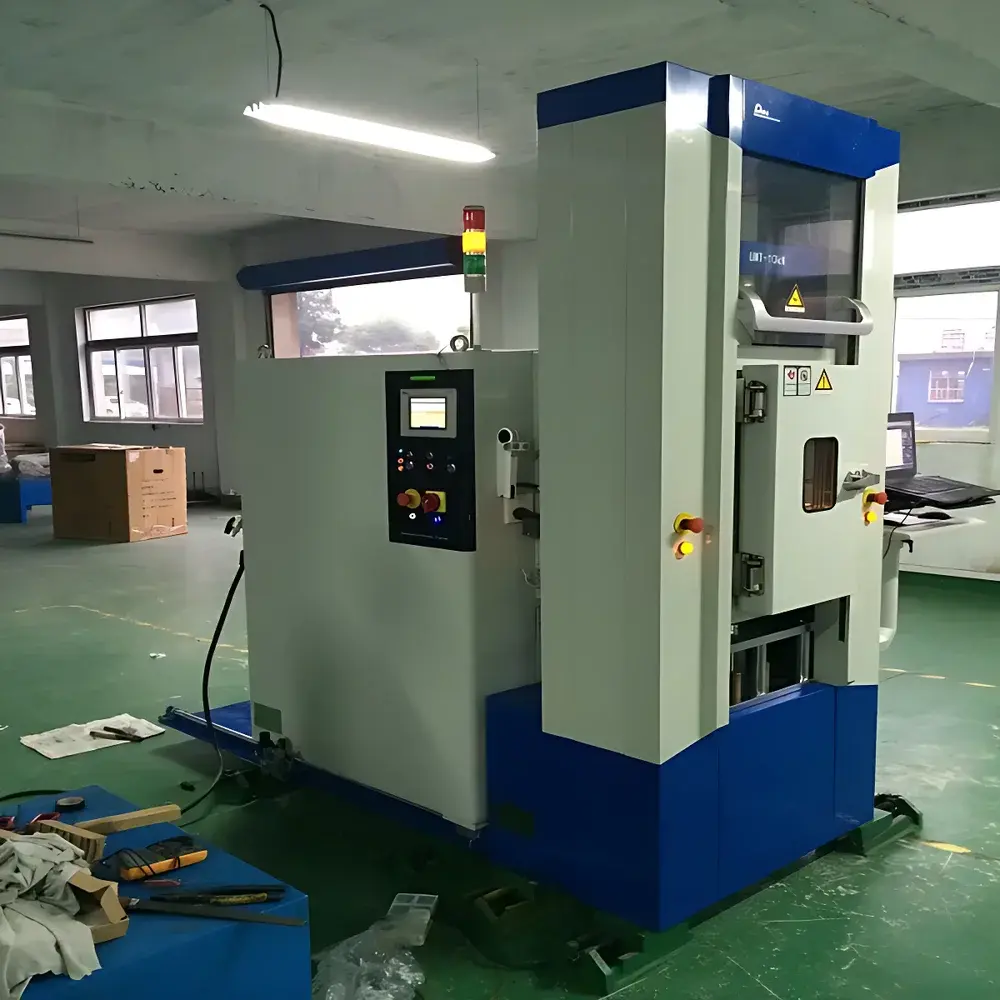
Qinsun QJ211B High-Low Temperature Electronic Universal Testing Machine
| Brand | Qinsun |
|---|---|
| Origin | Shanghai, China |
| Model | QJ211B |
| Load Capacity | 0–100 kN |
| Load Accuracy | ±0.5% FS |
| Temperature Range | −70 °C to +350 °C (isothermal at 350 °C) |
| Heating/Cooling Rate | ≥5 °C/min |
| Temperature Resolution | 0.1 °C |
| Crosshead Speed Range | 0.01–500 mm/min (optional up to 1000 mm/min) |
| Speed Accuracy | ±0.5% |
| Displacement Measurement Accuracy | ±0.5% |
| Strain/Deformation Measurement Accuracy | ±0.5% |
| Effective Test Width | 420 mm |
| Maximum Test Height | ~800 mm (extendable) |
| Safety Features | Electronic travel limit protection, emergency stop button |
| Machine Weight | 265 kg |
| Compliance | GB/T 228.1, ISO 6892-1, ASTM E8/E21, JIS Z2241, DIN 50125 |
Overview
The Qinsun QJ211B High-Low Temperature Electronic Universal Testing Machine is a dual-environment mechanical testing system engineered for precision tensile, compression, flexural, shear, peel, tear, puncture, and low-cycle fatigue characterization of metallic, polymeric, composite, ceramic, and elastomeric materials across extreme thermal conditions. Its integrated high-performance environmental chamber enables real-time mechanical property evaluation from cryogenic −70 °C to isothermal 350 °C, supporting thermomechanical coupling studies critical for aerospace composites, battery electrode materials, high-temperature alloys, and thermoplastic elastomers. The system employs a servo-controlled electromechanical actuation architecture with closed-loop feedback on load, displacement, and strain—ensuring traceable force control per ISO 7500-1 Class 0.5 and displacement resolution compliant with ASTM E4 requirements. Unlike ambient-only testers, the QJ211B maintains full metrological integrity throughout temperature ramping and dwell cycles, eliminating thermal drift-induced measurement artifacts.
Key Features
- Modular environmental chamber with rapid thermal response (≥5 °C/min ramp rate) and high-stability isothermal control (±0.3 °C at 350 °C over 2 h)
- High-capacity 100 kN load frame with reinforced crosshead guidance and low-friction ball-screw drive system
- Precision load cell with 0.01% linearity and repeatability, calibrated to ISO 376 Annex A traceability
- Independent high-resolution extensometer interface supporting clip-on, video, or non-contact strain measurement options
- Dual-mode operation: fully automated PC-based control via dedicated test software, plus manual digital panel operation for quick setup verification
- Comprehensive safety architecture including hardware-based emergency stop, programmable electronic limits, and overload cut-off logic
- Structural rigidity optimized for minimal deflection (<0.02 mm/kN), ensuring accurate modulus determination in stiffness-sensitive applications
Sample Compatibility & Compliance
The QJ211B accommodates standardized specimens per ISO 527-2 (plastics), ASTM D638 (tensile bars), ASTM D790 (flexure), and GB/T 1040 (general plastics), as well as custom geometries up to 420 mm wide and 800 mm tall (extendable). Gripping solutions include pneumatic wedge, hydraulic, and screw-type fixtures compatible with metallic, fibrous, and brittle substrates. The system meets essential regulatory and quality framework requirements: it supports audit-ready test documentation aligned with GLP principles; its software architecture allows configuration for FDA 21 CFR Part 11-compliant electronic records (with optional user authentication, audit trail, and electronic signatures); and all calibration certificates reference NIST-traceable standards. Full compliance documentation—including Declaration of Conformity to CE Machinery Directive 2006/42/EC and electromagnetic compatibility (EMC) certification—is provided with each unit.
Software & Data Management
Control and analysis are executed through Qinsun’s proprietary TMS-Link v5.2 testing software, a Windows-based platform designed for ISO/IEC 17025-accredited laboratories. The software features real-time multi-channel data acquisition (load, displacement, temperature, strain), synchronized thermal profiling, and customizable test sequences (ramp-hold-ramp, cyclic loading with thermal modulation, creep-recovery under temperature gradient). All raw data are stored in open-format ASCII (.csv) and binary (.qdt) files with embedded metadata (operator ID, calibration date, environmental chamber status, machine serial number). Built-in reporting tools generate PDF test reports conforming to ISO 14289-1 (PDF/A-1a) archival standards, including graphical overlays of stress–strain curves, modulus evolution vs. temperature, and statistical summaries across replicate tests. Data export interfaces support LIMS integration via ODBC and HL7 protocols.
Applications
- Thermal expansion coefficient (CTE) and modulus transition mapping of polymer matrix composites during cure simulation
- Tensile strength degradation analysis of turbine blade coatings at service temperatures up to 350 °C
- Cryogenic fracture toughness assessment of aluminum-lithium alloys for space launch vehicle structures
- Adhesion strength evaluation of pressure-sensitive adhesives across −40 °C to +80 °C operating envelopes
- Creep behavior quantification of PEEK and PEI under combined mechanical and thermal stress
- Low-cycle fatigue life prediction of solder joints in automotive power electronics modules
FAQ
Can the environmental chamber be removed for ambient-only testing?
Yes—the chamber is mechanically decoupled and can be detached without recalibration, increasing workspace clearance and enabling high-speed dynamic testing or large-part evaluation.
Is third-party calibration support available?
Yes—Qinsun provides annual recalibration services traceable to national metrology institutes (NIM, PTB, NIST), including full uncertainty budgets per ISO/IEC 17025 requirements.
What extensometer options are compatible?
The system supports ISO 9513 Class 1 clip-on extensometers (e.g., Zwick Roell 2500 series), non-contact video extensometry (Qinsun VEM-300), and high-temperature furnace-compatible strain gauges (up to 1000 °C with external signal conditioning).
Does the software support custom test method scripting?
Yes—TMS-Link includes an embedded Python 3.9 interpreter for user-defined control logic, conditional branching, and real-time parameter adjustment based on sensor feedback.
What is included in the standard warranty?
A 12-month comprehensive parts-and-labor warranty covering mechanical, electrical, and thermal subsystems; extended service plans (3–5 years) with priority response and preventive maintenance visits are available upon request.
Related Products



