
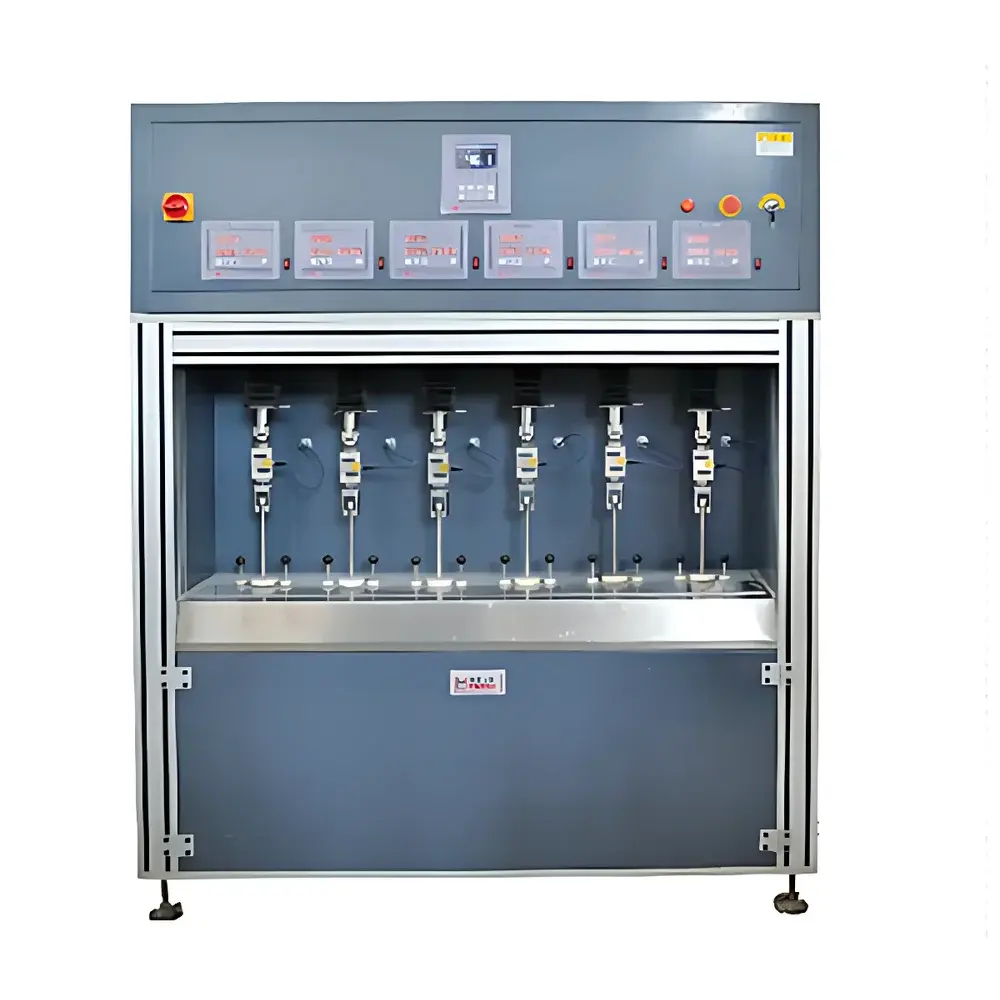
Hengyi HY-QKRB Full-Notch Creep Testing System
| Brand | Hengyi / Hengyitest |
|---|---|
| Origin | Shanghai, China |
| Manufacturer Type | Direct Manufacturer |
| Country of Origin | China |
| Model | HY-QKRBUIO |
| Quotation | Available Upon Request |
| Load Capacity | 2000 N (interchangeable load cells available below 2000 N) |
| Force Measurement Range | 0.4–99.999% of full scale |
| Force Accuracy | Class 0.5 |
| Effective Test Width | 120 mm |
| Effective Test Height | 200 mm |
| Crosshead Speed | 0.001–100 mm/min (adjustable) |
| Speed Accuracy | ±1% of indicated value |
| Displacement Accuracy | ±1% of indicated value |
| Strain/Deformation Accuracy | ±1% of indicated value |
| Test Stations | 12 independent stations |
| Temperature Control Bath Range | Ambient to 95 °C |
| Temperature Stability | ±0.5 °C |
| Control Interface | PC-based control system |
| Power Requirement | 10 kW, 220 V AC |
| Machine Weight | 850 kg |
| Dimensions (W×D×H) | 1620 × 850 × 1750 mm |
| Compliance Standards | GB/T 15820–1995, GB/T 11546, GB/T 32682–2016, ISO 899-1, ISO 16770, ISO 3501 |
Overview
The Hengyi HY-QKRB Full-Notch Creep Testing System is an engineered platform designed for standardized environmental stress cracking (ESC) evaluation of polyethylene (PE) and other thermoplastic polymer composites under sustained tensile loading in controlled chemical and thermal environments. Based on the full-notch creep test (FNCT) principle defined in ISO 16770 and GB/T 32682–2016, this system applies a constant axial load to pre-notched specimens immersed in a surfactant solution—typically Igepal CO-630—at elevated temperatures up to 95 °C. The primary output is time-to-failure (tf), which serves as a quantitative indicator of ESC resistance. Unlike conventional tensile creep tests (ISO 899-1), FNCT introduces a sharp geometric stress concentrator—a full-thickness notch—to accelerate crack initiation and propagation under static load, enabling accelerated assessment of long-term durability in pressure pipe applications. The system supports three standardized test modes: uniaxial tensile creep, full-notch tensile creep (FNCT), and pull-out testing per GB/T 15820 for PE pipe joint integrity verification.
Key Features
- Twelve independently controlled test stations enable parallel execution of replicate or multi-condition FNCT trials—critical for statistical confidence in tf determination and Weibull analysis.
- High-stability temperature-controlled bath with ±0.5 °C uniformity across all stations ensures strict compliance with ISO 16770 thermal requirements and minimizes inter-station variability.
- Class 0.5 force measurement accuracy (per GB/T 11546) achieved via calibrated, interchangeable load cells (up to 2000 N), allowing precise application of low-load conditions relevant to real-world service stresses.
- Motor-driven crosshead with closed-loop speed control (0.001–100 mm/min, ±1% accuracy) supports both slow-rate creep deformation tracking and rapid setup/retraction cycles.
- Rigid structural frame (850 kg mass) and precision-ground guide rails minimize parasitic vibrations and thermal drift during extended-duration tests (commonly 100–10,000 hours).
- PC-based control architecture with deterministic real-time data acquisition (≥10 Hz sampling) records load, displacement, and elapsed time synchronously for each station—essential for ISO 899-1 and GB/T 32682–2016 reporting.
Sample Compatibility & Compliance
The HY-QKRB accommodates standard FNCT specimens per ISO 16770: rectangular bars (10 × 4 × 4 mm) with a full-thickness U-notch (0.2 mm radius, 2 mm depth) machined centrally. It also accepts ASTM D1598-compliant pipe ring specimens and GB/T 15820 pull-out test assemblies (e.g., PE pipe–fitting joints). All mechanical and thermal subsystems are validated against national and international standards including GB/T 11546 (plastic creep), ISO 899-1 (tensile creep), ISO 3501 (test apparatus verification), and GB/T 32682–2016 (PE ESC via FNCT). The system’s metrological traceability supports GLP-compliant laboratories and satisfies audit requirements for ISO/IEC 17025 accreditation.
Software & Data Management
The embedded Windows-based software provides ISO 16770-compliant test sequence automation: automatic load ramping, bath temperature stabilization monitoring, real-time failure detection (via displacement threshold or load drop), and timestamped event logging. Raw data (force, position, time, temperature per station) are stored in CSV and binary formats with embedded metadata (operator ID, calibration certificate IDs, environmental logs). Audit trails record all user actions—including parameter changes and manual overrides—in accordance with FDA 21 CFR Part 11 principles. Export modules generate compliant reports aligned with GB/T 32682–2016 Annex B, including Weibull distribution plots, median tf, and confidence intervals.
Applications
- Quality assurance of PE100/PE100-RC resins for gas/water distribution pipes
- Comparative ESC screening of novel polymer blends and stabilizer packages
- Validation of pipe fusion joint integrity per GB/T 15820 and ISO 13953
- Regulatory submission testing for CE marking (PED Annex I) and NSF/ANSI 61 certification
- Research into crack growth kinetics under combined thermal–chemical–mechanical stress states
FAQ
What standards does the HY-QKRB fully support for FNCT testing?
It complies with ISO 16770, GB/T 32682–2016, and ISO 899-1 for creep methodology; GB/T 15820 for pull-out testing; and GB/T 11546 for general plastic creep instrumentation requirements.
Can the system operate unattended for multi-day tests?
Yes—its industrial-grade power supply (10 kW), redundant thermal safety cutoffs, and non-volatile data logging ensure continuous operation for up to 30 days without intervention.
Is third-party calibration documentation provided?
Each unit ships with NIST-traceable calibration certificates for load cells and temperature sensors, valid for 12 months from commissioning.
How is specimen failure detected automatically?
Failure is triggered by either a ≥5% load drop at constant displacement or a displacement excursion exceeding 2 mm beyond the initial creep plateau—configurable per test standard.
Does the software support multi-user role-based access control?
Yes—administrator, technician, and reviewer roles enforce data integrity and align with ISO/IEC 17025 clause 7.5.2 on result reporting controls.



