
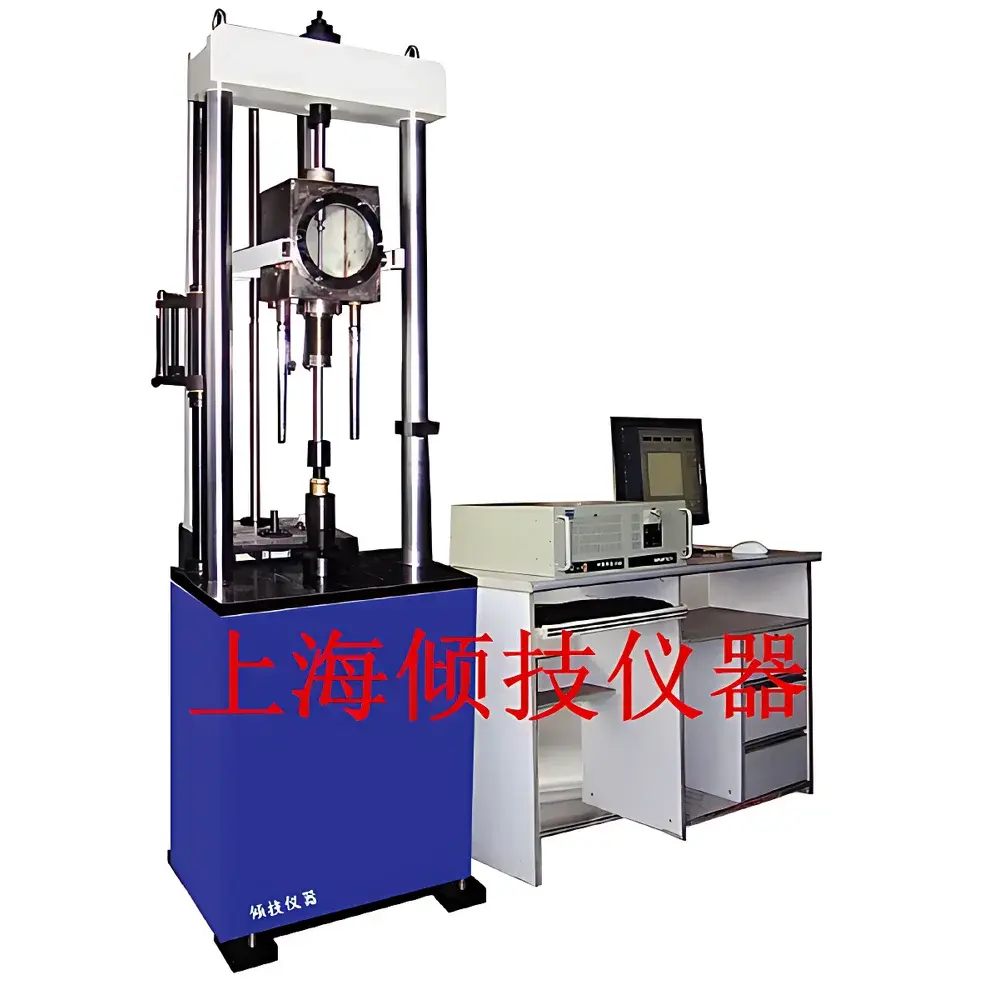
Qinji QJBV212P Electronic Stress Corrosion Testing Machine
| Brand | Qinji |
|---|---|
| Origin | Shanghai, China |
| Model | QJBV212P |
| Max. Test Load | 100 kN |
| Force Measurement Range | 1–100% FS |
| Force Accuracy | ≤ ±0.5% of reading |
| Force Control Stability | ≤ ±0.5% of set value |
| Crosshead Speed | 0.01–60 mm/min |
| Stroke (Lower Crosshead) | ≥ 80 mm |
| Strain Rate Range | 10⁻⁶ – 1 mm/s |
| Specimen Dimensions | Ø10 × 180 mm (30 mm gauge length) |
| Operating Temperature Range | RT + 10 °C to 60 °C |
| Temp. Uniformity | ≤ ±2 °C |
| Corrosive Medium Volume | ≥ 400 mL |
| Control Architecture | Dual-ARM Digital Controller with Adaptive PID |
| Data Interface | Ethernet (TCP/IP), DCS-compatible |
| Compliance | GB/T 15970.7–2000, HB 7235–1995 |
Overview
The Qinji QJBV212P Electronic Stress Corrosion Testing Machine is a precision-controlled, load-frame-based mechanical testing system engineered for evaluating the susceptibility of metallic materials to stress corrosion cracking (SCC) under sustained static or slow-strain-rate loading in aggressive chemical environments. It operates on the principle of controlled uniaxial tensile loading while immersing specimens in standardized corrosive media—enabling quantitative assessment of time-to-failure, crack initiation thresholds, and environmentally assisted degradation kinetics. Designed to meet the rigorous metrological and procedural requirements of GB/T 15970.7–2000 (equivalent to ISO 7539-7) and HB 7235–1995, the system supports both constant-load and constant-extension-rate test modes essential for SCC mechanism studies in aerospace alloys, nuclear structural steels, offshore pipeline materials, and high-strength fasteners.
Key Features
- Monolithic cast-iron load frame with high rigidity and minimized thermal/mechanical drift—eliminating residual welding stresses inherent in welded frames and ensuring geometric stability under full 100 kN load;
- Dual-ARM embedded controller architecture: one core dedicated to real-time closed-loop force/displacement control, the other to parallel data acquisition, filtering, and adaptive PID parameter tuning—enabling consistent control performance across diverse material families without manual recalibration;
- Integrated touchscreen HMI for local test configuration, real-time curve monitoring, and emergency stop activation—reducing dependency on external PCs during routine operation;
- Dual mechanical limit switches on the lower crosshead provide hardware-level overtravel protection, complementing software-defined safety zones;
- Temperature-regulated environmental chamber (RT+10 °C to 60 °C, ±2 °C stability) with sealed 400 mL+ corrosion cell volume, compatible with standard ASTM G30/G123-compliant electrolyte containment fixtures;
- Ethernet-based TCP/IP communication enables seamless integration into centralized DCS or LIMS environments, supporting remote supervision, audit-trail logging, and synchronized timestamping per IEC 62443 and FDA 21 CFR Part 11 readiness guidelines.
Sample Compatibility & Compliance
The QJBV212P accommodates cylindrical specimens conforming to ISO 6892-1, ASTM E8/E8M, and GB/T 228.1 standards—including Ø10 mm × 180 mm rods with 30 mm gauge lengths. Its modular corrosion cell design permits rapid reconfiguration for chloride, sulfide, or acidic media per NACE TM0177, ASTM G36, or ISO 15156 protocols. All force and displacement measurements are traceable to national metrological standards; system validation includes as-found/as-left calibration reports per ISO/IEC 17025 requirements. The machine satisfies GLP-compliant documentation workflows, with configurable electronic signatures, user access levels, and immutable test record archiving.
Software & Data Management
The proprietary Qinji TestMaster™ software provides ISO 17025-aligned data handling: automatic generation of load–displacement–time–environmental parameter matrices, customizable report templates (PDF/CSV/XLSX), and built-in statistical analysis tools for time-to-failure distribution fitting (Weibull, log-normal). Raw data streams are stored with metadata tags including operator ID, calibration certificate numbers, environmental setpoints, and firmware revision. Audit trails capture all parameter modifications, test starts/stops, and calibration events—with tamper-evident hashing compliant with 21 CFR Part 11 Annex 11 principles. Remote data export via SFTP or OPC UA is supported for enterprise-scale quality management systems.
Applications
- Quantitative SCC threshold stress (KISCC) determination in duplex stainless steels exposed to seawater-mimicking solutions;
- Slow strain rate testing (SSRT) of titanium alloys (Ti-6Al-4V) in molten salt environments for concentrated solar power applications;
- Long-term creep-corrosion interaction studies in carbon-manganese steels under simulated nuclear coolant conditions (high-purity water, 300 °C equivalent via accelerated testing);
- Validation of protective coating integrity on aluminum-lithium aerospace alloys subjected to cyclic humidity–chloride exposure;
- Interlaboratory round-robin testing per ISO/IEC 17043 proficiency schemes for SCC methodology harmonization.
FAQ
Does the QJBV212P support automated test sequence scripting?
Yes—TestMaster™ includes a macro scripting interface (Python-based) enabling programmable multi-step protocols, conditional branching based on real-time sensor feedback, and dynamic parameter adjustment during test execution.
Is third-party calibration certification available?
Certified calibration services per ISO/IEC 17025 are provided by accredited laboratories; certificates include uncertainty budgets, traceability statements, and as-found/as-left comparisons.
Can the system be integrated with existing MES or SAP QA modules?
Via RESTful API and OPC UA server functionality, raw test data and summary metrics can be pushed directly to ERP/QMS platforms with configurable field mapping and authentication handshaking.
What corrosion cell accessories are included by default?
Standard delivery includes a PTFE-lined 400 mL immersion cell with dual electrode ports, reference electrode holder, and inert gas purging inlet—compatible with saturated calomel (SCE) and Ag/AgCl reference electrodes.
How is temperature uniformity verified across the specimen gauge section?
Calibration includes infrared thermography mapping at three load points (0%, 50%, 100% FS) and five axial positions; spatial deviation is documented in the factory acceptance test report (FATR).



