
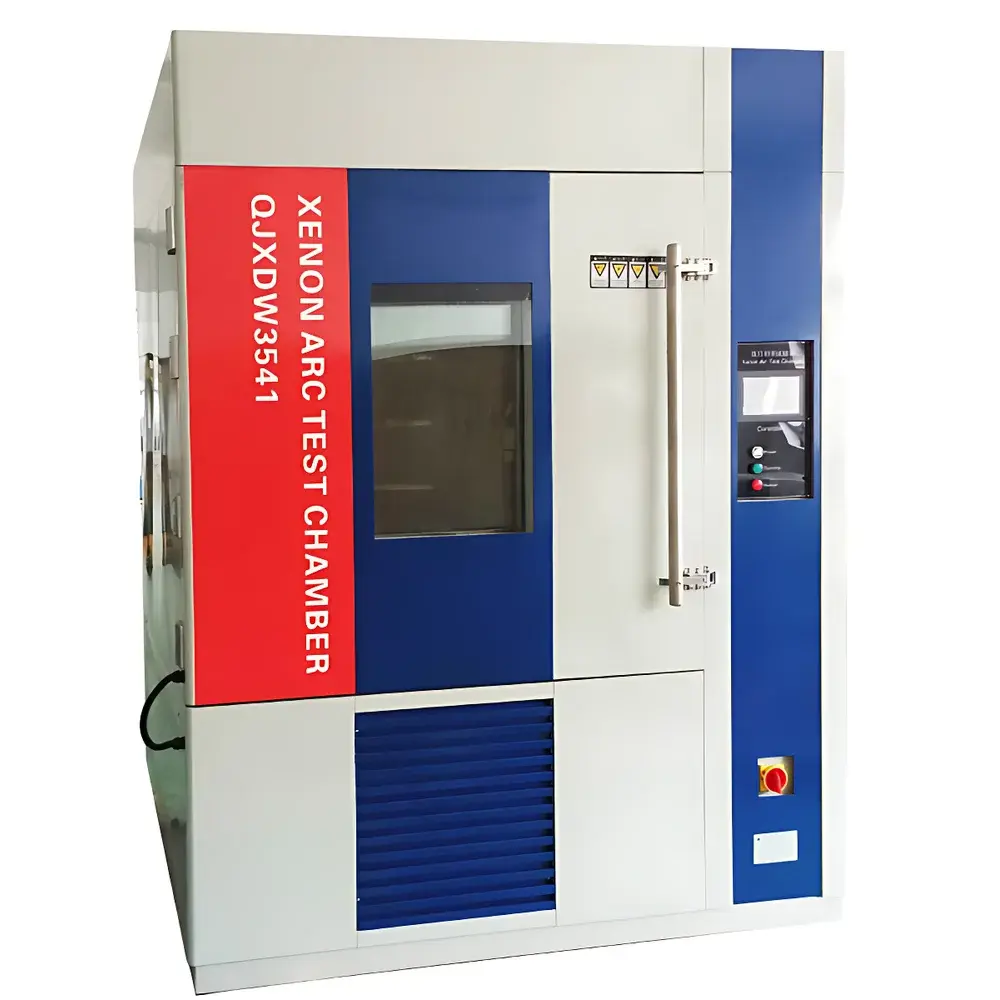
Qinji QJXDW3541 Xenon Arc Weathering Test Chamber
| Brand | Qinji |
|---|---|
| Origin | Shanghai, China |
| Manufacturer Type | Authorized Distributor |
| Country of Origin | China |
| Model | QJXDW3541 |
| Lamp Power | 4.5 kW (water-cooled) |
| Temperature Range | RT+10°C to 80°C ±1°C |
| Humidity Range | Not specified (condensation-based humidity simulation only) |
| Spectral Range | 290–800 nm |
| Radiant Intensity | 550 W/m² (300–800 nm) |
| Sample Rotation Speed | 5 rpm |
| Chamber Interior Dimensions | 500 × 500 × 600 mm |
| Rainfall Duration | 0–9999 min (adjustable) |
| Rainfall Cycle Interval | 0–240 min (adjustable) |
| Lamp Lifetime | ~2000 h |
Overview
The Qinji QJXDW3541 Xenon Arc Weathering Test Chamber is an engineered environmental simulation system designed to replicate the photodegradative, thermal, and hygroscopic stresses encountered in real-world outdoor exposure. It operates on the principle of xenon arc irradiation—utilizing high-intensity, full-spectrum xenon lamps that closely match natural solar radiation (290–800 nm), including critical UV-B and UV-A bands responsible for polymer chain scission, pigment fading, and surface embrittlement. Combined with precise temperature control, programmable condensation cycles, and calibrated rainfall simulation, the chamber enables accelerated evaluation of material durability under controlled, repeatable conditions. This methodology aligns with internationally recognized standards such as ISO 4892-2, ASTM G155, SAE J2527, and AATCC TM16, supporting regulatory compliance and comparative benchmarking across R&D, quality assurance, and product certification workflows.
Key Features
- Water-cooled 4.5 kW xenon lamp assembly with spectral output calibrated to CIE daylight illuminant D65 and ISO standard irradiance levels (550 W/m², integrated over 300–800 nm)
- Digital PID-controlled temperature regulation within a range of RT+10°C to 80°C ±1°C, with uniformity ≤±2°C across the sample plane
- Programmable condensation cycle via chilled water jacketed chamber walls, simulating dew formation without requiring humidification systems
- Adjustable rainfall function: duration (0–9999 min) and interval (0–240 min), enabling reproducible wet/dry cycling per ASTM D4329 or ISO 11341 protocols
- Motor-driven rotating sample holder (5 rpm) with inner/outer radii of 100 mm / 220 mm and center-to-lamp distance of 165 mm, ensuring uniform irradiance distribution
- Flat, modular sample tray compatible with standardized specimen frames (e.g., ISO 11341 multi-position holders or ASTM G155 carousel adapters)
- Integrated radiant flux monitoring with real-time display and accumulated dose logging (W·h/m²), traceable to NIST-traceable reference sensors
Sample Compatibility & Compliance
The QJXDW3541 accommodates rigid and flexible specimens up to 420 mm in height, including coated panels, automotive trim, architectural cladding (e.g., aluminum composite panels), safety glazing, textiles, and elastomeric seals. Its operational envelope supports testing per multiple international specifications: ISO 4892-2 (plastics), ISO 11341 (paints and varnishes), ASTM D4329 (plastics), ASTM D4459 (interior automotive materials), and SAE J2412/J2527 (exterior automotive components). The system’s design facilitates GLP-compliant data generation when paired with validated software; all irradiance, temperature, and timing parameters are logged with timestamped audit trails suitable for internal QA review or external regulatory submission.
Software & Data Management
The chamber integrates with Qinji’s proprietary WinWeather™ control software (Windows-based, USB/RS485 interface), providing intuitive test profile creation, real-time parameter visualization, and automated report generation in PDF/CSV formats. Software features include event-triggered data capture (e.g., irradiance deviation >±5%), password-protected user roles, electronic signature support, and optional 21 CFR Part 11 compliance modules—including audit trail logging, operator authentication, and immutable record archiving. Raw sensor outputs (irradiance, black panel temperature, chamber air temperature) are sampled at 1 Hz and stored locally with metadata tagging (test ID, operator, calibration date).
Applications
This instrument serves as a core tool in formulation development labs evaluating UV stabilizers, HALS additives, and pigment dispersion stability; in QC laboratories verifying batch-to-batch consistency of weatherable coatings and extruded polymers; and in tier-1 automotive supplier validation centers conducting multi-axis aging studies (e.g., combined light/heat/humidity cycling per GMW14124). It is routinely deployed for failure mode analysis of yellowing, chalking, gloss loss, tensile strength reduction, and adhesion degradation—providing quantitative correlation between accelerated test hours and field service life estimates (e.g., 1000 h in QJXDW3541 ≈ 12–24 months of subtropical exposure, depending on material class and spectral weighting).
FAQ
What spectral filters are available for this chamber?
Standard configuration includes Daylight-Q filter (matching terrestrial solar UV cutoff at ~295 nm); optional Extended UV (Xenon B) and Window Glass (WG) filters are available for specialized applications.
Is the lamp output intensity automatically stabilized during operation?
Yes—the system employs closed-loop feedback using a calibrated silicon photodiode sensor to maintain setpoint irradiance within ±3% tolerance throughout lamp aging.
Can the chamber be validated per IQ/OQ protocols?
Yes—Qinji provides factory-issued IQ/OQ documentation templates, calibration certificates for all critical sensors (NIST-traceable), and on-site qualification support upon request.
What maintenance intervals are recommended for optimal performance?
Lamp replacement every ~1800–2000 operating hours; quartz outer filter cleaning weekly; cooling water filtration and pH monitoring monthly; annual recalibration of temperature and irradiance sensors.
Does the system meet electromagnetic compatibility (EMC) requirements for laboratory use?
Yes—it complies with IEC 61326-1 (industrial EMC) and carries CE marking for safe integration into ISO 17025-accredited testing environments.



