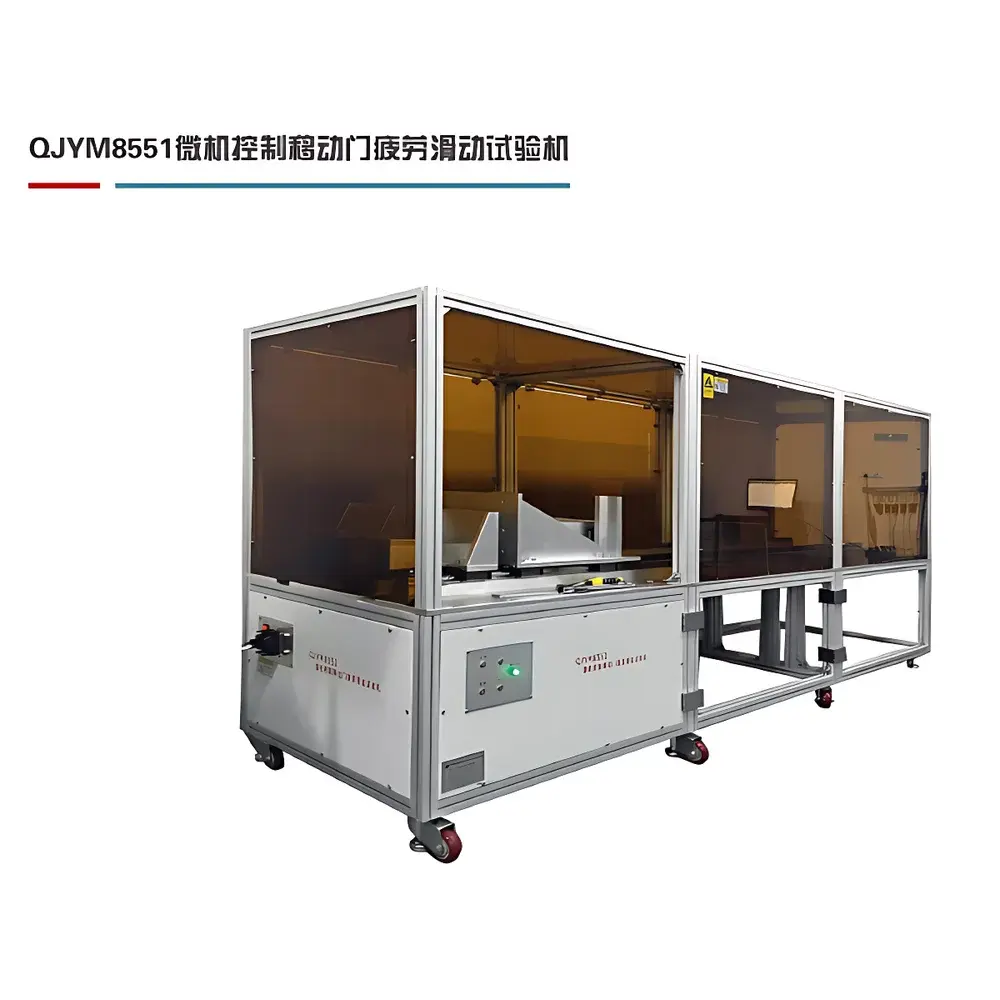
QJYM8551 QJIT Computer-Controlled Sliding Fatigue Tester for Movable Doors and Windows
| Brand | QJIT |
|---|---|
| Origin | Shanghai, China |
| Manufacturer Type | Authorized Distributor |
| Country of Origin | China |
| Model | QJYM8551 |
| Price | USD 8,400 (FOB Shanghai) |
Overview
The QJYM8551 Computer-Controlled Sliding Fatigue Tester is an engineering-grade mechanical endurance testing system designed to evaluate the long-term operational reliability of sliding components in architectural fenestration systems — specifically movable doors, windows, and associated roller-based hardware. It replicates real-world usage conditions by subjecting test specimens to controlled, repetitive linear motion under defined gravitational loading, force profiles, displacement limits, and acoustic monitoring. The system operates on a servo-motor-driven linear actuation principle, with closed-loop feedback from high-accuracy load cells and calibrated microphone arrays. Its core function is to quantify performance degradation over time — including changes in actuation force, positional repeatability, noise emission (dB(A)), and mechanical failure onset — enabling compliance verification against international durability standards such as EN 14351-1, ISO 12519, and ASTM E283 for operable building elements.
Key Features
- Programmable stroke length: User-defined linear displacement range (0–500 mm typical), adjustable via intuitive GUI with sub-millimeter resolution
- Adjustable actuation force control: Digital setpoint input for push/pull force (range: 0–200 N, ±0.5% FS accuracy), with real-time PID-regulated output
- Cycle count precision: Programmable fatigue cycles up to 100,000+ with automatic termination upon reaching target or failure condition
- Acoustic threshold monitoring: Integrated Class 2 sound level meter (IEC 61672-1 compliant) continuously measures broadband noise; system triggers emergency stop if dB(A) exceeds user-specified limit (minimum 5 dB above baseline ambient + mechanical self-noise)
- Zero-point calibration & sensor validation: Onboard calibration routines for load cell and position encoder, traceable to national metrology standards
- Real-time data overlay: Simultaneous display of force vs. time, displacement vs. time, and RMS sound pressure level during test execution
- Automated pass/fail logic: Configurable decision tree based on force deviation (>±10% from nominal), cycle interruption, or acoustic anomaly detection
Sample Compatibility & Compliance
The QJYM8551 accommodates standard-sized residential and commercial sliding door/window assemblies (max. specimen width: 1,200 mm; height: 2,400 mm; weight capacity: ≤150 kg). Mounting fixtures are modular and adaptable to common rail systems (e.g., aluminum U-rails, stainless steel tracks). The tester supports both single- and double-panel configurations with optional counterweight kits for vertical-load simulation. All test protocols align with ISO/IEC 17025-accredited laboratory practices. Data acquisition meets GLP audit requirements, with full traceability of operator ID, environmental conditions (temperature/humidity logged), calibration certificates, and raw channel data timestamps. Optional 21 CFR Part 11-compliant software module available for regulated environments requiring electronic signatures and audit trails.
Software & Data Management
Control and analysis are performed using QJIT TestSuite v3.2 — a Windows-based application built on .NET Framework with SQLite backend. It provides test method templates preconfigured for EN 14351-1 Annex D (sliding resistance and durability), GB/T 8478–2020 (Chinese fenestration standard), and internal OEM specifications. Each test generates a structured XML metadata file containing configuration parameters, raw sensor streams (1 kHz sampling), statistical summaries (mean/max/min force, cycle-to-failure, noise drift rate), and PDF-formatted reports with embedded charts and pass/fail annotations. Data export supports CSV, Excel, and ASTM E1461-compliant binary formats for third-party statistical process control (SPC) integration.
Applications
- Durability qualification of roller carriages, bottom guides, and top-hung sliders prior to mass production
- Comparative benchmarking of lubricant formulations and polymer wheel materials under accelerated aging conditions
- Root cause analysis of premature jamming, binding, or abnormal noise generation in field-failed units
- Validation of maintenance intervals and wear-life predictions for building maintenance management (BMM) programs
- Supporting CE marking documentation for CE-marked window systems sold in the EEA
- Quality assurance testing in Tier-1 component suppliers’ incoming inspection labs
FAQ
Is the QJYM8551 suitable for testing non-standard or oversized door assemblies?
Yes — custom mounting frames and extended travel rails can be supplied upon request; maximum payload and envelope dimensions must be confirmed during pre-order engineering review.
Does the system support remote monitoring or networked operation?
Standard configuration includes Ethernet connectivity for LAN-based supervision; optional OPC UA server module enables integration into factory MES or SCADA platforms.
What calibration documentation is provided at shipment?
Each unit ships with a UKAS-traceable certificate of calibration for force transducer and position encoder, valid for 12 months from date of manufacture.
Can test methods be password-protected or locked to prevent unauthorized modification?
Yes — role-based access control (Operator, Technician, Administrator) is enforced within TestSuite; method editing requires elevated credentials and logs all changes to the audit trail.
Are spare parts and technical support available outside China?
QJIT maintains authorized service partners in Germany, USA, and Singapore; critical spares (load cells, servo drives, microphones) are stocked regionally with <72-hour dispatch SLA.