
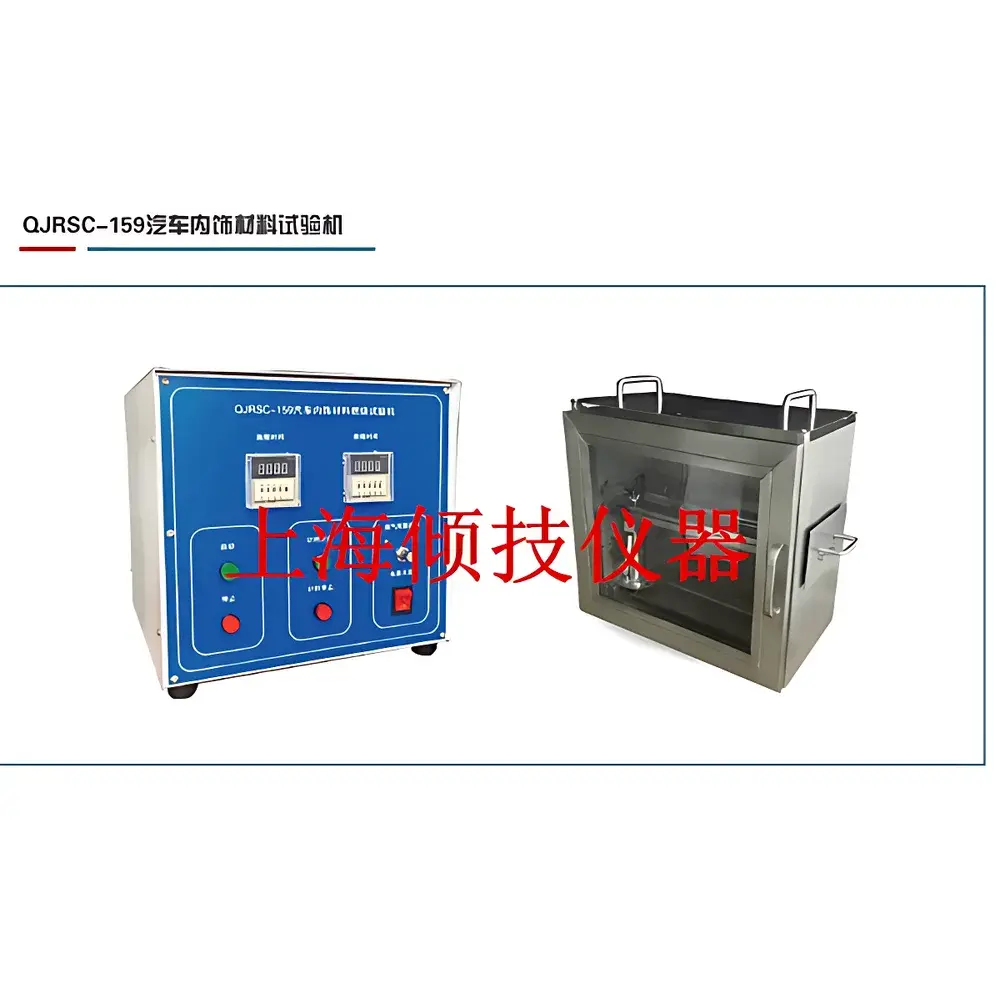
Qinji QJRSC-159 Automotive Interior Horizontal Burning Tester
| Brand | Qinji |
|---|---|
| Origin | Shanghai, China |
| Manufacturer Type | Authorized Distributor |
| Country of Manufacture | China |
| Model | QJRSC-159 |
| Price | USD 2,800 (FOB Shanghai) |
| Standards Compliance | GB 8410–2006, ISO 3795, ASTM D5132, FMVSS 302 |
| Ignition Time Range | 0–99 min 99 sec (adjustable) |
| Burn Time Range | 0–99 min 99 sec (adjustable) |
| Flame Angle | 90° (vertical flame impingement on horizontal specimen) |
| Nozzle Center Position | 19 mm below free end centerline of specimen |
| Comb Specifications | ≥110 mm length |
| Burner Dimensions | 9.5 mm inner diameter nozzle |
| Flame Height Adjustment | 20–100 mm |
| Temperature Sensor | 150 °C max, 1 °C resolution |
| Metal Enclosure | 385 mm (L) × 204 mm (D) × 360 mm (H) |
| Fuel Supply | High-purity LPG (liquefied petroleum gas) |
| Power Input | AC 220 V, 50 Hz |
Overview
The Qinji QJRSC-159 Automotive Interior Horizontal Burning Tester is a precision-engineered benchtop apparatus designed to evaluate the flammability behavior of interior trim materials used in motor vehicles—including passenger cars, multi-purpose vehicles, light-duty trucks, and commercial buses—under standardized horizontal orientation conditions. It operates on the principle of controlled flame impingement, where a calibrated Bunsen-type burner delivers a defined thermal flux to the free end of a horizontally mounted specimen. The device measures critical fire performance parameters including afterflame time, afterglow time, and char length, all in strict accordance with internationally recognized regulatory test methods. Its mechanical and control architecture adheres to the physical geometry, dimensional tolerances, and procedural sequencing specified in GB 8410–2006 (China), ISO 3795:2018 (International Organization for Standardization), ASTM D5132–21 (American Society for Testing and Materials), and FMVSS 302 (U.S. Federal Motor Vehicle Safety Standard). This ensures data comparability across global OEM supply chains and third-party certification laboratories.
Key Features
- Stainless steel construction for both control cabinet and combustion chamber—resistant to thermal oxidation, acidic combustion byproducts, and long-term exposure to LPG exhaust gases
- Automated ignition sequence with high-voltage piezoelectric spark generator, eliminating manual match-based ignition and reducing operator variability
- Dual independent digital timers: one for flame application duration (ignition time), another for post-ignition observation (afterflame/afterglow)
- Precision-machined brass burner assembly featuring a 9.5 mm ID stainless steel nozzle, 100 mm effective length, and integrated air regulation orifice for stable laminar flame profile
- Calibrated flame height adjustment mechanism (20–100 mm range) verified against thermocouple-based flame temperature mapping per ISO 3795 Annex A
- Integrated specimen support system with upper/lower stainless steel brackets conforming to GB 8410 specimen mounting geometry (100 mm × 356 mm × thickness ≤13 mm)
- Standardized metal comb (≥110 mm length, 7–8 smooth round teeth per 25 mm) for uniform surface preparation prior to testing
- Enclosed viewing chamber with heat-resistant borosilicate observation window and internal LED illumination for real-time flame propagation monitoring
Sample Compatibility & Compliance
The QJRSC-159 accommodates flat, rigid, or semi-rigid polymeric sheets, foams, composites, and laminates commonly employed in automotive dashboards, door panels, headliners, seat covers, and pillar trims. Specimens are conditioned per ISO 291 (23 °C ± 2 °C, 50% ± 5% RH) prior to testing. All mechanical dimensions—including nozzle-to-specimen offset (19 mm), flame angle (90°), and enclosure internal volume—meet dimensional verification requirements outlined in Clause 5 of ISO 3795 and Section 4 of FMVSS 302. The instrument supports full traceability for GLP-compliant testing environments and may be integrated into laboratory quality management systems aligned with ISO/IEC 17025:2017 accreditation criteria.
Software & Data Management
While the base QJRSC-159 operates via embedded microcontroller logic without PC dependency, optional RS-232 or USB-C interface modules enable connection to external logging software (e.g., LabVIEW or custom Python-based acquisition tools). Timestamped event logs—including ignition initiation, flame cutoff, and operator-triggered stop commands—are stored internally with non-volatile memory retention. Audit trail functionality complies with FDA 21 CFR Part 11 principles when paired with validated third-party software platforms. Calibration records, maintenance history, and user access logs can be exported in CSV format for internal QA review or regulatory submission.
Applications
- OEM Tier-1 and Tier-2 suppliers conducting pre-release flammability screening of new interior material formulations
- Third-party testing laboratories accredited to ISO/IEC 17025 performing certification testing for China CCC, ECE R118, or U.S. DOT compliance
- R&D departments evaluating flame-retardant additive efficacy in thermoplastic olefins (TPO), polypropylene (PP), polyurethane (PU) foams, and PVC compounds
- Quality assurance teams performing incoming inspection of bulk trim materials against contractual fire performance clauses
- Academic research groups studying pyrolysis kinetics and flame spread dynamics in polymer composites under standardized boundary conditions
FAQ
What standards does the QJRSC-159 fully support out-of-the-box?
It is mechanically and functionally configured to execute GB 8410–2006, ISO 3795:2018, ASTM D5132–21, and FMVSS 302 without hardware modification.
Is LPG the only approved fuel source?
Yes—high-purity liquefied petroleum gas (propane/butane mixture, ≥99.5% purity) is required to maintain stoichiometric flame characteristics and repeatability per all referenced standards.
Can the instrument be upgraded for vertical burning tests (e.g., UL 94)?
No—the QJRSC-159 is purpose-built for horizontal orientation per automotive-specific protocols; vertical flame testing requires a separate UL 94-compliant apparatus.
What calibration documentation is provided with shipment?
Each unit ships with a factory calibration certificate verifying burner alignment, timer accuracy (±0.1 sec), flame height repeatability, and temperature sensor linearity across 0–150 °C.
Is CE or UKCA marking available?
The QJRSC-159 is supplied as a laboratory test instrument without CE/UKCA marking; end-user responsibility includes local conformity assessment per Machinery Directive 2006/42/EC if installed in EU/UK facilities.



