
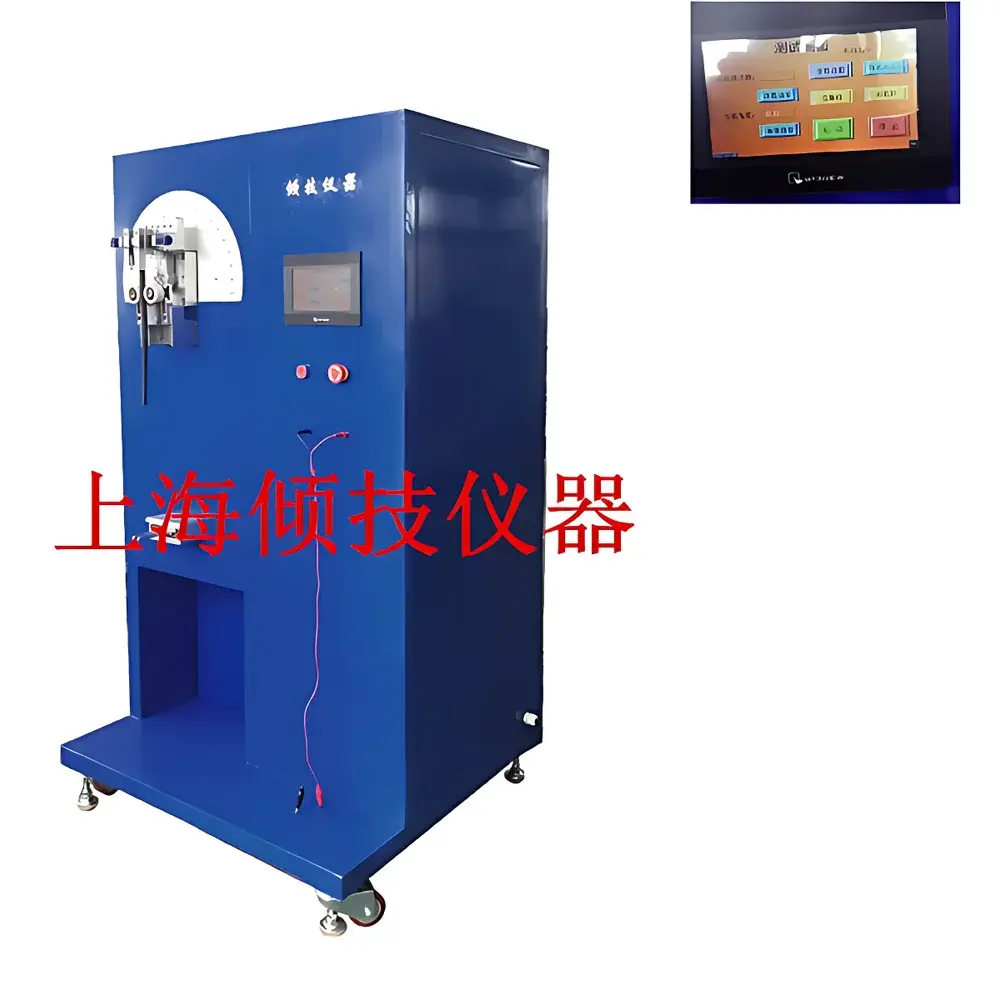
Qinji QJWQ-302F Color-Touchscreen Repeated Bending Tester for Metallic Wires and Sheets
| Brand | Qinji |
|---|---|
| Origin | Shanghai, China |
| Manufacturer Type | Authorized Distributor |
| Country of Manufacture | China |
| Model | QJWQ-302F |
| Price | USD 5,600 (FOB Shanghai) |
| Wire Diameter Range | 0.1–25 mm |
| Bend Cycle Count Range | 0–9999 cycles |
| Bending Frequency | 60 cycles/min (programmable via firmware update) |
| Angular Stroke | ±90° |
| Specimen Length | 150–200 mm |
| Operating Temperature | Ambient (10–35 °C) |
| Max Relative Humidity | ≤85 % RH |
| Dimensions (W×D×H) | 420 × 300 × 1320 mm |
| Power Rating | 1.1 kW |
| Weight | 250 kg |
Overview
The Qinji QJWQ-302F Color-Touchscreen Repeated Bending Tester is a precision mechanical testing instrument engineered to evaluate the fatigue resistance and ductility of metallic wires and thin sheets under controlled cyclic bending deformation. It operates on the principle of uniaxial, reciprocating angular displacement—applying repeated ±90° bends at a fixed pivot point—to simulate real-world flexural stress conditions encountered in cable manufacturing, spring fabrication, and flexible conductor applications. Designed in strict compliance with ISO 7800:2012 (Metallic materials — Wire — Repeated bending test) and aligned with the technical requirements of GB/T 238–2013 (Method of repeated bending test for metallic wires) and GB/T 235–2013 (Method of repeated bending test for metallic thin plates and strips), the system delivers high reproducibility for comparative mechanical endurance assessment. Its rigid cast-iron frame, servo-controlled bending arm actuation, and optical encoder-based cycle counting ensure minimal hysteresis and positional drift across extended test sequences.
Key Features
- Full-color 7-inch capacitive touchscreen interface with intuitive icon-driven navigation and multilingual UI support (English, Chinese, Spanish)
- Programmable bending frequency: factory-set at 60 cycles/min; adjustable via firmware update without hardware modification
- High-resolution optical encoder for real-time, non-contact cycle counting (0–9999 cycles, ±1 cycle accuracy)
- Dual-mode specimen clamping: quick-release vise for round wires (Ø0.1–25 mm) and parallel jaw fixture for sheet specimens (thickness ≤3 mm, width ≤25 mm)
- Integrated safety interlock system: automatic halt upon door opening or abnormal motor current draw
- Robust structural design: 250 kg mass and reinforced base minimize vibration-induced measurement error during high-frequency operation
- Thermal overload protection and short-circuit safeguarding compliant with IEC 61000-6-2 electromagnetic immunity standards
Sample Compatibility & Compliance
The QJWQ-302F accommodates standardized metallic wire specimens per ASTM E1823–22 (Terminology Relating to Fatigue and Fracture Testing) and sheet specimens meeting ISO 6892-1:2019 thickness tolerances. It supports both as-received and heat-treated samples—including copper, aluminum, stainless steel (304/316), phosphor bronze, and beryllium copper alloys. All test procedures are traceable to national metrology institutes via optional calibration certificate (NIST-traceable load cell and angular position sensor). The instrument meets CE marking requirements under Machinery Directive 2006/42/EC and conforms to ISO/IEC 17025:2017 clause 6.4.3 for equipment suitability in accredited testing laboratories. Routine verification follows internal SOPs aligned with GLP principles for industrial QA/QC environments.
Software & Data Management
The embedded control firmware includes built-in data logging with timestamped cycle count, elapsed time, and operational status flags. Test records are exportable in CSV format via USB 2.0 port for integration into LIMS or statistical process control (SPC) platforms. Optional PC-based QinjiTest Suite v3.2 provides advanced features including: automated pass/fail evaluation against user-defined bend-cycle thresholds; batch report generation with PDF export; audit trail with operator ID and electronic signature (21 CFR Part 11-compliant when deployed with Windows domain authentication); and trend analysis across multiple specimen lots. Raw encoder data can be archived for forensic review during root-cause investigations of premature fracture events.
Applications
- Quality assurance of drawn copper wire used in automotive harnesses and aerospace wiring systems
- Evaluation of spring temper consistency in stainless-steel strip stock prior to coiling
- Comparative fatigue screening of alternative alloy compositions during R&D phase
- Verification of surface treatment efficacy (e.g., nickel plating, passivation) on bending endurance
- Teaching laboratory implementation for materials science curricula covering ductile-brittle transition behavior
- Third-party certification testing per UL 61058-1 (switches) and IEC 60335-1 (household appliances) mechanical durability clauses
FAQ
Is the bending angle precisely maintained at ±90° throughout all test durations?
Yes—the angular stroke is mechanically constrained by hardened steel limit stops and verified daily using a calibrated digital protractor (±0.3° uncertainty). Encoder feedback confirms positional repeatability over 10,000 cycles.
Can the instrument be integrated into an automated production line?
It supports Modbus RTU over RS-485 for remote start/stop and status polling; however, full robotic specimen loading requires custom end-effector integration and is not supplied standard.
What calibration documentation is provided at shipment?
A factory calibration report covering angular positioning accuracy, cycle counter linearity, and motor speed stability is included. NIST-traceable certificates are available as a chargeable option.
Does the warranty cover software updates?
Yes—firmware upgrades released within 12 months of purchase are provided free of charge via secure download portal with installation guidance.
Is humidity control required during operation?
No active humidification is needed, but ambient RH must remain ≤85% to prevent condensation on optical sensors and electrical contacts per IEC 60068-2-30.



