
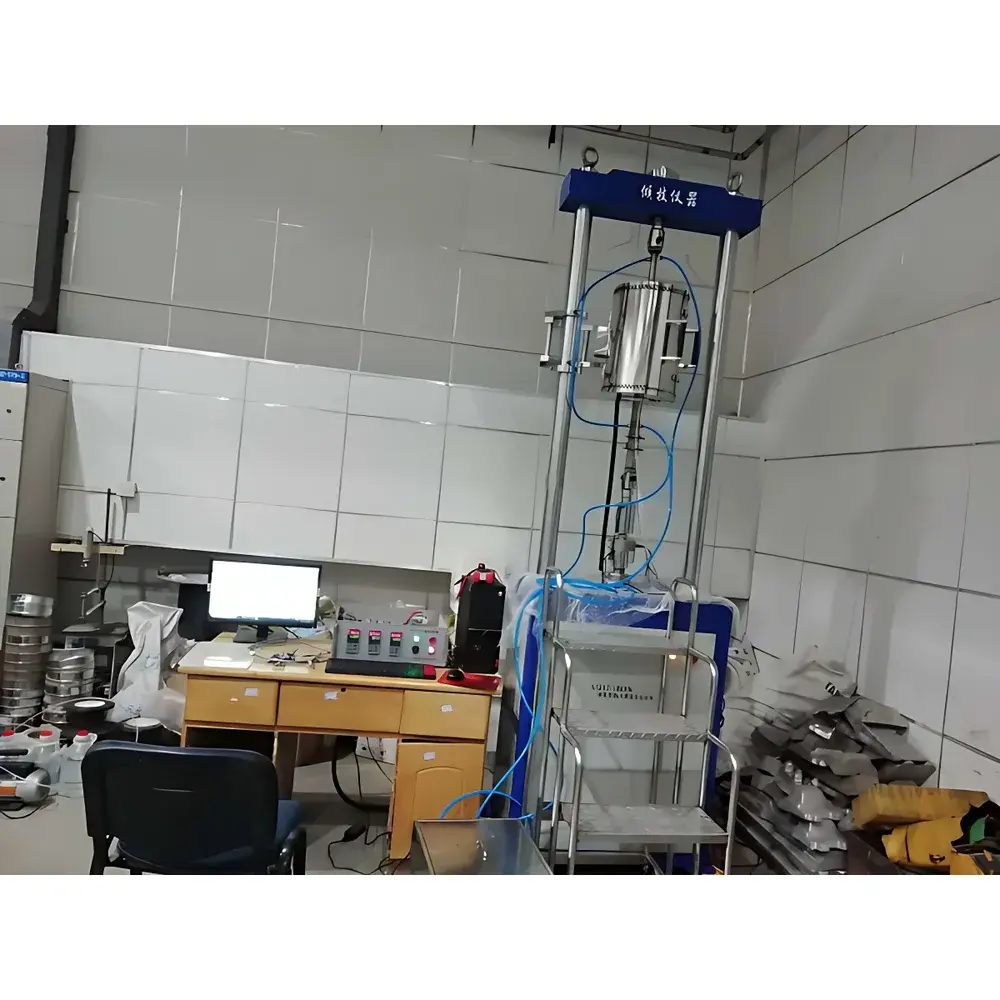
QJ212-100KN High-Temperature Universal Testing Machine with Microcomputer Control
| Origin | Shanghai, China |
|---|---|
| Manufacturer Type | Authorized Distributor |
| Origin Category | Domestic (PRC) |
| Model | QJ212-100KN |
| Instrument Type | Electro-Hydraulic Servo Testing Machine |
| Max Test Load | 100 kN |
| Force Measurement Accuracy | ±0.5% of reading (from 1% FS) |
| Force Control Stability | ±1% of reading |
| Crosshead Speed Range | 0.01–180 mm/min |
| Stroke | 200 mm |
| Extensometer | Imported linear encoder |
| Deformation Range | up to 25 mm (multiple ranges available) |
| Deformation Accuracy | ±0.5% |
| High-Temperature Furnace | Φ50 mm chamber × 450 mm length |
| Temperature Range | RT to 1200 °C |
| Temperature Control Accuracy | ±0.5 °C |
| Temp. Resolution | 0.1 °C |
| Uniform Temperature Zone Length | >150 mm |
| Creep Load Control | Imported servo system |
| Load Adjustment | 0–100 kN continuous, stepless |
| Load Resolution | 0.1 N |
| Furnace Power | 3 kW |
| Weight | 850 kg |
Overview
The QJ212-100KN High-Temperature Universal Testing Machine with Microcomputer Control is an integrated electro-hydraulic servo testing system engineered for precise mechanical characterization of metallic and alloy materials under sustained thermal and mechanical loading conditions. Designed in alignment with JJG276 (Verification Regulation for High-Temperature Creep and Stress-Rupture Testing Machines), GB/T 2039 (Metallic Materials — Tensile Creep and Stress-Rupture Testing Methods), HB 5150/5151 (Aerospace Industry Standards for High-Temperature Tensile Creep and Stress-Rupture Tests), this instrument implements a dual-closed-loop control architecture—simultaneously regulating axial force and displacement—while integrating a high-stability resistive furnace capable of maintaining uniform temperature fields up to 1200 °C. Its core measurement principle relies on servo-controlled load application combined with high-resolution encoder-based extensometry, enabling traceable, reproducible determination of time-dependent deformation behaviors including primary, secondary, and tertiary creep stages, as well as stress-rupture life at elevated temperatures. The system is purpose-built for laboratories requiring compliance-ready data acquisition in metallurgical R&D, aerospace component qualification, power-generation material certification, and national standards verification.
Key Features
- Electro-hydraulic servo actuation delivering stable, low-noise force control across the full 0–100 kN range, with resolution of 0.1 N and accuracy better than ±0.5% of reading (≥1% full scale)
- High-precision linear encoder-based extensometry with selectable deformation ranges up to 25 mm and ±0.5% measurement error
- Integrated high-uniformity tubular furnace (Φ50 mm × 450 mm) featuring a >150 mm isothermal zone, programmable from ambient to 1200 °C with ±0.5 °C thermal stability and 0.1 °C digital resolution
- Microcomputer-based control system supporting multi-stage ramp-hold profiles, real-time load-displacement-temperature synchronization, and automatic creep parameter extraction (e.g., minimum creep rate, time to rupture)
- Rigid structural frame (850 kg mass) minimizing dynamic deflection and ensuring long-term metrological integrity during extended-duration tests (up to 10,000+ hours)
- Modular hardware architecture permitting future expansion to high-frequency fatigue testing (via optional hydraulic pulsator integration) and static tensile/compression/bending configurations
Sample Compatibility & Compliance
The QJ212-100KN accommodates standard cylindrical or dog-bone-shaped specimens per ASTM E139, ISO 204, and GB/T 2039 geometries, with gauge lengths compatible with the furnace’s 150 mm uniform zone. Specimen holders are water-cooled to prevent thermal degradation at grips. All test sequences—including creep, stress-rupture, relaxation, and quasi-static tensile—are executed under audit-trail-enabled software, generating timestamped, user-identifiable records compliant with GLP and GMP documentation requirements. Data output formats (CSV, XML) support direct import into statistical analysis platforms used in failure prediction modeling (e.g., Larson-Miller parameter derivation). The system meets mechanical and electrical safety requirements per IEC 61000-6-2/6-4 and is CE-marked for industrial laboratory deployment.
Software & Data Management
The embedded Windows-based control software provides intuitive graphical configuration of test protocols, real-time multi-parameter plotting (load vs. time, strain vs. time, temperature vs. time), and automated pass/fail evaluation against predefined acceptance criteria. All raw sensor data—including load cell output, encoder pulses, and thermocouple voltages—are acquired at ≥100 Hz and stored with metadata (operator ID, calibration certificate IDs, environmental logs). Audit trails record every user action, parameter change, and calibration event—fully satisfying FDA 21 CFR Part 11 requirements for electronic records and signatures. Export modules generate PDF test reports with embedded digital signatures, traceable to NIST-traceable force and temperature calibrations performed prior to delivery.
Applications
- Determination of creep strain rate, time-to-rupture, and rupture ductility for nickel-based superalloys used in turbine disks and blades
- Stress-rupture life assessment of austenitic stainless steels in nuclear reactor pressure vessel applications per ASME BPVC Section III
- Long-term relaxation behavior quantification of high-temperature bolted joints in petrochemical piping systems
- Validation of constitutive models (e.g., Norton-Bailey, Garofalo equations) using multi-stress-level creep data sets
- Interlaboratory round-robin testing for national metrology institutes verifying high-temperature mechanical standards
- Graduate-level materials science education in time-dependent deformation mechanisms and thermal-mechanical coupling effects
FAQ
What standards does the QJ212-100KN comply with for high-temperature creep testing?
It conforms to JJG276, GB/T 2039, HB 5150, and HB 5151, and supports protocol configuration aligned with ASTM E139 and ISO 204.
Can the system perform both creep and stress-rupture tests simultaneously on multiple specimens?
No—it operates as a single-test-axis platform; however, sequential multi-specimen testing is supported via automated specimen exchange routines and batch protocol scheduling.
Is furnace calibration included with the system, and how often is recalibration recommended?
A factory-issued temperature uniformity report and NIST-traceable thermocouple calibration certificate are provided. Annual recalibration is recommended, with furnace uniformity verification required before each critical qualification campaign.
Does the software support custom scripting for advanced data reduction (e.g., Monkman-Grant analysis)?
Yes—the API supports Python and MATLAB interfaces for post-processing automation, including derivative-based minimum creep rate calculation and log-log rupture time vs. stress regression.
What maintenance intervals are specified for the electro-hydraulic subsystem?
Hydraulic oil analysis and filter replacement are scheduled every 2,000 operating hours or biannually; servo valve inspection is recommended every 5,000 hours per OEM service manual.
Related Products



